
Turf Pests and Weeds in Australian Turf
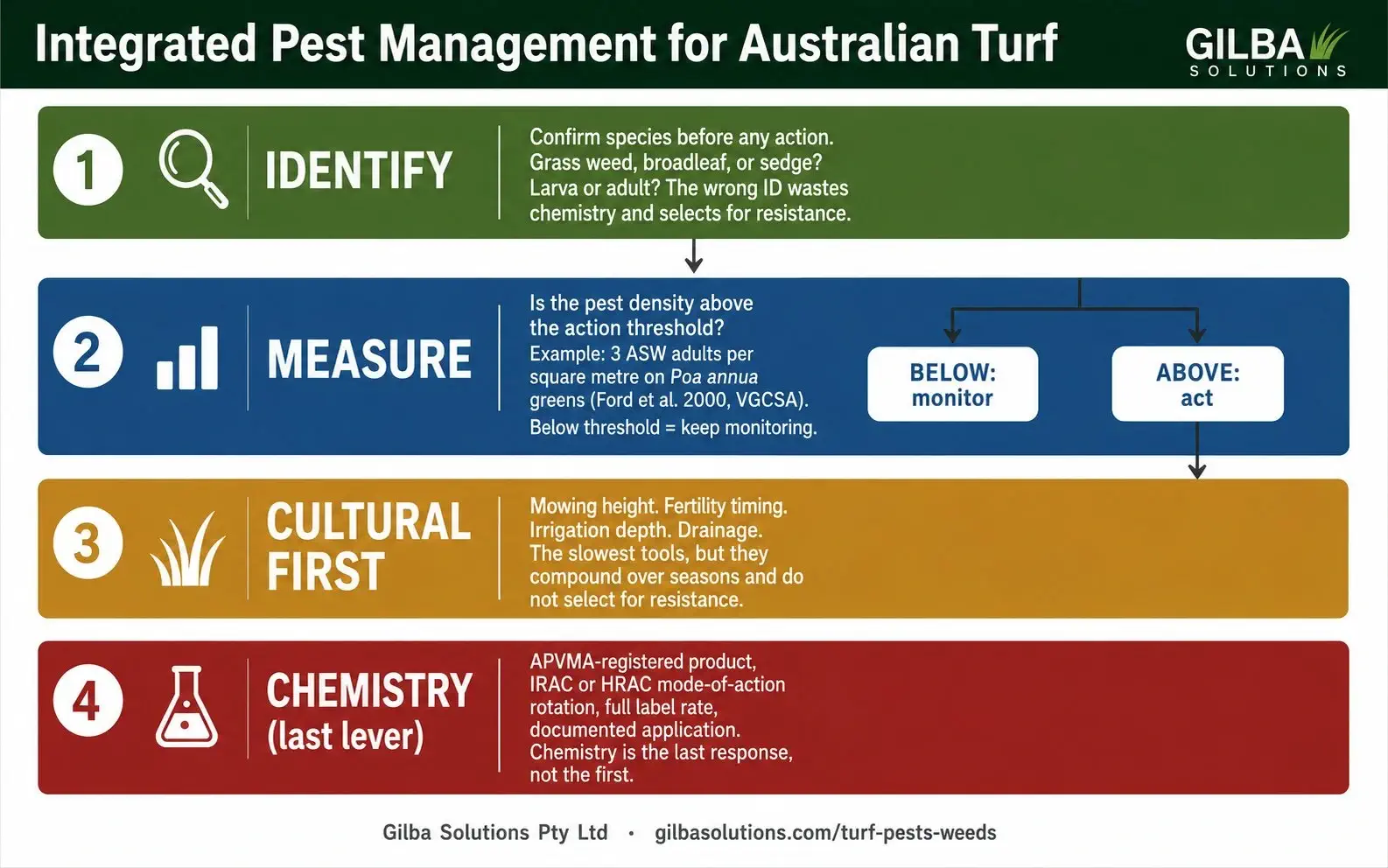
This is the Gilba Solutions reference hub for turf pest and weed management in Australia. It frames the topic as an integrated system: identify, monitor against an action threshold, use cultural levers, then rotate chemistry. The recommendations below cite APVMA-registered chemistry, IRAC and HRAC mode-of-action groups, and Australian field thresholds where the data exists.
The audience is for this is Golf course superintendents, sports venue managers, council turf coordinators, and consulting agronomists who need decisions backed by Australian-registered chemistry and local field thresholds. US work does not always translate directly. Where US data is the best available, it is cited with a note of that limitation. The 2024 IGFH Turf Pesticides Manual sits alongside this hub as the registration-accurate reference for turf chemistry in Australia.
Three things distinguish this content.
- Every product is traceable to APVMA PubCRIS, the canonical Australian registration database.
- Resistance management is built into every section rather than being treated as a separate topic. Barua et al. 2020 confirmed multi-herbicide resistance in Poa annua across southeastern Australia (propyzamide, simazine, rimsulfuron, foramsulfuron, and endothal). Resistance is here, in turf, now.
- Action thresholds and Growing Degree Day timing inform every chemical decision rather than calendar habits.
Jerry Spencer, Senior Agronomist, Gilba Solutions Pty Ltd. Hons Soil Science (Newcastle University, UK, 1988). Former STRI agronomist. 35+ years across Australia, NZ, UK and Europe. Author, CSIRO/Landlinks Press Sports Turf Nutrition. LGP panel member since 2020.
Published: 19 May 2026
What This Topic Covers
Integrated pest management framework
An IPM program is a decision hierarchy, not a chemical schedule. The first move when a pest or weed appears is to confirm its identity and assess its severity against a threshold. Only if the threshold is crossed do cultural and chemical controls follow, with chemistry being the last option. Without monitoring data the framework collapses into routine spraying.
- Action thresholds: what pest density or weed cover needs a response
- Scouting and monitoring: frequency, methods, record-keeping
- Cultural-first hierarchy: mowing, fertility, drainage, irrigation as primary levers
- Resistance management as a continuous overlay across every chemical decision
Weed identification and resources
Identification before chemistry is the single highest-return discipline in weed control. The wrong herbicide on a misidentified weed wastes product and selects for resistance. Climate zone matters: Queensland weed populations differ markedly from those in Victoria, and active species shift across the calendar within each zone.
- Browse the full Australian Weed Identification Chart: 60+ profiled species, NSW QLD and VIC
- Grass weeds vs broadleaf weeds vs sedges: the three categories that determine a chemistry class
- Seasonal emergence patterns and the spray-susceptiblity for each species
- Indicator weeds.
- Common identification mistakes, including the nutgrass vs sedge distinction in managing nutgrass
Herbicide strategy: pre-emergent and post-emergent
Pre-emergent herbicides intercept weed seedlings before or at germination. They fail when timing misses the germination window, the soil residual breaks down before weed pressure ends, or the program uses the same MOA year after year. Post-emergent chemistry is more aggressive, the window is shorter, and resistance consequences are much faster to develop.
- Pre-emergent timing chart: 50+ AU turf weeds month by month
- Autumn broadleaf weed control: the strongest seasonal post-emergent window
- Sulfonylureas and Group 4 phenoxies: high resistance risk, rotation essential
- 2025 AU turf herbicide resistance chart: every product mapped to its HRAC group
- Factors that can affect turf herbicide performance.
- Reasons for pre-emergent failure
- How to use pre emergent herbicides
- The role of temperature in pre-emergent timing
Insect pest identification and chemistry
Damaging insect pests of Australian turf fall into three groups: weevils (Argentine Stem Weevil and Billbug), scarab larvae (African Black Beetle, Argentinian Scarab, Pruinose Scarab), and caterpillars (Armyworm and Cutworm). Modern chemistry centres on four IRAC groups: neonicotinoids (4A), diamides (28), pyrethroids (3A), and spinosyns (5).
- Argentine Stem Weevil: lifecycle, GDD timing, VGCSA action thresholds
- Argentine Stem Weevil Predictor
- Scarab larvae ID chart: the three main AU species
- How to manage scarab beetles in turf
- Scarlet Trio: the only insecticide currently registered for Ground Pearl in AU
- DIY pest control
- Browse the full chemistry range at turf chemicals
- Identifying and managing Ground Pearl
- ID and control of lawn armyworm
Resistance management
Resistance is the most consequential issue in modern turf pest and weed management. Once it appears, the chemistry rarely recovers. Lolium rigidum in Australian broadacre cropping is the world’s worst herbicide-resistant weed (12 countries, 11 sites of action). Turf is not immune. The rotation discipline broadacre learned the hard way now applies in turf.
- HRAC and IRAC group rotation: never use the same group twice in a season without a break
- Tank-mixing different MOA groups in one application to delay selection
- International resistance survey at weedscience.org
- IRAC classification at irac-online.org
- Spring dead spot lifecycle and management
Cultural and biological controls
Cultural management is the most underused tool in Australian turf pest control. Mowing height, fertility timing, irrigation depth, and drainage alter pest and weed pressure before chemistry enters the conversation. Biological controls multiply chemistry effectiveness rather than replace it.
- Mowing height and weed competition: dense, healthy turf is the cheapest weed control
- Drainage and pest pressure: Soil and Rootzone Science covers the underlying framework
- Entomopathogenic nematodes (Steinernema, Heterorhabditis) for weevil larvae
- Entry-level options: DIY pest control and the 2024 IGFH Turf Pesticides Manual
What is Integrated Pest Management (IPM) for Australian turf?

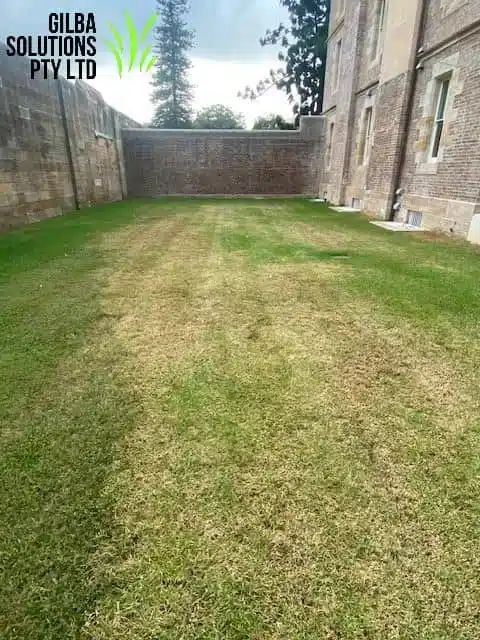
Side-by-side proof-of-result on a treated versus untreated couch fairway
Integrated Pest Management (IPM) for Australian turf combines monitoring, action thresholds, cultural practices, biological controls, and APVMA-registered chemistry. You use this framework in that order, to manage weeds, insect pests, and turf diseases while delaying the onset of resistance. An effective Australian turf IPM program has four components.
- Regular scouting and species-level identification. You need to know whether a weed is a grass, broadleaf, or sedge, and whether an insect is a larva or adult. This determines every downstream decision.
- Action thresholds drawn from local data, such as 3 adults per m2 for Argentine Stem Weevil on Poa annua greens, or 7 adults per m2 on bent (Ford et al. 2000, VGCSA).
- Cultural-first responses. The height of cut, fertility, irrigation depth, and drainage suppress pests more reliably than any single product.
- The chemistry selected and rotated by IRAC or HRAC mode-of-action groups, with reference to the international resistance survey at weedscience.org.
The framework is hierarchical for a reason. Cultural levers are slower to act but compound over seasons. Chemistry is fast but selects for resistance every time it is used. The agronomist’s job is to slow the spray decision down enough for the right one to be made.
In practical terms, IPM means written scouting records, posting threshold values somewhere visible, a documented program of MOA rotation, and the discipline to not spray when the threshold has not been crossed. APVMA PubCRIS confirms what is actually registered in Australia. IRAC and HRAC group rotation is non-negotiable on any site with a resistance history.
How do I identify turf weeds in Australia?
Identification is the single highest-return discipline in weed control. The wrong herbicide on a misidentified weed wastes product, fails to control the target, and selects for resistance. What Australian climate zone you are in determines which weeds are active and when. For example, Queensland weed populations differ a lot from Victorian ones: Singapore daisy, Praxelis, and Blue heliotrope dominate parts of QLD but are rare in VIC. Within each zone, active species shift across the calendar.
The first identification step is category: grass weed, broadleaf weed, or sedge. That single decision determines which herbicide that you can use. Misidentifying a sedge as a grass weed and reaching for a Group 1 grass-killer is a common, costly mistake. The Gilba Solutions weed ID chart profiles over 60 species across NSW, QLD, and VIC with that categorisation built in.
Species-level identification matters because herbicide spectrum varies within each category. Sulfonylureas like Recondo control some grass weeds but not others. Group 4 phenoxies control most broadleaf weeds, whereas Nutsedge needs sedge-specific chemistry.
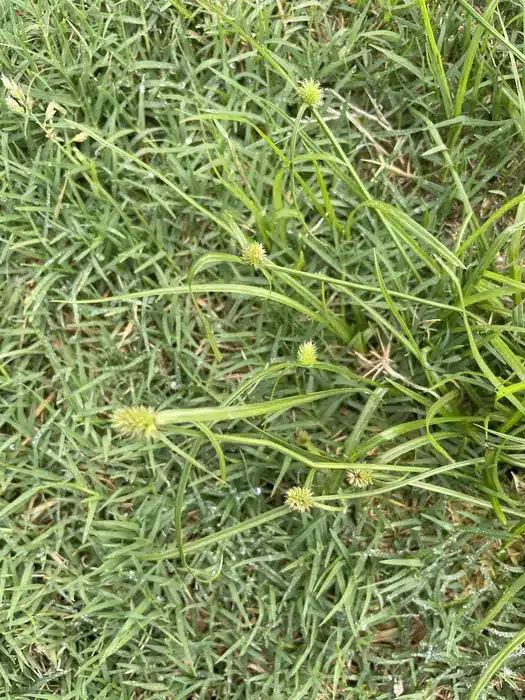
Mullumbimby couch (Kyllinga brevifolia, syn. Cyperus brevifolius) showing the diagnostic globular flower heads that distinguish a sedge from a grass weed.
Photo-based identification works for distinctive species. Taxonomic features (leaf venation, ligule shape, inflorescence structure) become necessary for the lookalikes. When uncertain, sample the weed and confirm before spraying. The cost of identification is minutes. The cost of misidentification is a wasted spray plus resistance pressure on the surviving population.
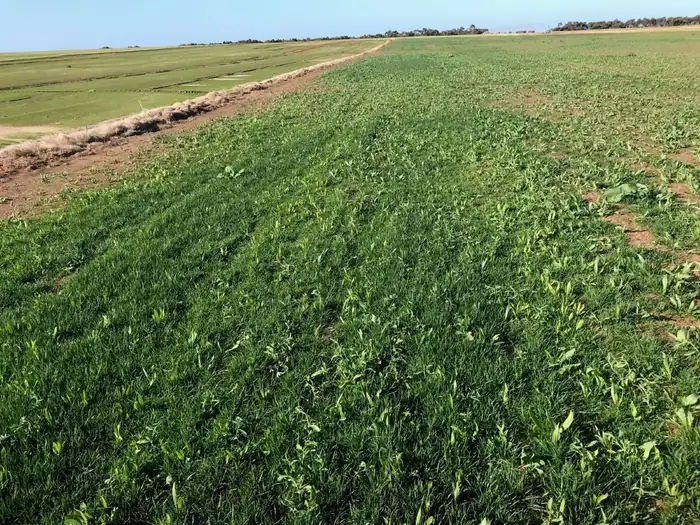
Broadleaf weed contamination in a grass-seed paddock. The supply-chain origin of weed problems that turf managers later encounter on-site, and the reason certified seed grade matters.
When should pre-emergent herbicides be applied in Australian turf?
In Australia pre-emergent herbicide timing in turf is driven by soil temperature triggers and the target weed’s biology. Not by the calendar. Pre-emergents work by intercepting weed seedlings before or at germination, so you must use these before the germination window. They fail in three ways: timing misses the germination window, the soil residual breaks down before weed pressure ends, or the program uses the same mode-of-action group year after year and selects for resistance.
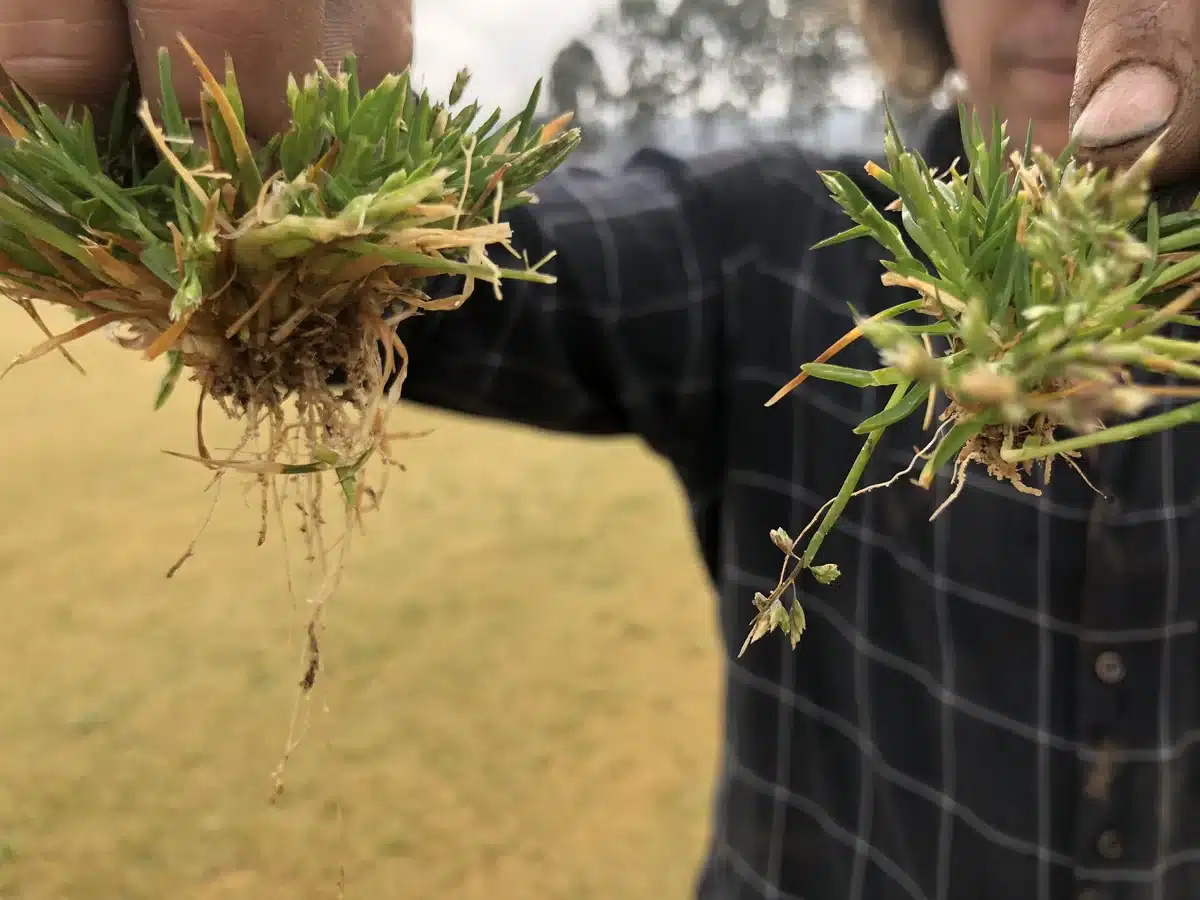
Comparison of indaziflam-treated and untreated poa annua cores showing the root pruning damage caused by the pre-emergent herbicide
For winter grass (Poa annua) in southern Australia, once the soil temperatures drop below 15°C in the autumn, this is the standard trigger. For summer grass and crowsfoot, soil temperatures rising through 12 to 14°C in the spring is the trigger. Queensland has an earlier shift in both directions due to its warmer baseline soil temperatures. The Gilba Solutions pre-emergent timing chart maps these windows for 50+ AU turf weeds month by month, with the AU corrections applied to the underlying US extension data.
Group choice matters as much as timing. Group 3 dinitroanilines (prodiamine, pendimethalin) bind to organic matter and require activation by water within a few days. Group 14 PPO inhibitors (oxadiazon) work on the soil surface and tolerate dry conditions better. Group 15 long-chain fatty acid inhibitors (S-metolachlor) sit in the upper soil profile and target germinating shoots.
Split applications cover germination curves longer than a single product’s residual. A spring application followed by a mid-summer top-up is often more effective than one heavy application. Rotate the MOA group between split applications and between seasons to delay resistance. Reasons for pre-emergent failure include irrigation timing, organic matter binding, and applying after the germination event.
What is the best post-emergent herbicide for Australian turf weeds?
There is no single best post-emergent herbicide for Australian turf weeds. The right product to use depends on the target weed (grass, broadleaf, or sedge), the turf species, the time of year, and the resistance status of the local population. Australian turf relies on three chemistry families. Sulfonylureas (HRAC Group 2, ALS inhibitors) including Recondo, Duke, Monument and Sempra are the workhorse selective herbicides for sedge and some grass weed control. Group 4 phenoxies including 2,4-D, MCPA, and dicamba dominate broadleaf weed control.
A smaller set of Group 27 bleachers includes Pylex (topramezone) and Quinstar (quinclorac). These handle weeds that escape the other two groups. Sulfonylureas carry the highest resistance risk in this group, and multi-herbicide resistance is now documented in Poa annua across southeastern Australia (Barua et al. 2020). MOA rotation between Groups 2, 4, and 27 is essential rather than optional.
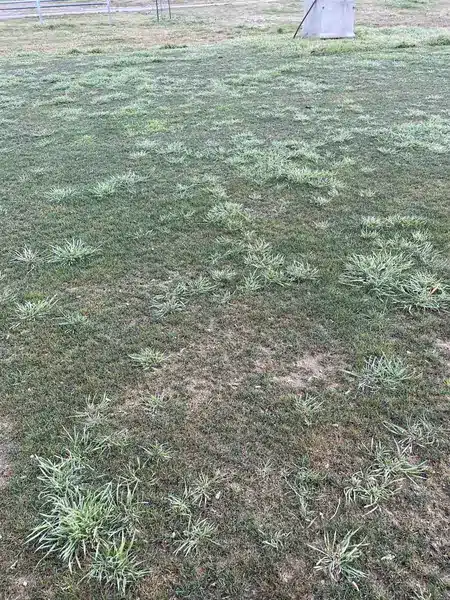
Paspalum infestation showing the characteristic clump growth habit that resists low mowing and crowds desirable turf.
Sedge control is a separate problem. Nutgrass herbicides target the tubers, not the foliage, because tuber regeneration is what causes the recurrence. Hand-weeding actually worsens purple nutgrass infestations by breaking the dormancy in the tuber chain. The tuber depth distribution (Siriwardana and Nishimoto 1987) explains why repeat low-rate applications outperform single high-rate sprays.
Spray adjuvants and methylated seed oils (MSOs) improve cuticle penetration and are essential for some chemistries. Group 27 bleachers like Pylex work much better with an MSO. Reading the label and using the recommended adjuvant is the difference between a working program and a wasted spray.
How do I identify Argentine Stem Weevil vs Billbug?
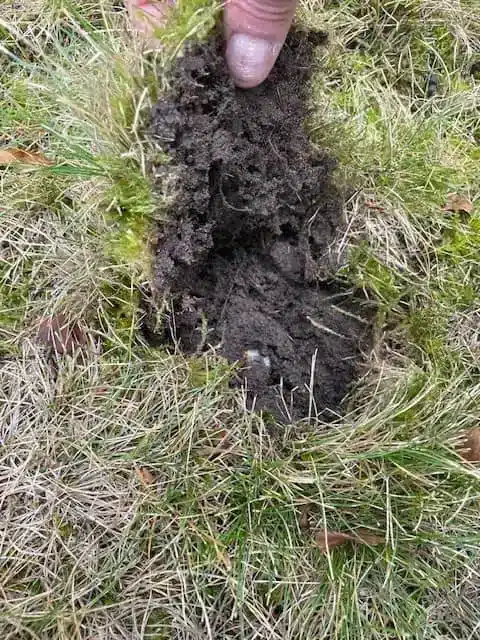
Argentine Stem Weevil (ASW, Listronotus bonariensis) and Billbug (Sphenosphorus brunnipennis) are both members of the weevil family. They were both introduced to Australia from South America in the 1920s, and both cause similar damage symptoms. They differ in larval colour, size, adult morphology, and host grass preference.
- ASW larvae are cream-white with a tan head, up to 5 mm long, and feed inside the stems of cool-season grass including ryegrass, bent, and fescue.
- Adult ASW are small (3 mm) with a short snout.
- Billbug larvae are creamy white with an orange head, up to 9 mm long with a swollen abdomen, and attack warm-season grass including kikuyu and couch.
- Adult Billbug are 9 mm, have a darker colour, and have a long snout that they insert backwards into the stem to lay eggs.
Correct ID matters because chemistry and timing differ between the two pests, even though label coverage often overlaps.
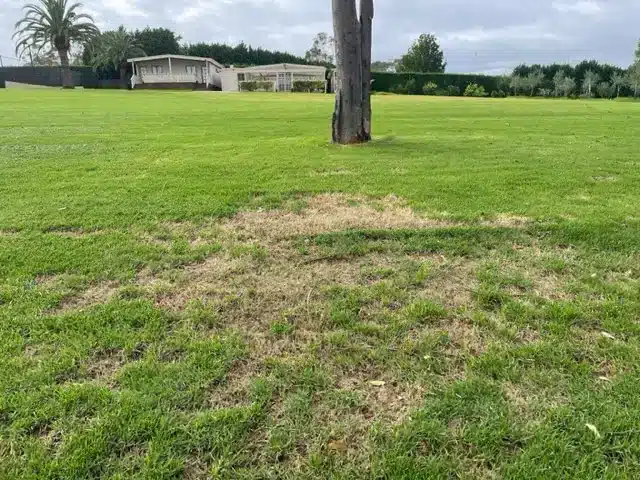
Billbug damage in Kikuyu, showing the irregular brown patches and easily-detached turf characteristic of larval root feeding.
ASW programs use GDD-based timing: 270 to 300 GDD (10°C base) for first-instar larvae inside the plant, and ~450 GDD for adult emergence. Billbug timing is broader and centres on adult emergence in spring. Strikezone and Curatol target ASW larvae specifically. Scarlet Trio and Recruit cover both pests as adults and larvae.

Argentine Stem Weevil (Listronotus bonariensis) life cycle and degree-day-based control windows for Australian turf — adulticide at 150–250 DD, larvicide at 250–350 DD, biological and resistance management from 350+ DD (base 10°C from 1 July).
Damage symptoms overlap. Both produce yellow or straw patches with turf that pulls up easily due to severed roots. Soap-flush counts (1 part dish soap to 50 parts water, irrigated into a 0.25 m² marked area, multiplied by 4 for adults/m²) bring both adult weevils to the surface for counting against action thresholds.
What insecticide chemistry works against Australian turf pests?
Australian turf insecticide chemistry is dominated by four IRAC mode-of-action groups:
- Neonicotinoids (Group 4A) including clothianidin and imidacloprid;
- Diamides (Group 28) including chlorantraniliprole and tetraniliprole;
- Pyrethroids (Group 3A) including bifenthrin; and
- spinosyns (Group 5) which includes spinosad.
Each acts on a different part of the insect nervous system, and each has documented resistance somewhere in the world. Australian programs lean heavily on neonicotinoids and diamides for scarab and weevil control. Spinosyns and indoxacarb (Group 22A) are increasingly used for caterpillar work including Armyworm and Cutworm.
GDD-based timing is essential. This is because if you apply an insecticide to vulnerable life stages, such as ASW first-instar larvae at 270 to 300 GDD (10°C base), it is much more effective than calendar-based applications. A study by Koppenhöfer et al. in 2018 confirmed pyrethroid resistance reduces toxicity of all the other groups, which is why rotation alone is no longer enough on high-pressure sites.
Product selection follows the target pest, the registration status, and the resistance status of the local population. Scarlet Trio is the only insecticide currently registered for Ground Pearl control in Australia, which removes choice for that pest. Nexar provides season-long control of grubs and caterpillars with a single application.
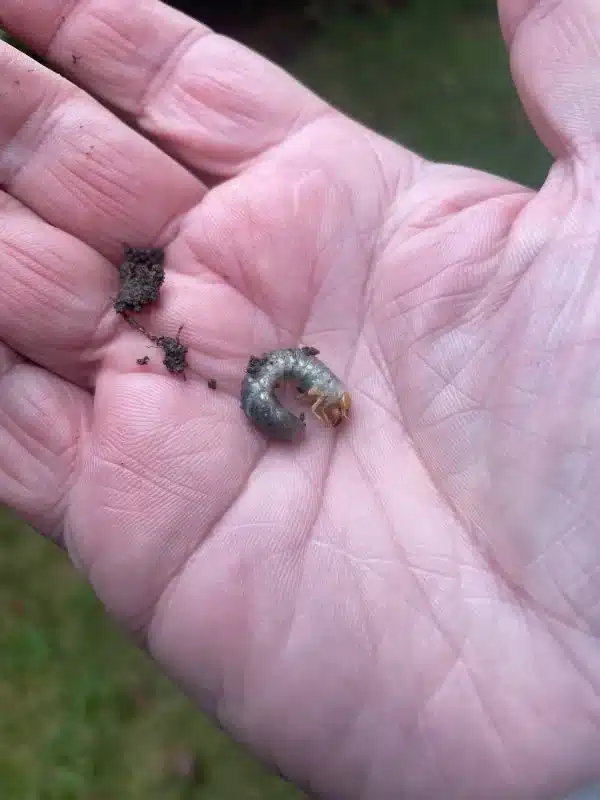 Yellow-headed cockchafer larva showing the curled body, distinctive head capsule and scale used for species identification[/caption]
Lawn armyworm damage on Sydney sportsturf showing the scalped feeding patches that develop rapidly in late summer and autumn
Application volume and irrigation timing change efficacy as much as the active ingredient. Soil-targeted products require >400 L/ha water volume and at least 3 mm irrigation within an hour of application to reach the root zone. Foliar-targeted products need to stay on the leaf surface long enough for ingestion.
How do I manage herbicide resistance in turf?
Manage herbicide resistance in turf by rotating modes of action, never using the same HRAC group twice in a season without a break, tank-mixing different MOA groups, and treating entire areas at label rate. Resistance is documented in Australian turf: Barua et al. 2020 confirmed Poa annua resistance to propyzamide (Group 3), rimsulfuron (Group 2), foramsulfuron (Group 2), and pinoxaden (Group 1) across southeastern Australia. Lolium rigidum in Australian broadacre cropping is the world’s worst herbicide-resistant weed, documented across 12 countries, 11 sites of action, and over 2 million hectares. The mechanisms documented by Preston and Powles 2002 are the same in turf as in broadacre: target-site mutations and metabolic resistance. The Gilba Solutions herbicide resistance chart maps every AU-registered product to its HRAC Group 1-30 classification with resistance risk attached.
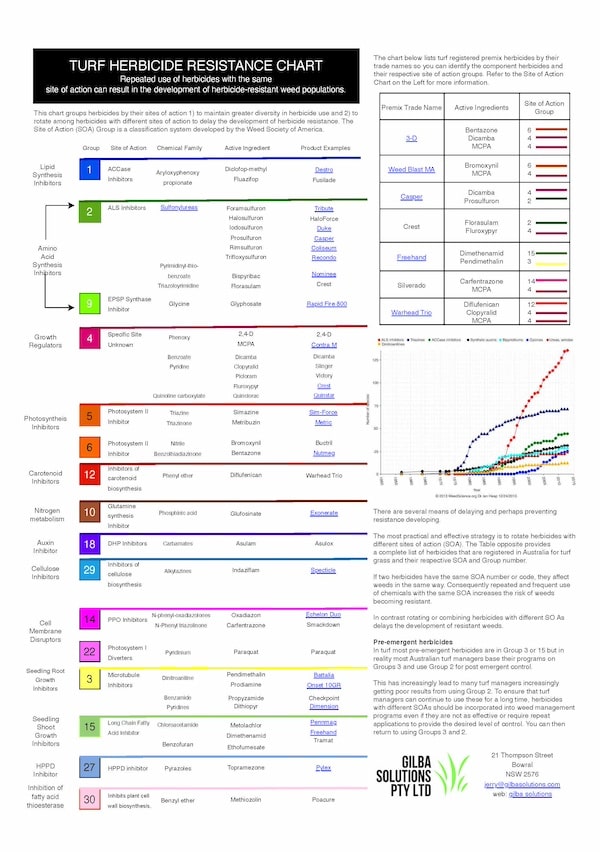
Australian-registered turf herbicides grouped by site-of-action (SOA). Rotating across SOAs delays resistance, and repeat reliance on a single group (Group 2 post-emergents) is the fastest path to resistant weeds.
Tank-mixing strategy uses two MOA groups with overlapping spectra to delay selection. If both groups kill the target weed, the survivors are rare double-resistance mutants rather than common single-resistance mutants. The same logic applies to pre-emergent plus post-emergent stacking in a single tank.
Cultural management is the resistance-management anchor that does not select for anything. Dense competitive turf, correct mowing height, and adequate fertility outcompete weed seedlings and reduce the population on which any herbicide must act. Spray escapes are where resistance breeds, so treating the entire area at label rate beats half-rate spot spraying.
What cultural controls reduce turf pest and weed pressure?
Cultural management is the most underused tool in Australian turf pest control and the longest-acting. Mowing height and dense canopy reduce weed establishment because most weed seedlings need light to compete. Correct fertility timing prevents the soft, over-fertilised tissue that scarab larvae and disease favour, and balanced potassium nutrition strengthens cell walls against feeding damage. Drainage and irrigation depth determine sedge and Pythium pressure: shallow frequent irrigation produces the wet surface conditions both pest groups prefer. Biological controls including entomopathogenic nematodes (Steinernema and Heterorhabditis), Beauveria bassiana, and neem-based products are part of the program rather than standalone solutions. The honest reading of the science (Wu et al. 2017, Koppenhöfer and Fuzy 2008) is that biologicals multiply chemistry effectiveness rather than replace it, particularly against pyrethroid-resistant weevil populations where chemistry alone has lost most of its efficacy.
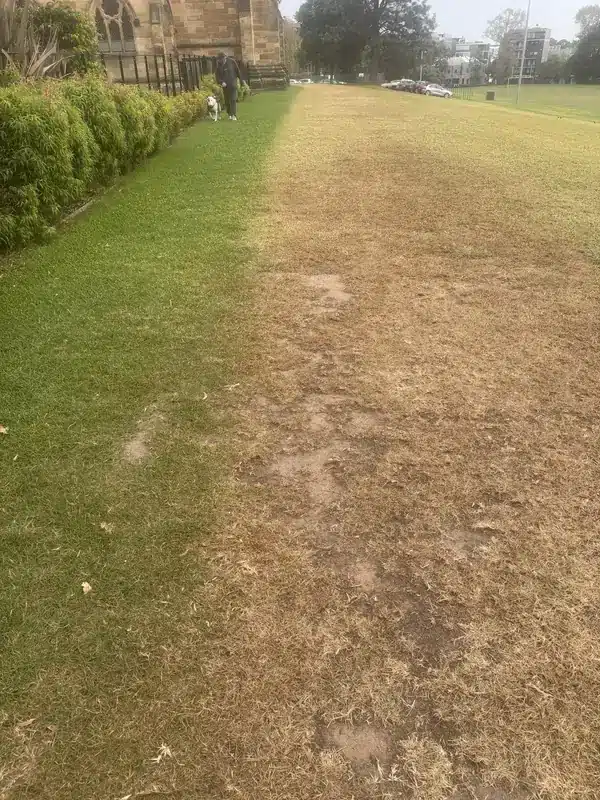
Cultural management failure on a kikuyu thoroughfare: the unsprayed buffer adjacent to the garden remained intact while the trafficked side, where Padre (maleic hydrazide) was applied at 10 L/ha in autumn, thinned to bare soil. Canopy condition determines PGR safety as much as product and rate.
Cultivar selection sits across the line between agronomy and pest management. The Turf Seed and Cultivars pillar covers the data sources. A cultivar with documented disease tolerance reduces fungicide load by definition, and the NTEP and A-LIST programs provide independent ratings.
The reduction-in-chemistry conversation is misleading when framed as binary. The right framing: cultural levers reduce the threshold-crossing frequency, biological controls extend the working life of registered chemistry, and chemistry is the last response to a problem that the first two have not solved.
Key Considerations for Australian Turf IPM
Biological considerations
Every pest and weed has a lifecycle, and that lifecycle determines when control is possible and when it is not. Argentine Stem Weevil is vulnerable as a first-instar larva inside the plant stem and again as an adult walking on the surface: different chemistry, different timing, different efficacy. Nutgrass tuber chains regenerate from dormant nodes when the surface plant is removed, which is why hand-weeding can worsen the problem (Siriwardana and Nishimoto 1987).
- Lifecycle stage determines vulnerability: first instar vs third instar matters more than calendar week
- Weed seed dormancy and viability: Yellow Nutgrass seeds reach 90-95% viability, Purple Nutgrass only 2-10%, with different management implications
- Predator-prey balance: broad-spectrum insecticides can suppress the natural enemies of secondary pests
- Climate-driven phenology shifts: warmer Sydney autumns now produce up to 4-5 ASW generations per year
Chemical considerations
The chemistry available in Australia is constrained by APVMA registration. A product effective in US extension trials but unregistered for AU turf is not an option. Registered products carry use-pattern constraints (application volume, irrigation timing, weather exclusion windows) that determine field efficacy as much as the active ingredient.
- APVMA registration status is the first filter on any product decision (PubCRIS database)
- Mode-of-action group: IRAC or HRAC classification with resistance risk attached
- Application volume and adjuvant requirements: frequently the difference between a working program and a failure
- Resistance status of the local population: assume resistance until proven otherwise on high-pressure sites
Cultural considerations
Cultural practices are the cheapest, longest-acting tool in the program. Healthy, dense turf at the right mowing height outcompetes most weed seedlings, hosts fewer scarab larvae, and recovers faster from any damage that does occur. Cultivar selection that suits one site can make the same cultivar a liability on another. The Turf Seed and Cultivars pillar intersects directly with pest and weed pressure.
- Mowing height matching turf species and use intensity
- Fertility timing: over-stimulating tissue going into a pest window is counterproductive
- Irrigation depth and frequency: shallow, frequent irrigation favours surface-feeding insects and weed germination
- Drainage: see the Soil and Rootzone Science pillar for the underlying soil framework
Decision-making considerations
The decision tree at the heart of IPM is simple in principle and difficult in practice: identify the problem, measure against a threshold, exhaust cultural options, then rotate chemistry. The hard part is the discipline to wait. The agronomist’s job, increasingly, is to slow the spray decision down enough for the right one to be made.
- Identify first: never spray without species-level confirmation
- Threshold check: is the pressure above the action threshold, or just visible?
- Cultural lever check: what else could be changed before chemistry?
- When to escalate: when a site warrants independent agronomic advice
References
APVMA (2024). (PubCRIS).
Barua, R., Bousalis, P., Malone, J., Gill, G., Preston, C. (2020). Incidence of multiple herbicide resistance in annual bluegrass across southeastern Australia. Weed Science 68(4): 340–347.
Bell, G.E., Xiong, X. (2008). The history, role and potential of plant growth regulators in turfgrass weed management. USGA Green Section Record 46(5): 8–11.
Brosnan, J.T., Reasor, E.H., Vargas, J.J., Breeden, G.K., Kopsell, D.A., Cutulle, M.A., Mueller, T.C. (2014). A putative prodiamine-resistant annual bluegrass (Poa annua) population is controlled by indaziflam. Weed Science 62(1): 138–144.
Cross, R.B., McCarty, L.B., Tharayil, N., McElroy, J.S., Chen, S., McCullough, P.E., Powell, B.A., Bridges, W.C. (2015). A Pro106 to Ala substitution is associated with resistance to glyphosate in annual bluegrass (Poa annua). Weed Science 63(3): 613–622.
Ford, P., Roberts, J., Dell, B. (2000). Action thresholds for Argentine stem weevil on Australian golf courses. Victorian Golf Course Superintendents Association Technical Report.
Heap, I. (2026). The International Survey of Herbicide-Resistant Weeds.
Held, D.W., Potter, D.A. (2012). Prospects for managing turfgrass pests with reduced chemical inputs. Annual Review of Entomology 57: 329–354.
HRAC (2024). HRAC Global Herbicide Mode of Action Classification.
IRAC (2024). IRAC Mode of Action Classification Scheme.
Koppenhöfer, A.M., Kostromytska, O.S., Wu, S. (2018). Pyrethroid-resistance level affects performance of larvicides and adulticides from different insecticide classes in populations of Listronotus maculicollis. Journal of Economic Entomology 111(4): 1851–1859.
Kostromytska, O.S., Wu, S., Koppenhöfer, A.M. (2018). Cross-resistance patterns to insecticides of several chemical classes among Listronotus maculicollis populations with different levels of resistance to pyrethroids. Journal of Economic Entomology 111(1): 391–398.
Preston, C., Powles, S.B. (2002). Mechanisms of multiple herbicide resistance in Lolium rigidum. Pesticide Biochemistry and Physiology 73(1): 1–15.
Siriwardana, G., Nishimoto, R.K. (1987). Propagules of purple nutsedge (Cyperus rotundus) in soil. Weed Technology 1: 217–220.

Principal agronomist, Gilba Solutions Pty Ltd
BSc Hons Soil Science (Newcastle). Former STRI agronomist. Author of Nutrition of Sports Turf in Australia (CSIRO/Landlinks Press) and The Definitive Guide to Australian Turfgrass Pesticide Management. 35+ years advising on sports turf, golf and stadia across Australia, NZ, UK and Europe.