
Turf Nematodes on Golf Greens: How to Spot and Test for Them in Australia
By Jerry Spencer, Principal Agronomist, Gilba Solutions Pty Ltd
Plant-parasitic nematodes are the most under-diagnosed cause of decline on Australian golf greens. They feed on roots out of sight, the damage looks like drought or a nutrition problem, and most greens are treated for everything except the actual cause.
This guide covers how to recognise a turf nematode problem, when and how to sample, how to read the result, and why prevention is the strongest lever in Australia. For the treatment side, choosing and timing nematicides and managing resistance, see the companion guide linked below.

Caption: Nematode damage on greens mimics drought and nutrition problems, which is why it is so often misdiagnosed.
How do you know if you have a turf nematode problem?
The only reliable way to confirm a turf nematode problem in Australia is a laboratory soil and root assay, and not by visual diagnosis.
You tend to see nematode damage on golf greens, as thinning, wilting, and a poor response to water and fertiliser. This is pretty non-specific and can be easily confused with drought, nutrient deficiency, compaction, or fungal disease. Basically you cannot use surface symptoms to confirm it.
Instead, take a plug and inspect the roots. If you can see short, stubby, blunted roots with few root hairs this points toward nematodes. However, only a lab test that counts and identifies the species can settle this.
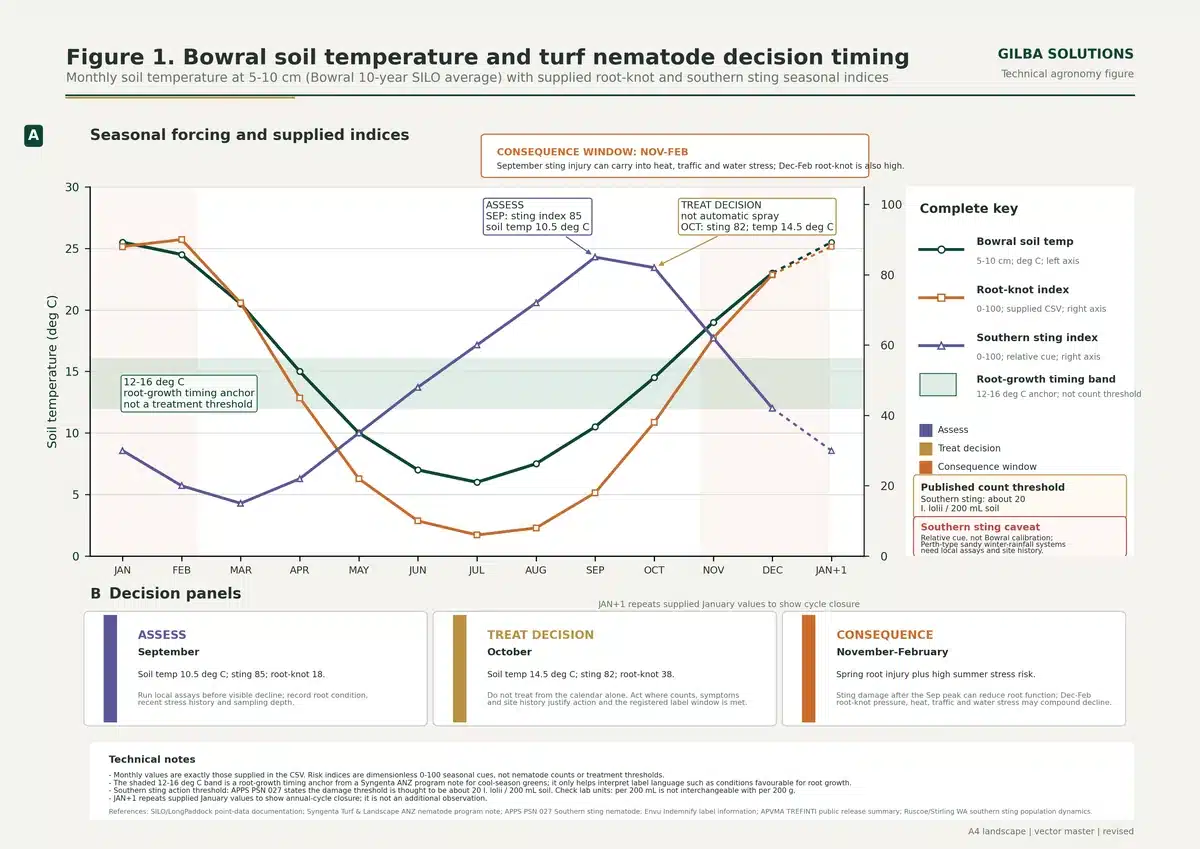
Aim to sample in the late winter to early spring, before populations build through the warm season. By doing testing then it gives you to time to modify your programme if you need to.
Because damage thresholds differ enormously between genera, a species identification with a count is essential. Not just a simple presence test. For southern sting, the dominant and most damaging Australian species, prevention and biosecurity are the strongest way to manage this pest.
What do plant-parasitic nematodes do to turf?
Plant-parasitic nematodes are microscopic roundworms that feed on turf roots, either from the outside (ectoparasites) or by entering root tissue (endoparasites). The feeding destroys root function. A green with a damaged root system cannot take up water or nutrients efficiently, so it wilts under heat, responds poorly to fertiliser, and thins despite a sound maintenance programme. The symptoms appear above ground but the cause is entirely below it, which is why nematode problems are so often misread as irrigation, nutrition, or compaction issues.
Nematode Genera
The nematode genera that matter on Australian turf are best understood by the damage they actually cause, and the Australian nematologist Graham Stirling (2023) sets out as a pathogenicity ranking.
The standout is the Southern sting nematode (Ibipora lolii), which is rated the most damaging turf nematode in Australia and is found in Newcastle, Sydney and Perth.
Its relative is the true sting nematode (Belonolaimus longicaudatus) which is the equivalent pest in the United States and is on Australian nematicide labels. However, it is the southern sting that the Australian survey literature (Stirling et al. 2013, 2021) identifies as the established turf pest here. This tends to spread via planting material.
Tiered Ranking
Below the stings sits a moderate-damage tier, root-knot (Meloidogyne), lance (Hoplolaimus), dagger (Xiphinema) and stubby-root (Paratrichodorus), and then a lower-damage group including lesion (Pratylenchus), stunt (Tylenchorhynchus) and ring (Mesocriconema). Spiral (Helicotylenchus) is the least damaging despite being common. The practical point is that the sting nematodes damage turf at very low population densities while others are tolerated at far higher counts. This is why a raw total count means little without species identification.
Golf greens are the highest-risk surface for nematode damage. Sand rootzones, a turf mono-stand, very low mowing heights, and constant traffic stress combine to put the plant under pressure even before nematodes are factored in.
Couch (Cynodon) and bentgrass greens differ in susceptibility, and the species present on each differs as well. This again points back to sampling rather than assumption. Sportsfields and couch surfaces carry nematode loads as well, but the intensively managed green is where populations most reliably can be seen as visible damage.
Can you diagnose nematodes from the surface?
It would save a great deal of time and cost if a superintendent could see nematode issues by simply looking at the surface of a green, or run a quick test in the shed. The honest answer is that you cannot confirm nematodes that way, and understanding why is itself useful.
Above-ground symptoms are real but pretty much useless on their own. When nematodes feed they produce irregular patches of thinning, wilting, chlorotic or declining turf. These areas then typically fail to respond to irrigation, fertiliser or fungicide.
The problem is that none of these are nematode specific. Drought, nutrient deficiency, compaction and several fungal diseases cause the same symptoms. You can’t use surface symptoms to tell them apart, as those symptoms can be caused by other biotic and abiotic stresses (Scientific Reports, 2025).
There are however, two things a turf manager can do to shift the odds, without ever confirming the diagnosis.
- The first is the pattern. Irregular patches that slowly expand outward over time, and are associated with the highest-stress areas of a green, are more likely due to nematodes. The distribution of symptoms often is the first clue that nematodes are worth investigating. Nematode-damaged grass competes poorly, and weeds, such as spurge, often move into the affected patches (Crow 2010).
- The second, is the roots. Take a plug and inspect the root system with a hand lens: short, stubby roots, dark lesions near the root tips, and a shortage of fine feeder roots are the below-ground signature of nematode feeding. Root inspection is the closest thing to a field check, but it only tells you the problem is worth sampling for, not that nematodes are present or which species.
Caption: The below-ground signature: short, stubby, blunted roots with few fine feeders (left) against a healthy root system (right). A hand lens on a lifted plug is the closest thing to a field check.
One trap is worth naming, because it can defeat even a correctly taken sample. The stage when root-knot nematodes cause damage is when they are inside the root. This means that a standard soil-extraction assay can under-detect it. The University of Florida lab uses a separate procedure for root-knot on greens, based on turf plugs containing root tissue rather than soil alone. If you suspect root-knot nematodes, ask the laboratory for the root-tissue procedure rather than relying on a soil sample.
As for genuine quick tests, there is no validated rapid field kit for turf nematodes. The most promising development is deep-learning image identification, where trained models classify nematode genera from images. This approach could ease the shortage of specialist nematologists in diagnostic laboratories (Scientific Reports, 2025).
That work still depends on nematodes being extracted and imaged under a microscope. It speeds laboratory identification but it is not a green-side test, and it does not change the central point. Surface symptoms and root inspection tell you when to sample. Only the assay tells you what you have, and in what numbers.
When should you sample for nematodes in Australia?
Sample timing is the single most important decision in turf nematode treatment, and it is a decision you should make well before you consider any product. The window that matters is late winter to early spring. This is when the turf comes out of dormancy and is before nematode populations build through the warm season.
The logic is the same one that governs sound disease and pre-emergent management: act on the leading indicator, not the symptom.
You can detect populations in late winter but they have not yet surged. If you sample then it gives laboratory turnaround time, and lets you calmly interpret the result against an agronomic threshold. It also allows you time to make any product and budget decisions before damage compounds under summer heat and traffic.
By the time a green visibly declines in the mid-summer, you are no longer managing the problem. You are trying to fix it, on a surface that is already under maximum stress, with the spring root damage already done. In the case of the sting at least, the population will have by then also moved deeper than a nematicide can reach (see the timing section below).
Exactly when each genus peaks varies by species, sting spikes in spring, and lance later in the autumn. This is another reason the assay, not the calendar, should drive the decision.
For most Australian golf greens this places the assessment window in late winter to early spring, roughly August to October, adjusted for local climate. Cooler southern sites run later, warmer northern and coastal sites earlier.
The same principle holds regardless of latitude: sample early enough that the result can change what you do, not so late that it only confirms what you can already see.
How do you sample a green for nematodes correctly?
A nematode assay is only as good as the sample. Several practical points determine whether the laboratory result reflects what is actually happening on the green.
Sample from the margin of an affected area, not the dead centre. Nematodes feed on living roots, so the worst of a declining patch, where roots are already dead, will often return a lower count than the actively damaged margin around it.
Take cores to root-zone depth, not just the top few millimetres, because that is where the feeding occurs. Pool several cores per green into a single composite sample to even out the patchiness of nematode distribution.
Keep samples cool and out of direct sun from the moment they are taken. Nematodes are live organisms and a sample left in a hot vehicle will under-report. Send to the laboratory quickly, early in the week so the sample is not sitting over a weekend. Where you can, submit a second sample from a healthy area of the same green or a comparable green. This gives, the laboratory a baseline for comparison. A count from a damaged area means far more when read against a count from healthy turf on the same site.
Always request species identification and a count, not a simple presence or absence. Because thresholds differ so sharply between genera, knowing that you have 200 nematodes per sample is meaningless until you know whether they are sting or spiral.
How do you read a nematode result against a threshold?
A damage threshold is the population density above which you expect a given nematode species to cause economic damage to turf. Thresholds are the backbone of treat-or-not decisions, but you need to understand what they are: species-specific, indicative rather than absolute, and heavily modified by the turf condition.
The same count carries very different weight depending on species. The Australian pathogenicity ranking published by Stirling (2023), a one-to-ten scale, places southern sting at the top as the most damaging turf nematode in Australia, with the other genera causing low to moderate damage.
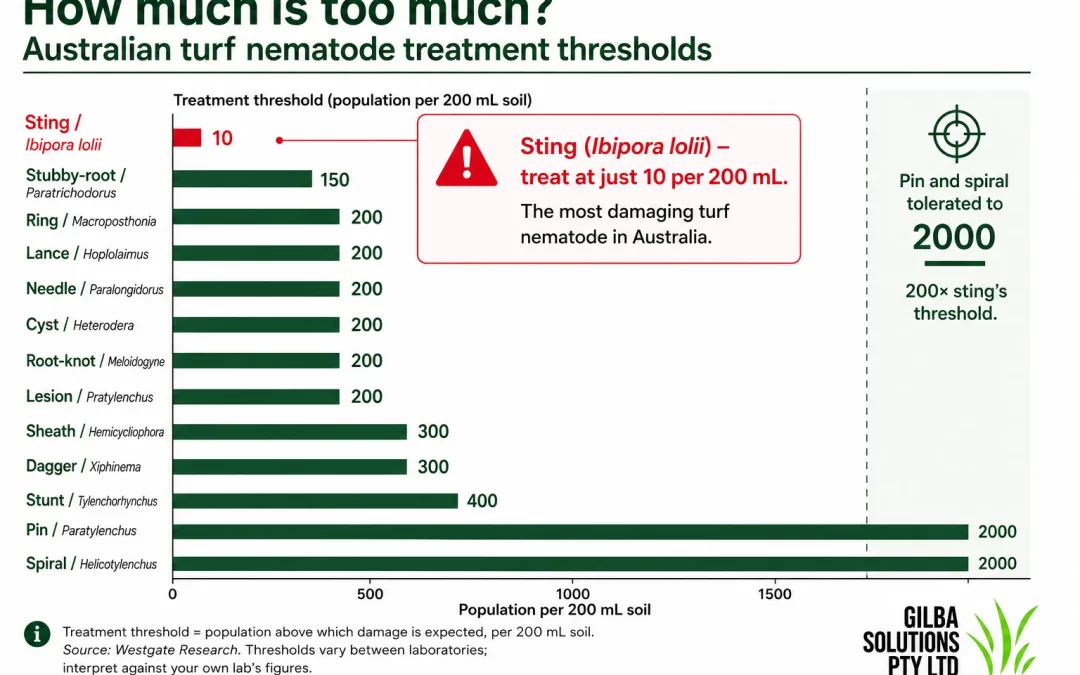
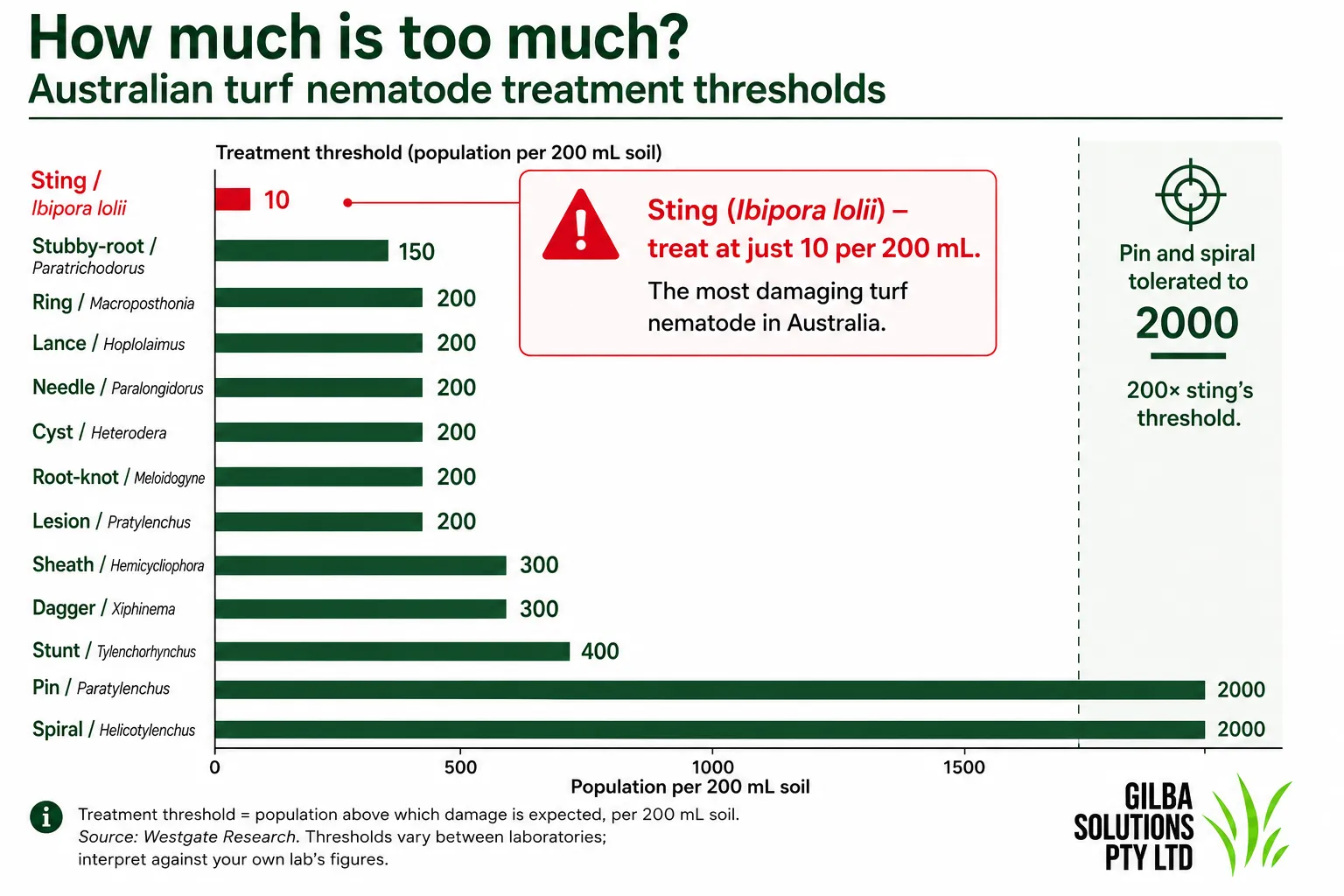
That ranking is borne out in the count thresholds Australian diagnostic laboratories report against. The figures below, per 200 mL of soil, are the working thresholds used by Australian turf nematode laboratories (source: Westgate Research Pty Ltd), the population density above which damage is expected for each genus.
Table Showing Turf Nematode Thresholds.
| Nematode | Genus | Threshold (per 200 mL soil) |
|---|---|---|
| Sting | Ibipora lolii | 10 |
| Stubby-root | Paratrichodorus | 150 |
| Ring | Macroposthonia | 200 |
| Lance | Hoplolaimus | 200 |
| Needle | Paralongidorus | 200 |
| Cyst | Heterodera | 200 |
| Root-knot | Meloidogyne | 200 |
| Lesion | Pratylenchus | 200 |
| Sheath | Hemicycliophora | 300 |
| Dagger | Xiphinema | 300 |
| Stunt | Tylenchorhynchus | 400 |
| Pin | Paratylenchus | 2000 |
| Spiral | Helicotylenchus | 2000 |
The single most important number in that table is the contrast at its extremes. Sting (Ibipora lolii) has a threshold of just 10 per 200 mL, while pin and spiral are tolerated up to 2000. That’s a 200 fold difference. Ten sting nematodes is a treat-now result, whereas two thousand spiral may need no action at all.
This is exactly why a raw total count, or a presence test, is close to useless. The same number means opposite things depending on which genus it represents. A result must be read genus by genus against the relevant threshold, and never as a single combined figure.
Two cautions apply to those numbers.
- First, they come from a single laboratory’s threshold set and thresholds vary between laboratories, extraction methods and sample sizes. This means that you should interpret your result against the thresholds your own laboratory reports against, not against an imported number.
- Second, the values for genera other than sting derive substantially from overseas research and general turf experience rather than Australian field calibration. The sting threshold is the one with the strongest Australian backing, and it is also the one that matters most.
Thresholds are also a guide, not a verdict. A green already weakened by low mowing, poor rootzone drainage, salinity, or heat stress will show damage at a lower nematode count than a healthy, vigorous green with a deep root system.
The published threshold is a starting point for interpretation, not a trigger you apply regardless. The right question is not only whether the count exceeds a number, but whether the turf shows stress consistent with the population present. This is exactly the kind of interpretation where laboratory results and on-the-ground agronomic judgement have to be read together.
Biosecurity and prevention: the strongest lever in Australia
Step back and all the evidence points to one conclusion. There is no published Australian data that any registered nematicide controls southern sting. Instead the chemistry is extrapolated from US work on a different species.
The one documented Australian field attempt, the Gabba, could not even be cleanly attributed to the nematicides and ultimately failed to eradicate the nematode. Meanwhile the way it spread is clear, and for southern sting nematode in Australia, the strongest management option is biosecurity and prevention, not chemical control.
The role of sand
Why machinery and material matter so much comes down to where nematodes live: sand. Sting nematode needs a very high sand content, around 80% or more, to survive, and even small amounts of silt, clay or organic matter sharply limit its build-up.
Golf greens are one of the few rootzones deliberately built into that range, and this is exactly why they are the high-risk surface. The practical consequence is that sand is the contaminated medium, and anything that moves sand between greens is a vector.
So topdressing, hollow tine cores, scarifyings or mower clippings, divot mix, and even boots can cause contamination. The USGA notes that aerification, verticutting and topdressing can worsen nematode stress symptoms shortly after they are performed; those same operations also physically move infested cores and sand around the course.
Agriculture Victoria’s biosecurity guidance states the position plainly: the nematode spreads in soil on plant material, machinery, and clothing or boots, and it is now present in New South Wales, Western Australia, Queensland, South Australia and Victoria. Its single most useful operational rule is worth lifting almost verbatim: when you manage turf, work on healthy sites first, to avoid transferring nematodes from infested to healthy sites. Clean to dirty, never dirty to clean.
The prevention programme that follows is one you can recommend with confidence, because every step interrupts a documented pathway:
- Sequence clean to dirty. Work healthy sites, and clean greens, before known or suspect infested ones, never the reverse (Agriculture Victoria).
- Clean machinery between sites, and ideally between greens (mowers, corers, topdressers), especially after aerification or verticutting, when infested sand and cores are being moved.
- Source turf, sod and sand from tested, nematode-free origins. This is exactly where the Gabba infestation originated, in turf brought in from elsewhere.
- Lab-test before establishment and before bringing material on site, and establish turf only on sites confirmed free of the nematode (Agriculture Victoria).
- Treat sand as the contaminated medium it is for this pest, and obtain a professional laboratory diagnosis, since damaged turf can have many causes.
Once you have confirmed and identified a nematode problem, choose the right nematicide. Application timing to the nematode’s depth, and managing resistance is a subject in its own right which is covered in the upcoming companion guide: Turf nematicides in Australia: choosing, timing, and resistance.
Further reading
Turf Pests and Weeds | Fungicide Mode of Action Table | 2024 Turf Pesticides Manual | Turf Chemicals | Pythium in Turf | Soil Temperature is the Only Pre-Emergent Trigger That Matters| Soil and Rootzone Science | Turf physiology and PGRs
Key points
- Nematode damage on greens is invisible below ground and non-specific above it, so it is often misdiagnosed. Sample before you treat.
- Sample in late winter to early spring. This is before warm-season populations peak, so the result can still change your programme.
- Sample the margin of affected areas to the root-zone depth, keep cool, despatch fast, and always request species identification with a count.
- Thresholds are species-specific and indicative, not absolute. Sting is damaging at just 10 per 200 mL while pin and spiral are tolerated to 2000. Read genus by genus, against the condition of the turf.
- For southern sting (Ibipora lolii), the dominant Australian species, biosecurity and prevention are the strongest evidence-based lever: clean machinery between greens, source tested nematode-free turf and sand, and work clean sites before infested ones.
Why sample for nematodes in late winter rather than summer?
Sampling early gives the result time to change your programme. Populations are detectable in late winter but have not yet surged, so laboratory turnaround, threshold interpretation, and decisions can happen before damage compounds under summer stress. Sampling in mid-summer, when the green is already declining, only confirms a problem that is already at its peak.
What does nematode damage look like on a golf green?
Can I diagnose nematodes without a laboratory test?
References
- Stirling, G.R., Stirling, A.M., Giblin-Davis, R.M., Ye, W., Porazinska, D.L., Nobbs, J.M. & Johnston, K.J. (2013). Distribution of southern sting nematode, Ibipora lolii (Nematoda: Belonolaimidae), on turfgrass in Australia and its taxonomic relationship to other belonolaimids. Nematology 15:401–415. DOI 10.1163/15685411-00002686.
- Stirling, G.R., Stirling, A.M. & Eden, L. (2021). Plant-parasitic nematodes on turfgrass in Queensland, Australia, and biosecurity issues associated with the interstate transfer and eradication of southern sting nematode (Ibipora lolii). Australasian Plant Pathology 50:695–704. DOI 10.1007/s13313-021-00820-1.
- Stirling, G.R., O’Neill, W., Cobon, J., Shuey, T. & Sandurski, D. (2023). Failure of an attempt to eradicate southern sting nematode (Ibipora lolii) from the Brisbane Cricket Ground (the Gabba). Australasian Plant Pathology 52:225–226. DOI 10.1007/s13313-023-00913-z.
- Stirling, G. (2023). Diagnosis of Disease Problems in Turfgrass Caused by Plant Parasitic Nematodes (Australian turf nematode pathogenicity ranking). Biological Crop Protection, Qld.
- Westgate Research Pty Ltd. Australian turf nematode treatment thresholds (per 200 mL soil), as reported by Australian diagnostic laboratories. Compiled via the Turf Finder pest database.
- Crow, W.T. (2010). Nematode Management for Golf Courses in Florida (ENY-008/IN124). University of Florida IFAS Extension. (Authoritative source for nematode feeding modes, diagnostic root and surface symptoms, sampling protocol, and biosecurity practice.)
- Ruscoe, P.E. (2020). Southern Sting Nematode (Ibipora lolii) on Turf Grass in Western Australia. MPhil thesis, University of Queensland. (Couch-cultivar tolerance trial; AU field data.)
- Agriculture Victoria. Sting nematode (biosecurity guidance for turf): spread vectors, distribution, and “work on healthy sites first” hygiene rule. agriculture.vic.gov.au.
- USGA. Best Management Practices for Controlling Turfgrass Nematodes. United States Golf Association, Green Section.
Get a nematode assessment for your greens
If your greens are declining without an obvious cause, a nematode assay may be the missing piece. Gilba Solutions provides independent, evidence-based turf agronomy services across Australia, New Zealand, the UK, and Europe, including nematode assessment and integrated management programmes built on laboratory data rather than guesswork (see also sports turf agronomy). Contact Gilba Solutions to discuss an assessment for your site.

Principal agronomist, Gilba Solutions Pty Ltd
BSc Hons Soil Science (Newcastle). Former STRI agronomist. Author of Nutrition of Sports Turf in Australia (CSIRO/Landlinks Press) and The Definitive Guide to Australian Turfgrass Pesticide Management. 35+ years advising on sports turf, golf and stadia across Australia, NZ, UK and Europe.