
Turfgrass Physiology and Plant Growth Regulators
Turfgrass physiology and plant growth regulation focuses on how turfgrass responds to environmental stress, nutrition, mowing, traffic and chemical growth regulators. A good understanding of growth dynamics is essential to manage recovery, density, carbohydrate storage, shade tolerance and seasonal performance. Modern turf management increasingly uses plant growth regulators such as trinexapac-ethyl, paclobutrazol and ethephon to influence growth behaviour, suppress unwanted species and improve the overall turf quality. This pillar provides technical interpretation of turfgrass physiology and evidence-based PGR management strategies for golf courses, sports fields and stadiums.
Written by Jerry Spencer, Principal Agronomist at Gilba Solutions Pty Ltd. Honours degree in Soil Science, 35+ years in turf agronomy, author of the CSIRO/Landlinks Press text on sports turf nutrition, LGP panel agronomist since 2020.
Published: 20 May 2026
What This Topic Covers
Mode of Action and PGR Chemistry
How trinexapac-ethyl, paclobutrazol, ethephon, prohexadione-Ca and maleic hydrazide intervene in plant hormone biosynthesis, and why their mode of action determines where each fits.
- Indigo Regulate (paclobutrazol) product information
- Indigo Incognito (ethephon) product information
- Maleic hydrazide on low maintenance turf
Growth Suppression and Carbohydrate Dynamics
How gibberellin inhibition redirects photoassimilates, what happens to root mass during and after suppression, and the temperature dependence of in-plant PGR half-life.
Poa annua Seedhead Suppression
Ethephon timing on bentgrass and bermudagrass, paclobutrazol as a population shifter, GDD targets for first application, the role of late autumn applications.
Rebound, GDD Reapplication and Programming
What the maximum suppression point means, why 200-GDD0 became the bentgrass green standard, and how rebound risk scales with reapplication interval.
Species-Specific PGR Programmes
Couch (Cynodon dactylon and hybrids), kikuyu (Pennisetum clandestinum), perennial ryegrass (Lolium perenne), and creeping bentgrass (Agrostis stolonifera). Different metabolism rates, different temperature responses, different programme structures.
Maleic Hydrazide and Niche PGR Use in Australia
The original turf PGR, its current uses in Australia, where it still belongs in roadside and low-maintenance turf, and where it does not.
Cold Hardiness and Freeze Injury
How do PGRs work in turfgrass?
Plant growth regulators in turfgrass work by interrupting the biosynthesis or signalling of plant hormones that drive shoot extension and reproduction. Each chemistry produces a different visible response and a different stress profile.
- Trinexapac-ethyl and prohexadione-Ca block the late stage of gibberellin biosynthesis and inhibit the enzyme that converts GA20 to bioactive GA1, the hormone that drives cell elongation in the leaf meristem.
- Paclobutrazol inhibits an earlier step in the same pathway and blocks the cytochrome P450 enzymes that convert ent-kaurene to gibberellins.
- The plant metabolises ethephon to release ethylene, the gaseous hormone that arrests seedhead elongation in winter grass.
- Maleic hydrazide stops cell division in meristematic tissue rather than acting on a hormone pathway.
Targeting the right hormone pathway
Late-pathway gibberellin inhibitors (Class B) reduce vertical growth and leave the plant fully capable of still being able to produce photoassimilate. This means that the leaf colour usually deepens during suppression. Early-pathway inhibitors (Class A) such as paclobutrazol produce stronger and longer suppression but have a higher risk of canopy thinning and reduced root mass when you use them on turf that is already under stress.
Why mode of action governs programme design
Foliar-absorbed PGRs such as trinexapac-ethyl have short in-plant half-lives and require frequent reapplication. Root-absorbed PGRs such as paclobutrazol persist in the rootzone for weeks and build-up with repeat use, which is why programme intervals differ by an order of magnitude between the two.
What's the difference between trinexapac, paclobutrazol, ethephon, and prohexadione-Ca?
Trinexapac-ethyl, paclobutrazol, ethephon and prohexadione-calcium are the four PGRs that account for the majority of professional turf use, and they differ on every variable that matters.
- Trinexapac-ethyl is a foliar-absorbed late-stage gibberellin inhibitor with a short in-plant half-life of 3 to 6 days depending on temperature. You use this for shoot suppression in cool-season and warm-season turf.
- Paclobutrazol is a root-absorbed early-stage gibberellin inhibitor that persists in the upper soil organic layer for weeks. This is used both for shoot regulation and to help manage Poa annua in bentgrass.
- Ethephon is a foliar-absorbed ethylene-releasing compound used primarily for Poa annua seedhead suppression.
- Prohexadione-calcium acts on the same enzymatic step as trinexapac-ethyl but has less phytotoxicity in warm temperatures.
Practical positioning
Trinexapac-ethyl (Indigo Amigo 120, Indigo Amigo 175, Primo 250EC) is the default growth regulator across cool-season and warm-season Australian turf. Paclobutrazol (Indigo Regulate) earns its place where you aim to reduce Poa annua, not just shoot regulation. Ethephon (Indigo Incognito 480) is purpose-built for seedhead suppression on Poa-contaminated bentgrass and ryegrass surfaces.
Why prohexadione-Ca matters in summer
Bigelow et al. (2007) and Reasor et al. (2018) document that prohexadione-calcium maintains efficacy at temperatures that compromise trinexapac-ethyl. It does not have an Australian registration on couch as of 2026 and is included here as a comparative reference for international readers.
How does trinexapac affect carbohydrate dynamics and root mass?
Trinexapac-ethyl redirects rather than reduces total carbon assimilation, and the destination of this carbon depends on temperature, use rate and reapplication frequency. Beasley and Branham (2005) demonstrated using a hydroponic Kentucky bluegrass system with WinRhizo root measurement that a single label-rate of trinexapac-ethyl application reduced shoot height for four weeks. Following this there was then a rebound period of enhanced shoot growth, and tiller number across the seven-week study. Beasley, Branham and Spomer (2007) showed that single-leaf carbon exchange rates were suppressed 17 to 29 per cent of the control at 4 and 12 days after treatment and recovered fully thereafter. Net effect on total photosynthesis was therefore short-lived.
The root-mass question
The popular claim that PGRs build deep roots needs qualification. Beasley and colleagues saw total root length, root surface area and average root diameter changes that did not consistently translate into deeper rooting. The benefit is most reliably seen as increased tiller density and canopy filling, not increased rooting depth.
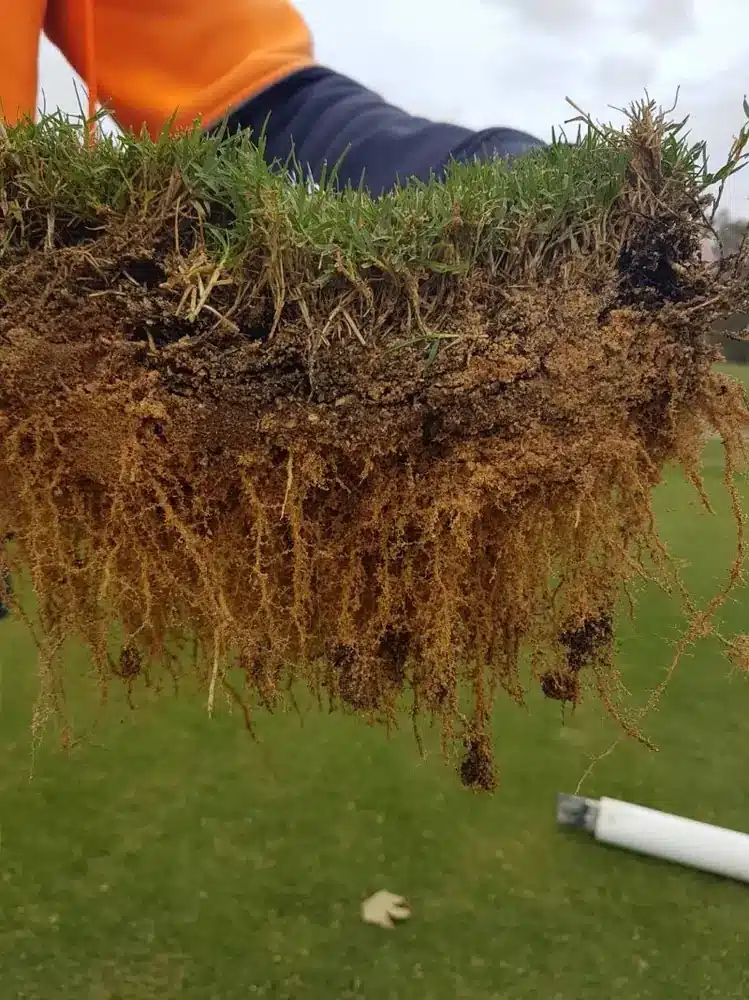
Soil core extracted from a Gilba Solutions client site showing a dense root profile to ~200mm.
Temperature governs everything
The half-life of trinexapac acid in Kentucky bluegrass is 5.3 days at 18°C and 3.4 days at 30°C (Beasley & Branham 2005). At 30°C the active breaks down so quickly that calendar-based 28-day intervals leave most of the cycle in rebound, not in suppression. This is the reason GDD scheduling matters.
How do you suppress Poa annua seedheads with ethephon and paclobutrazol?
Ethephon is the foundation of any Poa annua seedhead suppression programme on bentgrass and ryegrass surfaces in Australia, and it works best when paired with a winter pre-conditioning application followed by two spring applications timed by growing degree days. Askew (2017) demonstrated across five Virginia sites between 2011 and 2012 that a January or February ethephon application prior to a spring two-treatment programme reduced winter grass seedhead cover five to seven times more than the spring programme alone, with no creeping bentgrass injury and only transient discoloration of the Poa itself. The spring component is typically initiated at 200-250 GDD base 0°C, with the second application 21 days or 350-450 GDD later, just ahead of the peak seedhead flush.

Poa annua putting green at Duntry league Country Club under a trinexapac-ethyl programme (200-500 mL/ha). A fine uniform canopy with mild silver-tipping consistent with the lower TE sensitivity of Poa.
The paclobutrazol role
Paclobutrazol does not suppress seedheads acutely. It shifts the population over multiple seasons by handicapping shallow-rooted Poa annua more than the deep-rooted desired species. Application is timed to soil temperatures that drive root activity, not GDD heat units, because uptake is root-mediated.
Australian timing reality
The Virginia GDD trigger needs adjustment for local climate. In Bowral, 200-250 GDD base 0°C from 1 July typically accumulates by late August. Coastal Sydney sites accumulate the same heat sum two to three weeks earlier. The GAIP Hub runs this calculation per site rather than relying on a fixed calendar date.
What is the PGR rebound effect and how do you avoid it?
The rebound effect is the period of growth above the untreated control that follows the maximum suppression point after a trinexapac-ethyl application. It is the single most important variable in PGR programme design on cool-season turf.
Kreuser and Soldat (2011) demonstrated this on a Madison Wisconsin creeping bentgrass green. Specifically, reapplication at 100 or 200 growing degree days base 0°C maintained consistent yield suppression of 20 and 12 per cent respectively. In contrast, reapplication at 400 or 800 GDD produced alternating periods of yield reduction followed by yield enhancement above the control.
The practical implication is straightforward. In summer, calendar-based 28-day intervals cover most of the rebound period rather than the suppression period, because trinexapac acid metabolism accelerates with temperature.
The maximum suppression point
Reasor et al. (2018) on ultradwarf hybrid bermudagrass identified peak growth regulation at 166 to 177 GDD base 10°C. Building on this, Brown et al. (2021) confirmed the 1.3-times-peak-suppression rule that places ultradwarf reapplication at 216 to 230 GDD10.
Notably, no rebound growth was observed on the ultradwarf cultivars. This is a meaningful difference from creeping bentgrass.
How to avoid it in practice
Reapply trinexapac-ethyl at 200-GDD0 intervals on cool-season turf and 200-GDD10 intervals on warm-season turf. Crucially, use a GDD calculator rather than a calendar. The GAIP Hub does this automatically per site and accounts for any applications you miss by extending rather than restarting the cycle.
How do you build a PGR programme for couch versus ryegrass?
Couch and perennial ryegrass need different PGR programmes. This is because their growth physiology, temperature response and reapplication intervals all differ.
Couch is a warm-season C4 species with peak growth between 25 and 35°C surface temperature. Accordingly, trinexapac-ethyl on couch is scheduled on GDD base 10°C, with reapplication at 200-GDD10 intervals during active growth. Below 18°C soil temperature the turf is functionally dormant, so the programme is suspended.
Perennial ryegrass, by contrast, is a cool-season C3 species with peak growth between 15 and 24°C. As a result, trinexapac-ethyl on ryegrass is scheduled on GDD base 0°C, with reapplication at 200-GDD0 intervals.
Rates and seasonality differ
Couch programmes typically run at higher trinexapac-ethyl rates than ryegrass. This is because C4 growth potential during summer is higher and the rebound risk on warm-season turf is lower.
For example, a typical Australian couch programme uses Indigo Amigo 175 at 0.4 to 0.6 L/ha at 200-GDD10 reapplication. Ryegrass programmes, on the other hand, use Indigo Amigo 120 or 175 at the equivalent active ingredient rate but with closer monitoring of summer rebound at sites with high soil temperatures.
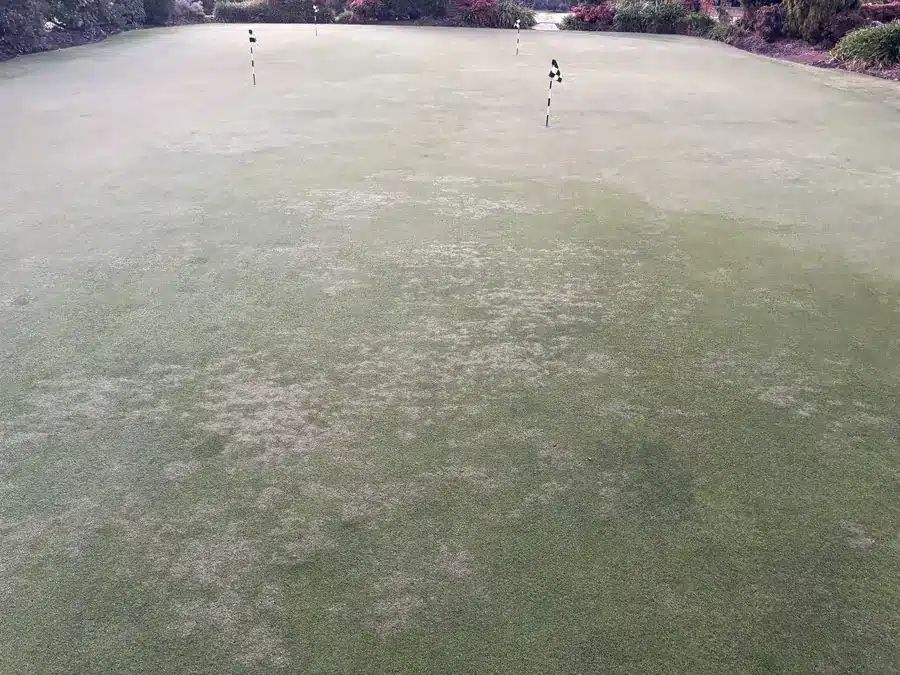
Practice putting green at Duntryleague Country Club. The pale mottled patches are Cynodon transvaalensis showing heavy trinexapac suppression. The green matrix is Poa annua under the same TE application but much less suppressed.
Combining with the Poa programme
Where couch fields are overseeded with ryegrass, the PGR programme switches base temperature mid-transition. For more on how this interacts with Poa suppression, see the winter grass management programme.
What is maleic hydrazide and what are its registered uses in Australia?
Maleic hydrazide has its place in a narrow set of Australian applications. In particular, it works for roadside and low-maintenance kikuyu where mowing access is limited and visual quality is not the priority.
Unlike trinexapac-ethyl, which blocks a hormone pathway, maleic hydrazide stops cell division in meristematic tissue. As a result, growth suppression lasts longer. However, the trade-off is phytotoxicity, which shows up as a yellowing of the turf canopy and slow recovery if the turf is stressed at application.
In Australia, the active ingredient is registered under products such as Slow Grow 270 (270 g/L maleic hydrazide potassium salt). Currently, APVMA approval covers sprout suppression in potato, onion and garlic, along with sucker control in tobacco.
Turf use in the Australian context
Turf-specific labels for maleic hydrazide in Australia are limited. Therefore, confirm the current APVMA registration for any turf use before application. Internationally, however, the active is in use on roadside vegetation, utility turf, and for kikuyu seedhead suppression where mowing is impractical.
Where it does not belong
Do not use maleic hydrazide on sports fields, golf greens, fairways, or any surface where canopy quality and you want rapid recovery. Specifically, its phytotoxicity profile, broad activity in roots and buds, and reduced rhizome growth on stressed turf rule it out wherever surface performance is the objective. Instead, trinexapac-ethyl, paclobutrazol or ethephon are the correct tools for those surfaces.
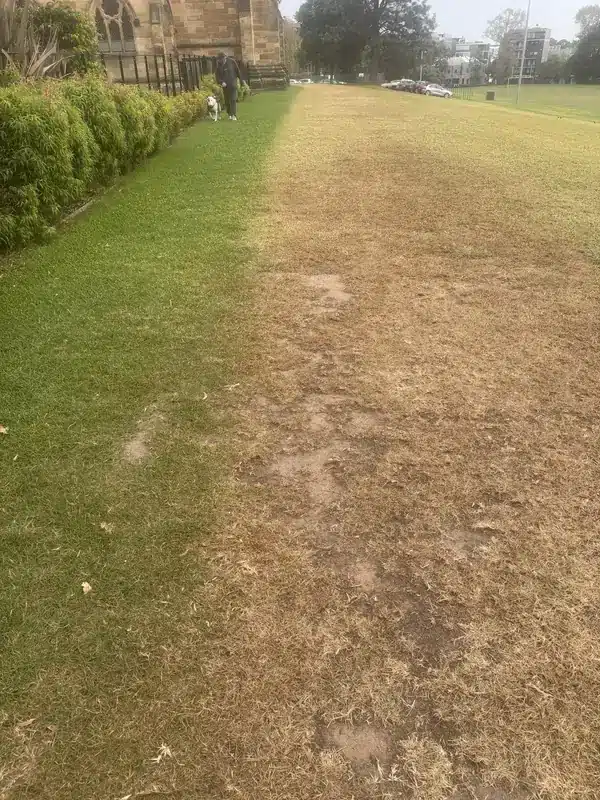
Sharp untreated/treated boundary on a kikuyu thoroughfare at a Sydney inner-city university campus. Padre (maleic hydrazide) at 10 L/ha applied in autumn to a trafficked surface produced severe thinning – the LHS no-spray buffer next to the garden remained intact, RHS has been thinned by the combined PGR plus traffic load.
How does the GAIP Hub model PGR effects?
The GAIP Hub models PGR effects through a Regulator Effect Index. This index tracks the in-plant concentration of active ingredient against site-specific growing degree day accumulation, soil temperature, and species-specific peak suppression and rebound parameters.
First, each application is logged with date, product, active ingredient and rate. Then the Hub accumulates GDD from the site weather feed using the correct base temperature for the species — 0°C for cool-season turf, 10°C for warm-season. Finally, it reports the proportion of the cycle remaining before the next application is recommended.
If an application is missed, the model extends the cycle rather than restarting it. In addition, it flags when a reapplication has been delayed long enough that rebound is probable.
Why species and product matter inside the model
The Hub holds different peak suppression and rebound parameters for each combination. For example, trinexapac-ethyl on bentgrass runs to 200-GDD0, while trinexapac-ethyl on ultradwarf couch runs to 220-GDD10. Paclobutrazol on bentgrass uses a longer interval that is also adjusted for root uptake. Similarly, ethephon on cool-season Poa-contaminated surfaces follows a GDD-triggered seedhead programme.
These differences come straight from Kreuser and Soldat (2011), Brown et al. (2021), and Calhoun et al. (2022).
Where it sits in the daily decision
The Regulator Effect Index appears alongside Growth Potential, Disease Risk and Irrigation Demand. Ultimately, the aim is one screen, one decision, with evidence visible behind each number.
Key Considerations Across Turfgrass Physiology and PGRs
Mode of action governs everything else
Class A early-pathway inhibitors (paclobutrazol), Class B late-pathway inhibitors (trinexapac-ethyl, prohexadione-Ca), ethylene-releasing compounds (ethephon) and cell-division inhibitors (maleic hydrazide) each produce different visible responses, different stress profiles and different programme structures. Selecting the chemistry comes before selecting the rate.
Temperature drives metabolism, and this drives interval
The half life of Trinexapac nearly halves between 18°C and 30°C. Calendar-based reapplication intervals that are built for a Northern Hemisphere spring perform poorly in an Australian summer. Schedule by GDD, not by date.
Rebound is a programme failure, not a chemistry failure
You reach the maximum suppression point at roughly 100 to 200 GDD0 on cool-season turf and 166 to 177 GDD10 on ultradwarf couch. Reapplication at 1.3 times peak suppression keeps the canopy in suppression. Longer intervals deliver rebound.
Surface type changes the answer
Greens, fairways, tees, sports fields and council parks each have different surface quality tolerances and mowing frequencies. The same active ingredient at the same rate produces different results on each surface type.
The proprietary asset
The GAIP Hub Regulator Effect Index, Growth Potential and GDD reapplication windows sit alongside Disease Risk and Irrigation Demand in the daily decision interface. The aim is one screen, one decision, evidence behind each number.
References
- Askew, S.D. (2017). Plant growth regulators applied in winter improve annual bluegrass (Poa annua) seedhead suppression on golf greens. Weed Technology 31(5): 701-713.
- Beasley, J.S.; Branham, B.E. (2007). Trinexapac-ethyl and paclobutrazol affect Kentucky bluegrass single-leaf carbon exchange rates and plant growth. Crop Science 47(1): 132-138.
- Beasley, J.S.; Branham, B.E.; Ortiz-Ribbing, L.M. (2005). Trinexapac-ethyl affects Kentucky bluegrass root architecture. HortScience 40(5): 1539-1542.
- Booth, J. C., Hutchens, W. J., Askew, S. D., Goatley, J. M., Zhang, X., & McCall, D. S. (2024). Evaluation of Fall and Winter Trinexapac-ethyl Applications on Ultradwarf Bermudagrass Putting Green Color, Quality, and Green Cover. Hortscience, 59 (3), 355-361.
- Brosnan, J. T., Breeden, G. K, & Hathaway, A. (2025). Shoulder season plant growth regulator programs for Poa annua control in creeping bentgrass putting greens in Tennessee. Crop, Forage & Turfgrass Management, 11, e70091.
- Brown, A.; et al. (2021). Growing degree-days optimize trinexapac-ethyl reapplications on ultradwarf bermudagrass putting greens: I. Predicting the maximum suppression point. Crop Science.
- Drake, A. M., Petrella, D. P., Blakeslee, J. J., Danneberger, T. K., & Gardner, D. S. (2023). Effect of Plant Growth Regulators on Creeping Bentgrass during Heat, Salt, and Combined Stress. HortScience, 58(4), 410–418.
- Kreuser, W.C.; Obear, G.R.; Michael, D.J.; Soldat, D.J. (2018). Growing degree-day models predict the performance of paclobutrazol on bentgrass golf putting greens. Crop Science 58(3): 1402-1408.
- Kreuser, W.C.; Soldat, D.J. (2011). A Growing Degree Day Model to Schedule Trinexapac-ethyl Applications on Agrostis stolonifera Golf Putting Greens. Crop Science 51(5): 2228-2236.
- Kreuser, W.C.; Soldat, D.J. (2012). Frequent trinexapac-ethyl applications reduce nitrogen requirements of creeping bentgrass golf putting greens. Crop Science 52(3): 1348-1357.
- Petelewicz, P., Orliński, P. M., & Baird, J. H. (2021). Suppression of Annual Bluegrass in Creeping Bentgrass Putting Greens Using Plant Growth Regulators. HortTechnology, 31(2), 155–165.

Principal agronomist, Gilba Solutions Pty Ltd
BSc Hons Soil Science (Newcastle). Former STRI agronomist. Author of Nutrition of Sports Turf in Australia (CSIRO/Landlinks Press) and The Definitive Guide to Australian Turfgrass Pesticide Management. 35+ years advising on sports turf, golf and stadia across Australia, NZ, UK and Europe.