

Soil Temperature is the Only Pre-Emergent Trigger That Matters
Timing pre-emergent herbicide applications in Australia by calendar month is the most common mistake in turf management. September feels right for summer grass and crowsfoot grass. May feels right for winter annuals. But weed seeds don’t read calendars. They respond to soil temperature and that varies by location, season, aspect, and soil type. Two sites 50km apart can be two weeks apart in their window. Get it wrong on a high-pressure site running indaziflam for Poa annua control and you have wasted your most expensive active ingredient.

Caption: Pre-emergent herbicides work when weeds are about to germinate, not when the calendar says spring. Soil temperature at 5cm depth is the reliable trigger. Target application window: 10–14°C.
What soil temperature tells you
Weed seeds germinate when soil temperature crosses a species-specific threshold. The two main problem groups sit on opposite sides of the seasonal curve and need separate triggers.
Summer grasses.
As spring soil warms, summer grasses germinate near the surface. Track them on accumulated soil growing degree days (base 10°C), not the calendar.
Crabgrass and summer grass (Digitaria spp.) emergence tracks accumulated soil growing degree days (base 10°C): small crabgrass emerges earlier (~346 GDD), large crabgrass later (~515 GDD), at the soil surface, beginning only after the cool-season turf has greened up and continuing well into summer (Turner & Van Acker 2013). Because small emerges before large and emergence is prolonged, a single barrier can miss part of the window so use a longer-residual active or a split application.
Crowsfoot grass (Eleusine indica) germinates later and warmer when soil is consistently above 16–18°C with a wide day-to-night temperature swing. This is typically 3–4 weeks after summer grass has moved (Nishimoto & McCarty 1997; Petrovsky & Elmore 2025). There is no reliable degree-day model for goosegrass, so use the soil-temperature trigger and a longer-residual or split programme to cover the later flush.
That gap matters for product selection. A barrier timed for summer grass can exhaust its residual before crowsfoot reaches its threshold. If your site carries both species, cover the later flush with a longer-residual active or a split application (see below).
Winter annuals
This is the part most calendar-based programmes get wrong. Winter annuals do not germinate as the soil warms in spring. They germinate as the soil cools through autumn, so the trigger is a declining temperature, and the pre-emergent must be down before the soil cools through the threshold.
The barrier should be in place when autumn soil temperature at 5 cm is declining through approximately the values below. Germination begins a few degrees cooler than the apply-at figure, which is why you act on the way down, not at the optimum.
| Winter weed | Apply when autumn soil (5 cm) is declining through | Confidence |
|---|---|---|
| Winter grass / Poa annua |
~26°C | High |
| Dandelion (Taraxacum officinale) |
~22°C | High |
| Common chickweed (Stellaria media) |
~22°C | High |
| White clover (Trifolium repens) |
~20°C | Medium |
| Creeping oxalis (Oxalis spp.) |
~20°C | Medium |
| Catsear / false dandelion (Hypochaeris radicata) |
~20°C | Low |
| Henbit (Lamium amplexicaule) |
~18°C | High |
| Bindii / lawn burweed (Soliva sessilis) |
~18°C | Medium |
Poa annua
Poa annua is the priority case: it emerges in the autumn flush as soil cools (germination optimum ~15°C, 13 to 18°C) and is stimulated by rainfall (Kaminski & Dernoeden 2007; Taylor et al. 2021; McCurdy 2026). This means that the pre-emergent must be down in early autumn while soil is still declining through the mid-20s, not once it has reached the optimum. A cooling-degree-day model (base 21°C from the summer solstice) can corroborate timing as a secondary check (Taylor et al. 2021), but the soil-temperature trigger at your site is the primary signal.
A note on species not listed: annual ryegrass, capeweed and wireweed are primarily pasture and broadacre weeds with limited turf-specific emergence data. Where they are a genuine problem on a low-maintenance or council surface, treat them on the same autumn-cooling principle, but recognise there is no validated turf threshold for them, so monitor the site rather than rely on a fixed figure.
The application window
For summer grasses, the target is soil temperature at 5 cm rising through about 10–14°C: past the point where germination pressure is building, but before the seeds break dormancy. For winter annuals it is the mirror image of soil temperatures falling through the species threshold in the autumn (see the table above).
Either way, the rule is the same: get the barrier in before the flush. Apply too early and you waste residual activity before the weed flush arrives. Apply too late and seeds are already moving and your barrier goes in behind the wave.
The problem with relying on observation
The traditional approach is to watch for environmental cues — flowering of indicator plants, air temperature trends, the date. These are proxies. They work until they don’t, and when a season runs warm early or cold late, they fail exactly when the program matters most.
What you need is actual soil temperature data at 5cm depth, from your site, updated regularly.
Measuring soil temperature: your options
Not all soil temperature monitoring is equal. The right tool depends on your site setup, budget, and how many locations you need to cover.
Continuous in-ground monitoring
HydroSight and SoilScout are wireless sensors that you install permanently at root zone depth. Both measure soil temperature continuously alongside volumetric water content and salinity, with data visible in real time via an app or a dashboard. For pre-emergent timing, the soil temperature output is the critical number.
Rather than having to rely on a regional average or a Bureau weather station kilometres away on a different soil type, continuous sensors give you the temperature at your site, at your depth, as the season develops. You can watch the curve building through late autumn and identify when you’re approaching the 10–14°C window with enough lead time to schedule your spray run.
On sites with variable aspects e.g. north-facing slopes that hit the threshold earlier than low-lying areas on the same property, a single regional average misses that variation entirely. A sensor in each zone does not.
Portable spot-check probes
The Pogo, TDR 300, and TDR 350 are handheld probes that give an instant soil temperature and VWC reading at any location. The TDR 350 also measures EC, which is useful on recycled water sites where salinity trends matter alongside temperature. These suit managers checking multiple zones or sites without permanent installations, or those wanting to verify that a specific area has actually hit the target window before committing to a spray run.
If you’re using a portable probe, check every 3–4 days once you’re in the right seasonal range. The window can open faster than expected in a warming spring, and a weekly check risks missing it.
The same soil temperature thresholds that trigger pre-emergent herbicide timing also govern Spring Dead Spot fungicide application windows — [see Spring Dead Spot: lifecycle and autumn management]
Using GAIP Hub to connect the data to the decision
Soil temperature data tells you when the window is approaching. The GAIP Hub connects that data to your pre-emergent program decisions.
GAIP Hub integrates sensor data from HydroSight, SoilScout, and compatible monitoring systems, tracks soil temperature trends for your target weed species, and generates pre-emergent timing recommendations based on actual site conditions. It also tracks your herbicide application history, residual windows, and mode of action rotation — so you can see at a glance when your barrier is due for renewal and whether you’re rotating correctly across active ingredient groups.
For turf managers running multiple sites or multiple zones on a single site with different aspects and soil types, this is the difference between a pre-emergent application and a pre-emergent system.
Choosing the right product
Once the window is confirmed, product selection comes down to four inputs: your target weed species, required residual duration, your turf species, and whether you’re running a single or split application strategy.
The decision matrix below maps those inputs to the five main pre-emergent active ingredients registered for Australian turf.
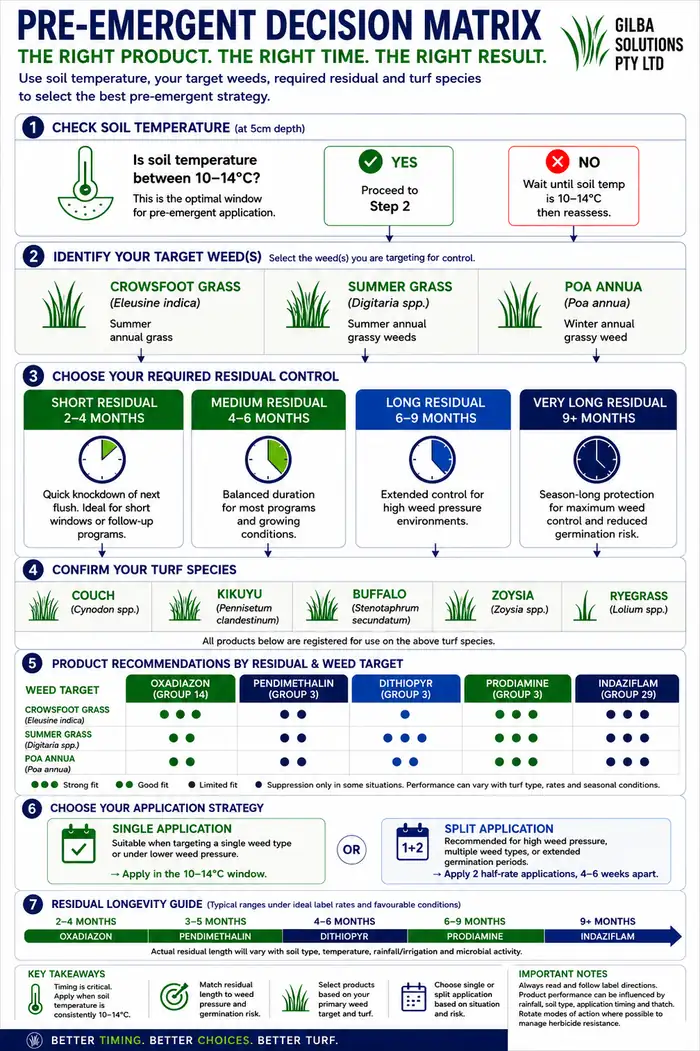
- Oxadiazon (Group 14, PPO inhibitor) is the broadest-spectrum option for crowsfoot grass (Petrovsky & Elmore 2025) and gives 2–4 months residual. It is the active in Echelon Duo granular.
- Pendimethalin (Group 3, dinitroaniline) gives 3–5 months residual and suits crowsfoot and summer grass programs on sand-based profiles where leaching risk needs managing. It is the active in Battalia 435.
- Dithiopyr is also in Group 3 so the same microtubule mode of action as pendimethalin and prodiamine). It has the useful extra of limited early post-emergent activity on crowsfoot at the 1–2 leaf stage, which is a small buffer if timing runs slightly late. Note: because it shares the dinitroaniline mode of action, dithiopyr is not a resistance-rotation partner for prodiamine or pendimethalin.
- Prodiamine (Group 3, same mode of action as pendimethalin) gives 6–9 months residual and suits high-pressure sites. US research has documented prodiamine resistance in annual bluegrass populations (Rutland et al. 2023; Heap 2025). So rotate modes of action, not just products.
- Indaziflam (Group 29, cellulose-biosynthesis inhibitor) gives the longest residual at 9+ months and is the standout for Poa annua control. It is also the most expensive and least forgiving on stressed turf. Note that indaziflam resistance in Poa annua has now been confirmed overseas, (Brosnan et al. 2020; Pritchard 2023, as cited in McCurdy 2026)so it still belongs in a rotation, not as a standalone crutch.
For high weed pressure sites or extended germination periods, a split application strategy (two half-rate applications 4–6 weeks apart) gives better season-long control than a single full-rate application. GAIP Hub tracks split application scheduling and flags when the second application window is due.
Resistance management
Herbicide resistance in annual grassy weeds is a growing issue in Australian turf. The microtubule-inhibitor group (Group 3 which includes prodiamine, pendimethalin and dithiopyr) dominates the pre-emergent market. Critically, all three share one mode of action, and Group 3 cross-resistance is documented: a population resistant to prodiamine is also resistant to pendimethalin and dithiopyr. Swapping between them is not rotation.
A genuine pre-emergent rotation moves between distinct modes of action: Group 3 (dinitroanilines) → Group 14 (oxadiazon) → Group 29 (indaziflam). If you are running the same sites year after year, rotating across these three is not optional. GAIP Hub logs mode-of-action history across seasons so rotation gaps are visible before they become resistance problems.
Practical summary
- Monitor soil temperature at 5cm depth at your site — not a regional average
- Target the consistent 10–14°C window, confirmed by soil temperature monitoring at your site
- Dense, vigorous turf suppresses crowsfoot germination by up to 90%, so the pre-emergent program works best on turf that is already healthy (Busey 2003/2004).
- Use HydroSight or equivalent for continuous site-specific data
- Use GAIP Hub to connect sensor data to your timing and product decisions
- Select product based on weed target, required residual and turf species — see the decision matrix
- Rotate modes of action across seasons
- For high-pressure sites, run a split application strategy
Further reading: Pre-emergent timing chart for 50+ Australian turf weeds | 7 reasons for pre-emergent failure | Split application strategy | Pests and Weeds | The problem with modern day turf agronomy in Australia |
What soil temperature should I apply pre-emergent herbicides in Australia?
Apply when soil temperature at 5cm depth is consistently between 10–14°C. This is the window where germination pressure is building for most common Australian turf weeds so confirm this by soil temperature monitoring at your site. Applying outside this window — either too early or too late — reduces the effectiveness of your barrier.
How do I measure soil temperature for pre-emergent timing?
For continuous monitoring, HydroSight and SoilScout sensors install permanently at root zone depth and provide real-time data via app or dashboard. For portable spot-checking, the Pogo, TDR 300, and TDR 350 give instant readings at any location. If using a portable probe, check every 3–4 days once you are in the right seasonal range — the window can open faster than expected.
Why does soil temperature matter more than calendar dates for pre-emergent timing?
Weed seeds respond to soil temperature, not the date. Each species has a threshold temperature below which germination stops. Crowsfoot grass requires consistent soil temperatures above 15–18°C with diurnal fluctuation before seeds will move (Nishimoto & McCarty 1997). Poa annua pre-emergent applications are most effective when soil temperatures are declining through 10°C in autumn (McCurdy 2026). A calendar date gives you the same answer every year regardless of conditions. Soil temperature gives you the right answer for this season.
Which pre-emergent herbicide is best for crowsfoot grass in Australia?
Oxadiazon (Group 14) is the broadest-spectrum option for crowsfoot (Eleusine indica), with a 2–4 months residual. Pendimethalin and prodiamine (both Group 3) also give good control with longer residuals (3–5 and 6–9 months). Because crowsfoot germinates 3–4 weeks later and warmer than summer grass, time the barrier to the crowsfoot window or use a longer-residual active.
Always confirm registration for your turf species and rotate modes of action (Group 3 → 14 → 29) across seasons.
What is the difference between a single and split pre-emergent application?
A single application applies the full label rate in one pass. A split application divides that into two half-rate applications 4–6 weeks apart. Split applications give better season-long control on high weed pressure sites or where germination periods are extended, and reduce the risk of a single timing error undermining the whole program. GAIP Hub tracks split application scheduling and flags when the second application is due.
How does GAIP Hub help with pre-emergent timing?
GAIP Hub integrates soil temperature data from compatible sensors including HydroSight and SoilScout, tracks soil temperature trends against species-specific germination thresholds, and generates timing recommendations based on actual site conditions. It also logs herbicide application history, residual windows, and mode of action rotation across seasons so you can manage your program systematically rather than from memory.
What is herbicide resistance and how do I manage it in my pre-emergent program?
Herbicide resistance develops when repeated use of the same mode of action selects for resistant weed biotypes. In Australian turf, the dinitroaniline group (Group D — prodiamine and pendimethalin) dominates pre-emergent use, and resistance in annual bluegrass populations has been documented.
Rotating to a genuinely different mode of action — Group 14 (oxadiazon) or Group 29 (indaziflam) — reduces selection pressure. Note that dithiopyr is not a rotation option away from prodiamine/pendimethalin: it is also Group 3.
GAIP Hub logs mode of action history so rotation gaps are visible before they become a problem.
References
- Brosnan, J.T., Breeden, G.K., Vargas, J.J. & Grier, L. (2012). PRE and POST control of annual bluegrass (Poa annua) with indaziflam. Weed Technology 26(3): 511–517. As cited in McCurdy (2026).
- Brosnan, J.T., Breeden, G.K., Vargas, J.J. & Grier, L. (2020). Confirmed indaziflam early post-emergence resistance in Poa annua. As cited in McCurdy (2026).
- Busey, P. (2003/2004). Managing crowsfoot: prevention is critical for goosegrass. Golf Course Management (GCSAA).
- Heap, I. (2025). International Herbicide-Resistant Weed Database. weedscience.org. Accessed June 2026.
- Kaminski J.E. & Dernoeden, P.H. (2007). Crop Science 47:775–779. DOI 10.2135/cropsci2006.03.0191
- McCurdy, J.D. (2026). Chemical control strategies for Poa annua in managed turfgrass systems. Crop, Forage & Turfgrass Management. https://doi.org/10.1002/cft2.70092
- Nishimoto, R.K. & McCarty, L.B. (1997). Fluctuating temperature and light influence seed germination of goosegrass (Eleusine indica). Weed Science 45(3): 426–429.
- Petrovsky, J. & Elmore, M.T. (2025). A guide to goosegrass control. USGA Green Section Record 63(4). https://www.usga.org/content/usga/home-page/articles/2025/a-guide-to-goosegrass-control.html
- Pritchard, C. (2023). Confirmed indaziflam pre-emergence resistance in Poa annua. As cited in McCurdy (2026).
- Rutland, C.A., Russell, S., Hall, N.D., Patel, J.D. & McElroy, J.S. (2023). Target-site resistance survey of Poa annua. Crop Science. https://doi.org/10.1002/csc2.21066
- Taylor, D.R., Prorock, M., Horvath, B.J. & Brosnan, J.T. (2021). Sci Reports 11. DOI 10.1038/s41598-021-98525-4
- Turner, F.A. & Van Acker, R.C. (2013). Can. J. Plant Sci. 93:503–509. DOI 10.4141/cjps2012-122

Principal agronomist, Gilba Solutions Pty Ltd
BSc Hons Soil Science (Newcastle). Former STRI agronomist. Author of Nutrition of Sports Turf in Australia (CSIRO/Landlinks Press) and The Definitive Guide to Australian Turfgrass Pesticide Management. 35+ years advising on sports turf, golf and stadia across Australia, NZ, UK and Europe.