

Turf Seed and Cultivars
Turf seed and cultivar selection is the most important decision in any sports turf or amenity surface project. It’s also the decision most often made without evidence. In the Australian market, seed has historically been sold on relationships and marketing rather than on independent trial data. When you get this wrong the cost of shows up in every fungicide application, every irrigation cycle and every season of wear that follows.
This pillar covers how to read independent trial data from NTEP (USA), the Turfgrass Seed list (EU) and BSPB (UK), what being on the A-LIST means, when to specify Variety Not Stated (VNS) versus named cultivars, and how to match species and cultivar to climate, usage and management budget. It covers cool-season species (perennial ryegrass, tall fescue, bentgrass, fine fescues) and warm-season species (couch, kikuyu, zoysia, paspalum), plus overseeding and species transition.
The independent angle matters. A turf manager who spends $1,000 per hectare on a fungicide for brown patch on a susceptible ryegrass should know that switching to a brown-patch-resistant variety costs a fraction of a cent more per kilogram of seed. That’s the most cost-effective fungicide program available. Evidence-based selection is what this pillar is built on.
Authored by Jerry Spencer, Principal Agronomist at Gilba Solutions. BSc (Hons) Soil Science, Newcastle Upon Tyne. Former STRI agronomist. Author of Nutrition of Sports Turf in Australia (CSIRO/Landlinks Press). 35+ years advising on golf, stadia and council sports turf across Australia, New Zealand, the UK and Europe. Independent supplier of A-LIST and NTEP top-performing varieties through partnerships with Landmark Seed and RAGT.
Published: 15 May 2026
What This Topic Covers
Independent Trial Data and Variety Selection
NTEP, A-LIST, BSPB and the European Turfgrass List provide the only credible evidence base for cultivar performance. You should ignore any marketing claims without trial data. This section covers how to read the trial reports, what the rating scales mean, and how to apply them to Australian conditions despite the trials being held elsewhere.
- NTEP trial database (USA, 19 sites)
- A-LIST low-input variety designation
- Mediterranean vs Continental turf type ryegrass
- BSPB annual turfgrass ratings (UK)
- Variety Not Stated (VNS) versus named cultivars
Cool-Season Species and Cultivars
Perennial ryegrass, tall fescue, bentgrass and fine fescues. Modern genetics from US and European breeding programs significantly outperform older varieties on wear tolerance, disease resistance and lower water use. This section covers species selection and key cultivar comparisons.
- Improvements in perennial ryegrass cultivars
- Turf-type tall fescue selection
- Creeping bentgrass cultivars for greens
- Fine fescue selection for low-input and shade
Warm-Season Species and Cultivars
Couch (bermudagrass), kikuyu, zoysia and seashore paspalum. Vegetative and seeded options. Couch dominates Australian sports turf. Newer varieties include Tahoma 31 and TifTuf, and show measurable advantages on water use and recovery rate over older Wintergreen and Santa Ana.
- Kikuyu management and selection
- Couch (bermudagrass) cultivar selection
- Zoysia matrella and japonica
- Seashore paspalum for saline conditions
Overseeding and Species Transition
Cool-season overseeding of dormant warm-season turf maintains colour, traction and recovery through winter dormancy. Timing, species choice, seed rate and transition timing determine whether the program protects or damages the underlying warm-season base.
- Overseeding and transition timing
- Couch oversowing trial results (Tahoma 31)
- Annual versus perennial ryegrass for overseeding
- Pre-emergent timing and overseeding compatibility
Seed Quality and Specification
Seed certificates list variety, purity, production date, germination percentage and weed seed content. Reading this label is the single fastest way to filter premium seed from low-grade product. Specification for tender documents and commercial procurement.
- Sports turf seed range
- Reading the seed certificate
- Coated versus uncoated seed
Establishment and Performance Drivers
The cultivar is necessary but not sufficient. Soil preparation, irrigation, nutrition and weed management at establishment determine whether the genetic potential is realised. Linked to the broader agronomic context where soil and water management determine outcomes.
What is NTEP and how should turf managers use the data?
NTEP (the National Turfgrass Evaluation Program) is the independent trial network that evaluates turfgrass cultivars across around 19 sites in the USA. It is the most rigorous and widely used source of comparative cultivar data in the world. NTEP tests assess turf quality, colour, density, disease resistance, drought and wear tolerance and water use. It does this with the use of a visual rating scale from 1 to 9 where 9 is best. Data is published for perennial ryegrass, tall fescue, Kentucky bluegrass, bentgrass, couch and zoysia.
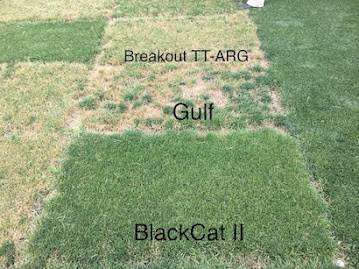
Turf managers should use NTEP data to filter varieties before they consider the price or any marketing claims. A variety with consistent top-quartile NTEP performance across multiple sites is the only credible evidence that genetic potential exists. Local performance still depends on how you manage your turf, but a poor NTEP variety will not perform anywhere.

Side-by-side cultivar plots showing visible performance differences. Independent trial data quantifies what the eye sees.
Reading NTEP reports requires three steps. First, identify the trait that matters to you. This could be turf quality, brown patch resistance for ryegrass in humid climates, drought tolerance for low-input sites. Second, look at multi-site means rather than single-site results, since one site is a snapshot and the multi-site mean is the trend. Third, check the year of trial. Turf breeding moves fast, and a variety that was in the top 10% in 2015 may be mid-pack against 2024 entries.
Australian relevance is a fair question. NTEP sites are not in Australia, so the trials differ in soil, climate and pathogen pressure. However, the relative ranking (variety A versus variety B) is generally consistent across environments, even when the absolute scores differ. Australian-specific trial data is limited, which makes NTEP the best available proxy.
What does A-LIST mean and why does it matter for sustainable turf?
A-LIST (the Alliance for Low Input Sustainable Turf) is a US-based independent program that designates turfgrass cultivars meeting low-input performance standards. Varieties earn A-LIST approval through a multi-stage process: breeders submit candidates, the candidates are grown and evaluated by independent cooperators including NTEP, and a committee reviews performance under reduced inputs (lower water, lower fertiliser, lower fungicide). Only varieties that show top-quartile performance under these conditions earn the designation. A-LIST currently covers perennial ryegrass, tall fescue, Kentucky bluegrass, fine fescues and bentgrass.
For Australian turf managers, A-LIST is a useful filter because it identifies varieties that perform well under stress, which is the reality for most Australian sports turf, where water restrictions and fertiliser budgets are tightening.
The economic logic is simple. Fungicide programs on perennial ryegrass can cost $1,000/Ha per application, with multiple applications per season. A brown patch-resistant ryegrass variety might cost an additional $0.30 per kilogram of seed, which spread across an establishment rate of 300 kg/ha works out to $90 per hectare for a multi-year benefit. The variety choice is the cheapest fungicide program available.
A-LIST varieties available in Australia include Intense PRG (perennial ryegrass, top turf quality with disease resistance), and several tall fescue and bentgrass entries. Specification documents for council tenders and stadium contracts should list A-LIST status as a procurement criterion alongside NTEP performance.
How do you select the right perennial ryegrass cultivar?
Perennial ryegrass cultivar choice is driven by four traits in order of priority. These are disease resistance, wear tolerance, turf quality and colour. For Australian sports turf in humid coastal climates, brown patch resistance is the highest-value trait because this disease causes substantial damage and the fungicide cost to manage it.
NTEP brown patch ratings should be the first point of call. Modern varieties include Intense PRG, and Slugger 3GL and the top entries in the 2020-2024 NTEP cycles tend to outperform older varieties like Caravelle on disease resistance. This translates to far less fungicide use in a season. Wear tolerance matters more on sports fields than golf greens; turf quality and colour matter more on television-broadcast venues.
The genetic background matters. Most modern perennial ryegrass cultivars are bred in the USA or Europe, and the US germplasm tends to consistently outperform NZ-bred varieties in independent NZ ryegrass trials despite marketing claims to the contrary. This is documented in successive NZ trial cycles and reflects the much larger US breeding pipeline.
Avoid using Variety Not Stated (VNS) seed on all sports turf. VNS means the seed has not been registered as a specific variety, which means there is no performance data, no consistency between batches and no accountability. VNS appears in cheap blends as “professional sports mix” or similar. Reading the seed certificate is the protection.
What is the best couch cultivar for Australian sports fields?
Couch cultivar selection for sports fields in Australia depends on climate zone, water availability and their usage. Tahoma 31 has become one of the strongest all-round performers for cool-to-temperate Australian conditions, with NTEP data showing good cold tolerance, early spring green-up and recovery rate in comparison to Wintergreen and Santa Ana.
TifTuf is the leading drought-tolerance variety, with water-use efficiency seen in University of Georgia trials. Wintergreen remains widely used because of historical availability and lower cost, but the genetic gap to modern varieties is now substantial. For stadium turf where television colour and recovery from event traffic matter Agridark or Tahoma 31 are the defensible specifications. For low maintenance council sports fields under budget constraints, Wintergreen or hybrid blends remain workable but represent a clear drop off in performance.
Seed versus vegetative establishment is a real choice. Most premium couch varieties are sterile hybrids that must be established vegetatively (sprigs, stolons or sod). Common couch and a small number of seeded hybrids can be sown from seed at 5 to 10 g/m². Vegetative establishment is faster to produce a mature playing surface (8 to 12 weeks for Wintergreen) but costs more upfront. Seeded establishment is cheaper but takes longer and offers fewer variety options.
Climate zoning matters. North of Brisbane, common couch and TifTuf perform reliably. Sydney to Melbourne, Tahoma 31 outperforms on cold tolerance. Tasmania and the alpine regions sit at the cool limit of couch viability and this is where you may need to consider tall fescue alternatives instead.
When should warm-season turf be overseeded with ryegrass?
Overseed warm-season turf when the night-time soil temperatures drop to around 12°C. In southern Australia this tends to be from mid-April to early May. The aim is to establish the cool-season grass before the warm-season grass becomes fully dormant which avoids overseeding so early that the still-active warm-season turf competes with the ryegrass. Common timing errors are overseeding too early (warm-season grass competes, ryegrass establishment fails, spring transition is delayed) or too late (cold soil suppresses seed germination, the surface is bare through winter weeks). Using a 12°C night-time soil temperature is more reliable than the use of calendar dates because seasonal variations between years and sites is substantial. A soil thermometer at 50 mm depth gives the answer in two readings.

Successful overseeding shows seedlings with good seed-to-soil contact.
Species choice matters. Annual ryegrass establishes faster and costs less but has poor wear tolerance and is susceptible to disease. It tends to die out in the spring, and works for sites where winter use is moderate. Perennial ryegrass (turf type) offers much better wear tolerance, disease resistance and turf quality, but spring transition back to warm-season turf can be a challenge without active management. For high-use stadia and racecourses, turf-type perennial ryegrass at 300 to 400 kg/ha is standard.
Pre-overseeding management protects the warm-season base. Avoid aggressive scarification (removes 80 to 85% of stolon growing points, and weakens spring recovery). Use a PGR such as trinexapac-ethyl like Amigo 120 or 175 on the warm-season turf before you overseed to slow growth and reduce competition with the germinating ryegrass. Check pre-emergent herbicide restrictions before overseeding. Some pre-emergents prevent ryegrass establishment for several months after application.
How do you read a turf seed certificate?
A turf seed certificate is the legal label on every bag of seed and lists the variety, purity percentage, germination percentage, production year, weed seed content and inert matter content. Reading the certificate before purchase filters premium seed from low-grade product. Look for a named variety (not “VNS” or “Variety Not Stated”), purity above 98%, germination above 85% (above 90% for premium), production year within the previous 12 to 18 months, weed seed content below 0.5%, and no listed weeds.
Certificates also list “other crop seed” which should be zero or near-zero for turf applications. Annual ryegrass listed as “other crop” in a perennial ryegrass bag is a contamination flag. Coated seed will show inert matter at 30 to 50% which is the coating mass; this is normal for coated kikuyu and some bentgrass.
The certificate protects against three problems: stale seed with poor germination, variety substitution (a cheaper variety substituted for the labelled one), and contamination with weed seeds or other crops. Reputable suppliers issue certificates as standard. Suppliers who cannot produce a current certificate are not credible.
Pricing benchmarks help calibrate. Commercial annual ryegrass is approximately $5/kg, perennial ryegrass $7 to $10/kg, uncoated kikuyu around $80/kg, bentgrass $40 to $80/kg depending on variety. Seed priced substantially below these benchmarks is either old stock, VNS or contaminated.
Are seed blends better than straight varieties for sports turf?
Straight varieties (a single named cultivar) are generally better for professional sports turf, while blends (multiple cultivars of the same species) and mixtures (multiple species) have their place in certain applications. The argument for straights is that you get the full benefit of the genetics with consistent appearance, growth habit, disease resistance and management response. The argument for blends is that you are hedging your bets against unpredictable conditions. If one cultivar fails, another in the blend compensates. For sports fields and golf surfaces where playability and consistency dominate, straight A-LIST or top-NTEP varieties are defensible specifications. For council parks and amenity surfaces where budget and resilience to neglect matter more, blends of three to five compatible cultivars provide genetic diversity and risk reduction.
Annual ryegrass cultivar comparison plot.
Mixes across species (ryegrass plus fescue plus bluegrass) are OK for some shade and low-input situations but should not be specified for high-performance sports turf because the components have different growth habits, mowing height tolerances and visual appearance, which produces an inconsistent surface.
The market problem is that many blends are sold as premium product but contain VNS components, annual ryegrass as a cheap filler, or are contaminated with weed grasses. Reading the seed certificate, checking each component is named and reputable, and verifying the proportion of premium variety to filler is the only way to manage this. A blend that does not list every component variety by name is not a premium blend.
How does cultivar selection affect long-term fungicide and water costs?
Cultivar selection affects fungicide and water costs more than any other single management decision. A perennial ryegrass cultivar with 1 to 2 NTEP rating points better brown patch resistance can reduce fungicide use by 30 to 50% over a typical Australian summer. This equates to $2,000 to $5,000/Ha per year on a stadium or golf course. A drought-tolerant couch variety such as TifTuf can reduce irrigation requirement by 20 to 38% versus older varieties under the same management regime. This equates to substantial water cost savings and improved resilience under water restrictions. These differences compound across the 15 to 20 year lifecycle of a sports surface. The seed cost premium for top-tier varieties is typically $100 to $500 per hectare at establishment. You easily get this back via lower input costs within the first one to two seasons.
The decision logic is asymmetric. The downside of choosing a premium variety is a modest one-time establishment cost premium. The downside of choosing a low-grade variety is permanent. Each year of the surface’s life carries higher input costs, more disease pressure, more frequent renovation, and a greater risk of complete failure under stress events. The asymmetry strongly favours specifying premium varieties even when your budget is tight.
For tender specification and council procurement, the economic case for premium varieties should be presented as total cost of ownership over the surface lifecycle, not just establishment cost. This typically results in approval of premium specifications.
Key Considerations Across Seed and Cultivar Selection
Trial Data and Evidence
- NTEP rating across 19 US trial sites for the species
- On the A-LIST for low-input performance
- BSPB ratings for UK trials
- Turfgrass List (EU) data for Europe
- Brown patch, dollar spot and grey leaf spot disease ratings
- Wear tolerance and recovery rating
- Drought tolerance and water-use
- Cold tolerance and spring green-up timing
Species and Cultivar Selection
- Cool-season versus warm-season match to climate zone
- Usage (stadium or council field)
- Height of cut and mowing frequency
- Endophyte status (insect resistance)
- Shade tolerance and microclimate suitability
- Salt tolerance for coastal or recycled-water sites
- Seed versus vegetative options
- Genetics (US, EU, NZ, Australian breeding programs)
- Intense Perennial Ryegrass
Seed Quality
- Named variety not Variety Not Stated (VNS)
- Purity above 98% (premium above 99%)
- Germination above 85% (premium above 90%)
- Production year within 12 to 18 months
- Weed seed content below 0.5%, no weeds
- Other crop seed near zero for turf use
- Coated versus uncoated seed and coating make up
- Seed certificates from reputable suppliers
Establishment and Management Drivers
- Soil temperature thresholds for germination (species-specific)
- Seeding rate and method (drop, broadcast, slit-seed)
- Irrigation requirement during germination and establishment
- Pre-emergent herbicide compatibility and overseeding restrictions
- Fertiliser strategy at establishment
- First-mow timing and height
- Wear management during establishment
- Total cost of ownership over surface lifetime
References
Alliance for Low Input Sustainable Turf (A-LIST). Approved variety lists and trial protocols.
Beard, J.B. (1973). Turfgrass: Science and Culture.
British Society of Plant Breeders (BSPB). Turfgrass Seed Booklet (annual). BSPB.
Christians, N.E., Patton, A.J. and Law, Q.D. (2017). Fundamentals of Turfgrass Management, 5th Edition.
European Turfgrass Society (ETS). The Turfgrass List.
Hanna, W.W., Schwartz, B.M. and Hein, B.R. (2015). TifTuf bermudagrass: a new warm-season turfgrass with superior drought tolerance. HortScience, 50(9): S238.
Karcher, D.E., Patton, A.J., Richardson, M.D. and Steinke, K. (2017). Comparison of NTEP and quantitative measures of turfgrass quality. Crop Science, 57(5): 2796-2806.
Morris, K.N. and Shearman, R.C. (2008). NTEP turfgrass evaluation guidelines. National Turfgrass Evaluation Program.
National Turfgrass Evaluation Program (NTEP). Annual Progress Reports for perennial ryegrass, tall fescue, bentgrass, bermudagrass, zoysia, Kentucky bluegrass and fine fescue.
Plant Variety Rights Office (PVRO) Australia. Australian turfgrass cultivar registrations.
Schwartz, B.M., Hanna, W.W., Baxter, L.L., Raymer, P.L., Waltz, F.C., Kowalewski, A.R., Chandra, A., Genovesi, A.D., Wherley, B.G., Miller, G.L., Milla-Lewis, S.R., Reynolds, W.C., Wu, Y., Martin, D.L., Moss, J.Q., Kenworthy, K.E., Unruh, J.B., Kenna, M.P. and Williams, D.W. (2018). ‘DT-1’, a drought-tolerant triploid hybrid bermudagrass. HortScience, 53(11): 1711-1714.
Spencer, J. (2007). Nutrition of Sports Turf in Australia. CSIRO Publishing / Landlinks Press, Melbourne.
Sports Turf Research Institute (STRI). Turfgrass Seed Booklet 2025. STRI, Bingley, UK.
Stier, J.C., Horgan, B.P. and Bonos, S.A. (eds) (2013). Turfgrass: Biology, Use, and Management. Agronomy Monograph 56.
Turgeon, A.J. (2011). Turfgrass Management, 9th Edition.
Wu, Y., Martin, D.L., Moss, J.Q., Anderson, J.A. and Goad, C.L. (2017). Cold hardiness and recovery of hybrid bermudagrasses for northern transition-zone areas. Agronomy Journal, 109(4): 1356-1365.

Principal agronomist, Gilba Solutions Pty Ltd
BSc Hons Soil Science (Newcastle). Former STRI agronomist. Author of Nutrition of Sports Turf in Australia (CSIRO/Landlinks Press) and The Definitive Guide to Australian Turfgrass Pesticide Management. 35+ years advising on sports turf, golf and stadia across Australia, NZ, UK and Europe.