
This is a guide to the sulfonylurea (SU) herbicides registered for turf in Australia. It lists the turf-registered products we found by trade name and active ingredient, shows which turf grasses each one can go on, and gives the label rates, watering rules and overseeding intervals. All three differ from product to product.
We checked product details against APVMA labels on 17 October 2026. Labels change, so read the label in your hands before you spray. Labels and safety data sheets for most turf chemicals are in our turf chemical section, and our free turf pesticide manual covers the wider range.
What are sulfonylurea herbicides?
Sulfonylureas are a chemical family of selective herbicides in Group 2 (formerly Group B). Turf managers use them because they remove grass weeds such as winter grass and ryegrass, and many broadleaf weeds, from turf at very low rates of active ingredient.
Group 2 groups herbicides by mode of action, not chemistry. Every Group 2 herbicide blocks the enzyme acetolactate synthase (ALS, also called AHAS). Sulfonylureas are the largest family in the group, but not the only one. Nominee (bispyribac-sodium) is a Group 2 turf herbicide from a different chemical family, which is why it has its own section below.
How they work
ALS is the first enzyme in the pathway plants use to make three amino acids: valine, leucine and isoleucine. Once a sulfonylurea blocks it, cell division in the growing points stops within hours and the weed stops growing. Visible symptoms take one to three weeks and the weed dies slowly. Animals do not have the ALS enzyme, which is the main reason this group has low toxicity to mammals.
Selectivity comes from metabolism. A tolerant turf grass breaks the herbicide down quickly into inactive compounds. A susceptible weed cannot, so the herbicide keeps blocking ALS. Because the margin depends on how fast each species breaks the product down, tolerance differs from product to product and grass to grass. Couch tolerates almost all of them. Kikuyu and buffalo tolerate only a few. The tolerance table below shows which.
Tips for using sulfonylurea herbicides
Don't carry the rules for one product over to another, because the labels disagree. Coliseum needs two light irrigations within 12 to 24 hours. Tribute needs the opposite: no irrigation straight after spraying. Destiny and Duke need four rain-free hours. Coliseum, ProSedge, Destiny and Duke must go out with a non-ionic surfactant, while the Tribute and Nominee labels list none, so do not add one without the supplier's advice.
Organophosphate insecticides are a similar case. The Tribute and ProSedge labels say not to apply an organophosphate within seven days before or three days after the herbicide. Coliseum sets a seven-day gap from organophosphate insecticides and fungicides. The Negate and Recondo labels have no such restriction. Seven days is a rule for some products, not for the whole group.
Avoid spray drift. Sulfonylureas are active on non-target plants at very low doses, and several labels carry downwind buffer zones to aquatic areas and native vegetation. Our article on factors that affect herbicide performance covers spray conditions in more detail.
Tank mixing and water pH
Sulfonylureas break down faster in acidic spray water. The Coliseum label says not to add acidifying agents or surfactants such as LI 700, and the Destiny label says to buffer acidic water and not to mix with acid-forming compounds. Do not mix sulfonylureas with acidifying fertilisers. Several labels list no tank-mix partners at all. Tribute and ProSedge specifically say not to tank mix with organophosphates. If the label doesn't name a partner, don't assume one is safe.
Getting the best results
Sulfonylureas dissolve far more readily as pH rises. Foramsulfuron, the active in Tribute, dissolves at 0.04 g/L at pH 5 and 3.3 g/L at pH 7, about 80 times more. Metsulfuron-methyl goes from 550 mg/L at pH 5 to 2,790 mg/L at pH 7, about five times more. Sprayed product also dissolves in dew, and feet and mowers then carry it into cool-season turf. Tribute's label deals with this directly: if dew is present on the two mornings after spraying, irrigate lightly (3 to 5 mm) before the area is trafficked.
When you use a sulfonylurea to transition overseeded ryegrass out of couch, you want the ryegrass to die quickly while the couch is growing strongly enough to fill the gaps. As a guide, we wait until average air temperatures are 18°C or higher, or soil temperature at 150 mm is 21°C or higher, and the forecast holds for the following week.
Spray weeds that are actively growing. Weeds under drought, heat or cold stress take up less herbicide and recover more often. An extra adjuvant won't fix this, and one the label doesn't allow raises the risk of turf injury. Use only the adjuvants the label names. Our guide to spray adjuvants explains the types.
Sulfonylureas are not pre-emergent herbicides, but they leave enough residue in the soil to harm new seedlings. That is why most labels set an interval before you can overseed. Residues last longer in alkaline soils, so allow extra time on high-pH sites.
Resistance and other drawbacks
The biggest drawback is resistance. Every product on this page has the same mode of action, so a weed that is resistant to one is often resistant to others in the group. This is already a problem in Australian turf. A University of Adelaide survey of winter grass (Poa annua) from golf courses in Victoria, New South Wales and South Australia found that 97% of 31 populations were resistant to post-emergent Group 2 herbicides.
In glasshouse tests at the field rate, most populations survived rimsulfuron (97%), bispyribac (97%) and iodosulfuron (90%), and about half survived foramsulfuron (52%). The populations came from courses with suspected resistance, so these figures describe problem sites rather than all winter grass. Even so, Group 2 failure on Australian golf courses is common enough to plan for. Resistance to the group is also well documented in other weeds, including sulfonylurea-resistant common chickweed in the UK.
The second drawback is soil residue, which delays overseeding with sports turf seed. The product notes below give each overseeding interval.
Signs of sulfonylurea damage
Growth stops first. A few days later the leaves of affected plants wilt, crinkle and turn yellow. Leaf margins and stems often turn red or purple, and new growth is stunted and deformed. Death takes several weeks.

Sulfonylurea herbicides registered for turf in Australia
The first table below lists every Group 2 product we found registered for turf use in Australia, by active ingredient and trade name, with its APVMA approval number. Some products sell under a different name from the one on the APVMA register; where that happens we give both names. The second table shows which turf grasses each label allows.
Trade names and APVMA numbers
| Active ingredient | Trade name (APVMA no.) | Supplier | Main use in turf |
|---|---|---|---|
| Foramsulfuron 22.5 g/L | Tribute Selective Turf Herbicide (63240) | Envu | Winter grass, ryegrass, crowsfoot and goose grass in couch and zoysia |
| Rimsulfuron 250 g/kg | Coliseum (61358) | Turf Culture | Winter grass and ryegrass in couch |
| Rimsulfuron 167 g/kg + metsulfuron-methyl 200 g/kg | Quali-Pro Negate (88290) | ADAMA | Winter grass, ryegrass, onion grass and broadleaf weeds in couch, zoysia and Qld blue couch |
| Halosulfuron-methyl 750 g/kg | ProForce ProSedge 750 DF (87820, registered as Farmalinx Brawler); Halo-Force 750 WG (88911); Apparent Halosulfuron 750 WG (67730) | Indigo; Indigo; Apparent | Nutgrass and Mullumbimby couch in most turf species |
| Trifloxysulfuron-sodium 100 g/kg or 100 g/L | ProForce Recondo 100 WG (88827, registered as Farmalinx Reign); Monument Liquid (62571) | Indigo; Syngenta | Sedges, winter grass, ryegrass and broadleaf weeds in couch, zoysia and Qld blue couch |
| Iodosulfuron-methyl-sodium 100 g/kg | Destiny (56801); ProForce Duke 100 WG (88829) | Envu; Indigo | Broadleaf weeds and ryegrass in kikuyu, buffalo and couch |
| Bispyribac-sodium 100 g/L (Group 2, not a sulfonylurea) | Nominee (63233) | Sumitomo | Winter grass in bentgrass greens and in ryegrass, tall fescue and couch |
Turf tolerance by product
| Active (trade name) | Couch, common and hybrid | Qld blue couch | Zoysia | Kikuyu | Buffalo | Bentgrass | Perennial ryegrass | Tall fescue |
|---|---|---|---|---|---|---|---|---|
| Foramsulfuron (Tribute) | ✓ | ✗ | ✓ | ✗ | ✗ | ✗ | ✗ | ✗ |
| Rimsulfuron (Coliseum) | ✓ | ? | ? | ✗ | ? | ✗ | ✗ | ✗ |
| Rimsulfuron + metsulfuron (Negate) | ✓ | ✓ | ✓ | ? | ? | ? | ✗ | ? |
| Halosulfuron (ProSedge, Halo-Force) | ✓ | ✓ | ? | ✓ | ✓ | ✓ | ✓ | ✓ |
| Trifloxysulfuron (Recondo, Monument) | ✓ | ✓ | ✓ | ✗ | ✗ | ✗ | ✗ | ✗ |
| Iodosulfuron (Destiny, Duke) | ✓ | ✗ | ✗ | ✓ | ✓ | ✗ | ✗ | ✗ |
| Bispyribac (Nominee) | ✓ | ✓ | ? | ? | ? | ✓ | ✓ | ✓ |
Product notes
These are the main label directions for each product. Read the full label before you spray.
Tribute (22.5 g/L foramsulfuron)
Registration: Tribute Selective Turf Herbicide, Envu, APVMA 63240. In the US, Envu sells foramsulfuron for turf as Revolver.
Use on: common and hybrid couch, and zoysia. Do not use it on Queensland blue couch, or on turf that is stressed or poorly established.
Weeds and rates: winter grass and ryegrass at 1.5 L/ha (a repeat application may be needed); crowsfoot grass (Eleusine indica) at 2 L/ha, two or three applications 14 days apart; goose grass (Eleusine tristachya) at 2 L/ha; paspalum at 2 L/ha, once or twice 14 days apart, following MSMA or DSMA. It suppresses kikuyu at 2 L/ha applied three times 14 days apart. For spot spraying, use 8 to 15 mL per litre. The label notes that adding Destiny at 25 g/ha improves ryegrass control.
Watering and traffic: do not irrigate straight after application, and let the spray dry on the leaf before anyone walks or drives on it. If dew is present on the next two mornings, irrigate lightly (3 to 5 mm) before traffic, so feet and mowers don't carry treated dew into cool-season turf. Do not apply irrigation that causes run-off for seven days. Do not spray if heavy rain is forecast within 48 hours. As a precaution, we also leave a buffer of about 3 m from creeping bentgrass.
Additives and mixing: the label lists no surfactant, so do not add one without the supplier's advice. Do not tank mix with organophosphate insecticides, or apply one within seven days before or three days after Tribute.
Overseeding and sprigging: do not apply within one week before overseeding couch with cool-season grass, or within two weeks of sprigging couch. Newer couch cultivars that cope better with overseeding, such as those covered in our oversowing seed guide, reduce the need for a chemical transition aid.

ProSedge and other halosulfuron products (750 g/kg halosulfuron-methyl)
Registration: ProForce ProSedge 750 DF is on the APVMA register as Farmalinx Brawler (87820). Halo-Force 750 WG (88911) is a second Indigo product with the same active. Apparent Halosulfuron 750 WG (67730) carries the same turf directions. Sedgehammer (64928) and several more generic halosulfuron 750 WG products are also registered, but we have not checked their turf directions, so check the label before you buy one. ProSedge is not the only sulfonylurea that controls sedges: trifloxysulfuron (Recondo and Monument) also controls nutgrass and Mullumbimby couch, but on far fewer turf species.
Use on: established bentgrass, buffalo, carpet grass, common and hybrid couch, Durban grass, kikuyu, perennial ryegrass, Queensland blue couch and tall fescue. This is the widest turf range of any product on this page. The label still advises caution on new or stressed turf.
Weeds and rates: nutgrass (Cyperus rotundus) and Mullumbimby couch (Cyperus brevifolius) at 65 to 130 g/ha in at least 80 L of water per hectare. Spray nutgrass when leaves are at least 5 cm long and Mullumbimby couch at 2 cm or more. Repeat when there is enough new growth to take up the spray. Do not exceed 200 g/ha per season.
Additives: the label requires a non-ionic surfactant. For ProSedge, use a 1000 g/L product at 120 mL/100 L; for Halo-Force, use a 600 g/L product at 200 mL/100 L.
Rain and mowing: rain within two hours of application reduces control, and the label says not to apply if heavy rain is expected within 48 hours. Delay mowing for two days after spraying.
Mixing: do not tank mix with organophosphate insecticides, or apply one within seven days before or three days after.
Overseeding: the label sets no overseeding interval.
Coliseum (250 g/kg rimsulfuron)
Registration: Coliseum, Turf Culture, APVMA 61358. Rimsulfuron is also sold in the US for turf as TranXit, which is a separate product with its own label and a wider weed list.
Use on: common and hybrid couch, on commercial turf and home lawns. Do not use it where winter grass, ryegrass, fescue, kikuyu or bentgrass are wanted, on golf greens, or on newly seeded or turfed areas until the roots are more than 5 cm deep.
Weeds and rates: on commercial turf, winter grass at 75 to 100 g/ha and ryegrass at 120 g/ha. On home lawns, 1 g per 100 m² for winter grass and 1.2 g per 100 m² for ryegrass. Make no more than two applications per season, at least six to eight weeks apart (eight weeks on home lawns).
Watering: rain within three hours reduces control. Apply two light irrigations of about 3 mm, one hour apart, within 12 to 24 hours of spraying. Avoid run-off, especially where water drains onto cool-season turf.
Additives: on commercial turf, always add a non-buffering 1000 g/L non-ionic surfactant at 250 mL/100 L. Do not add acidifying agents or surfactants such as LI 700.
Mixing: leave seven days between Coliseum and organophosphate insecticides or fungicides.
Overseeding: allow at least 10 days before overseeding with cool-season grasses.
Recondo and Monument (trifloxysulfuron-sodium)
Registration: two trifloxysulfuron products are registered for turf in Australia. ProForce Recondo 100 WG (100 g/kg) is on the APVMA register as Farmalinx Reign (88827). Monument Liquid (Syngenta, 62571) is a 100 g/L liquid with the same use pattern, dosed in mL/ha. The US product Monument 75WG is not registered here, and figures quoted from its US label do not apply in Australia.
Use on: established common couch, hybrid couch, Durban grass, Queensland blue couch and zoysia. Do not use it on bentgrass, buffalo, centipede grass, fescue, kikuyu, paspalum, ryegrass or any turf not listed. Do not use it on putting greens or within 10 m upwind of bentgrass greens, on stressed turf, or in home gardens. On young turf, wait until there is 100% ground cover and the roots are more than 5 cm deep.
Weeds and rates (Recondo): burr medic at 115 g/ha; Mullumbimby couch and nutgrass at 150 g/ha; bindii, ryegrass and winter grass at 225 g/ha; catsear, chickweed, clover, cotula, creeping oxalis, curled dock and milk thistle at 300 g/ha. It suppresses kikuyu with two applications 21 to 28 days apart, and suppresses bahia grass at 75 g/ha with trinexapac-ethyl (no more than two consecutive applications per season). Repeat applications go on four to six weeks apart. The label sets no annual maximum.
Application: use 400 to 800 L of water per hectare. The label strongly recommends a non-ionic surfactant. Recondo is rainfast after three hours. For boom spraying (coarse droplets, boom 0.5 m or lower), the label sets downwind buffer zones of 20 m to natural aquatic areas and 60 m to natural vegetation.
Overseeding and replanting: allow at least six weeks before overseeding with cool-season grasses, and 12 months before planting any species not on the label.
Duke and Destiny (100 g/kg iodosulfuron-methyl-sodium)
Registration: ProForce Duke 100 WG (Indigo) carries APVMA approval 88829, the registration also used for Farmalinx Winx and Lawn Solutions Ferris. Destiny (Envu, 56801) contains the same active at the same strength. The directions below are common to both labels.
Use on: kikuyu, buffalo, and common and hybrid couch. Do not use it on Queensland blue couch, or on golf or bowling greens. Iodosulfuron and halosulfuron are the only sulfonylureas on this page labelled for kikuyu and buffalo. Indigo's product sheet for Duke adds that it should not be re-applied to buffalo within 12 months, and some newer buffalo cultivars have not been safety tested, so try a small area first.
Weeds and rates: ryegrass at 150 g/ha, and winter grass suppression at 150 g/ha (both labels list winter grass as suppressed, not controlled); bindii, black thistle, catsear, cotula, cudweed, Guildford grass, medic, mouse-ear chickweed, oxalis and white clover at 100 g/ha; false onion weed at 25 g/ha. It suppresses bahia grass and reduces its seed heads at 50 g/ha, applied two or three times four weeks apart after mowing.
Application: always add a non-ionic surfactant or Hasten at the rate on that product's label, and use 200 to 500 L of water per hectare. Do not spray if rain is expected within four hours or heavy rain is forecast. Do not apply through irrigation equipment. Buffer acidic spray water and do not mix with acid-forming compounds. Spraying very dry sandy soil that is then soaked by heavy rain can damage the turf.
Seasonal limit: do not make more than one application of any Group 2 herbicide in a season, except when treating bahia grass. This restraint applies to your whole programme, so a Duke or Destiny spray rules out a second Group 2 product on the same area that season.
Overseeding and replanting: allow at least six weeks before overseeding with cool-season grasses such as Intense perennial ryegrass, and 12 months before planting anything other than the listed turf grasses.
Negate (167 g/kg rimsulfuron + 200 g/kg metsulfuron-methyl)
Registration: Quali-Pro Negate, ADAMA, APVMA 88290. It combines two sulfonylureas in one granule, which widens the weed range but does not add a second mode of action.
Use on: common couch, hybrid couch, zoysia and Queensland blue couch. Test a small area first on new couch cultivars.
Weeds and rates: one rate, 110 g/ha in 200 to 500 L of water, controls winter grass, ryegrass, onion grass, bindii, caustic weed, white clover, cobblers peg, creeping indigo, creeping oxalis, plantain and tridax daisy.
Application: Negate is rainfast after four hours. Do not apply through irrigation equipment. On areas where children play, do not apply more than five times a year. Weeds take up Negate through the leaves, and it works faster in warm, moist conditions than in cold, dry weather.
Overseeding: the label gives no overseeding interval. Metsulfuron persists in soil, especially at high pH, so test-seed a small area before overseeding treated turf.
Nominee (100 g/L bispyribac-sodium): Group 2, but not a sulfonylurea
Registration: Nominee, Sumitomo Chemical Australia, APVMA 63233. Bispyribac-sodium belongs to a different chemical family (the pyrimidinyl benzoates) from the sulfonylureas, but it blocks the same enzyme and is in Group 2. Winter grass that is resistant to sulfonylureas is often resistant to Nominee too, so it is not a reliable rotation partner for them.
Use on: creeping bentgrass golf greens, and sports and recreational turf of tall fescue, perennial ryegrass and couch (including Queensland blue couch). It is the only product on this page that removes winter grass from cool-season turf. It does not control ryegrass.
Weeds and rates: winter grass (Poa annua), with seed head suppression on plants that survive, at 250 mL to 1 L/ha. On greens: 250 mL/ha as two applications 7 to 14 days apart; 500 mL/ha as two applications 7 to 21 days apart; or 750 mL to 1 L/ha as two applications 14 to 21 days apart. On sports turf: 250 mL to 1 L/ha as two applications 7 to 21 days apart. Apply no more than twice a year, and not in autumn or winter.
Application: the label lists no adjuvant, and an earlier version of it warned that adding a surfactant or crop oil causes unacceptable yellowing of tolerant turf, so do not add one. Do not spray turf stressed by heat, drought, poor nutrition or traffic. Do not spray if rain is expected within 12 hours, and do not irrigate or mow for 24 hours afterwards. Nominee is slow acting. Winter grass dies over several weeks, and heavy infestations leave bare patches that may need resowing.
Seeding: do not sow bentgrass, perennial ryegrass, tall fescue or couch for 42 days after application, and do not apply Nominee within 42 days of sowing them.
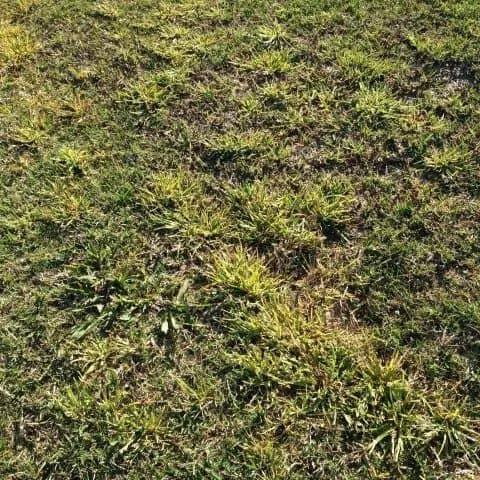
Results on mixed bentgrass and winter grass greens vary, and injury to the bentgrass is possible, as the photo below shows. Overseas research has tested many low-rate weekly programmes, but the Australian label allows only two applications a year, so those programmes cannot be used here.

Managing sulfonylurea resistance
Sulfonylureas remain the most useful selective herbicides for removing grass and broadleaf weeds from warm-season turf, and the standard tool for taking cool-season grass out of overseeded couch in spring. Heavy, repeated use is also what selects for resistance. In the University of Adelaide work, the researchers sequenced four resistant populations. Three carried a change at position Trp-574 of the ALS gene, which gives broad cross-resistance across Group 2, and one carried a change at Pro-197. Switching from one sulfonylurea to another, or to Nominee, is therefore an unreliable answer to resistance.
Rotate Group 2 with herbicides from other groups, use pre-emergent herbicides from different groups to cut the number of weeds that need a post-emergent spray, and do not rely on one product year after year. Where control has failed, have the population tested before you change programmes. Our herbicide resistance chart lists the groups of the main turf herbicides.
Weeds controlled by turf sulfonylureas
The table below lists the weeds named on each Australian label, with the label rate. Rates are per hectare of product. A weed missing from a column is not on that label, which does not always mean the product has no effect on it. Use our weed identification chart to identify the weed first.
| Weed | Tribute (foramsulfuron) | Coliseum (rimsulfuron) | Negate (rimsulfuron + metsulfuron) | ProSedge (halosulfuron) | Recondo (trifloxysulfuron) | Destiny, Duke (iodosulfuron) |
|---|---|---|---|---|---|---|
| Grass weeds | ||||||
| Winter grass (Poa annua) | 1.5 L | 75 to 100 g | 110 g | 225 g | S, 150 g | |
| Ryegrass | 1.5 L | 120 g | 110 g | 225 g | 150 g | |
| Crowsfoot grass (Eleusine indica) | 2 L, 2 or 3 sprays | |||||
| Goose grass (Eleusine tristachya) | 2 L | |||||
| Paspalum | 2 L after MSMA/DSMA | |||||
| Bahia grass | S, 75 g + trinexapac | S, 50 g | ||||
| Kikuyu | S, 2 L × 3 | S | ||||
| Onion grass, Guildford grass | 110 g | 100 g | ||||
| Sedges | ||||||
| Nutgrass (Cyperus rotundus) | 65 to 130 g | 150 g | ||||
| Mullumbimby couch | 65 to 130 g | 150 g | ||||
| Broadleaf weeds | ||||||
| Bindii | 110 g | 225 g | 100 g | |||
| Black thistle | 100 g | |||||
| Burr medic, medic | 115 g | 100 g | ||||
| Catsear | 300 g | 100 g | ||||
| Caustic weed | 110 g | |||||
| Chickweed | 300 g | 100 g (mouse-ear) | ||||
| Clover, white | 110 g | 300 g | 100 g | |||
| Cobblers peg | 110 g | |||||
| Cotula | 300 g | 100 g | ||||
| Creeping indigo | 110 g | |||||
| Creeping oxalis | 110 g | 300 g | 100 g | |||
| Cudweed | 100 g | |||||
| Curled dock | 300 g | |||||
| False onion weed | 25 g | |||||
| Milk thistle | 300 g | |||||
| Plantain | 110 g | |||||
| Tridax daisy | 110 g | |||||
Frequently asked questions
What are sulfonylurea herbicides?
Sulfonylureas are selective Group 2 herbicides that kill weeds by blocking the ALS enzyme, which plants need to make three essential amino acids. Turf managers use them to remove winter grass, ryegrass, sedges and many broadleaf weeds from tolerant grasses at very low rates.
Which sulfonylurea herbicides are registered for turf in Australia?
As of October 2026: Tribute (foramsulfuron), Coliseum (rimsulfuron), Negate (rimsulfuron plus metsulfuron-methyl), ProSedge, Halo-Force and other halosulfuron products, Recondo and Monument (trifloxysulfuron), and Duke and Destiny (iodosulfuron). Nominee (bispyribac-sodium) is also Group 2 but is not a sulfonylurea.
Which sulfonylureas are safe on kikuyu and buffalo?
Only the iodosulfuron products (Duke and Destiny) and the halosulfuron products (such as ProSedge and Halo-Force) carry labels for kikuyu and buffalo. Tribute, Coliseum and Recondo damage kikuyu, and the Recondo label rules out buffalo.
Is Nominee a sulfonylurea?
No. Nominee contains bispyribac-sodium, a pyrimidinyl benzoate. It works the same way as the sulfonylureas and is in Group 2, so it is not a reliable rotation partner for them.
Why have sulfonylureas stopped controlling winter grass on my course?
The most likely reason is Group 2 resistance. Australian research found Group 2 resistance in 97% of winter grass populations tested from golf courses with suspected resistance. Have the population tested and rotate to herbicides from other groups.
Sources
APVMA product labels (elabels.apvma.gov.au) and the PubCRIS register for products 63240, 61358, 88290, 87820, 88911, 67730, 88827, 62571, 56801, 88829 and 63233, checked 17 October 2026.
Barua R, Boutsalis P, Malone J, Gill G, Preston C (2020). Incidence of multiple herbicide resistance in annual bluegrass (Poa annua) across southeastern Australia. Weed Science 68:340-347.
Barua R (2021). Herbicide resistance in annual bluegrass (Poa annua L.) and its management. PhD thesis, University of Adelaide.
Lewis KA, Tzilivakis J, Warner D, Green A (2016). The Pesticide Properties DataBase (PPDB), University of Hertfordshire: bispyribac-sodium (chemical class and mode of action).
Water solubility by pH: foramsulfuron from the Merck Index entry; metsulfuron-methyl from Tomlin (1994), The Pesticide Manual, as summarised by ISPRA.
Marshall R, Hull R, Moss SR (2010). Target site resistance to ALS inhibiting herbicides in Papaver rhoeas and Stellaria media biotypes from the UK. Weed Research 50:621-630.
Disclaimer
The information on this website is for general purposes only. While we try to keep it up to date and correct, we make no representations or warranties of any kind, express or implied, about the completeness, accuracy, reliability, or suitability with respect to the website or the information, products, or services, on the website for any purpose.
© 2026, Gilba Solutions Pty Ltd, All rights reserved
Principal agronomist, Gilba Solutions Pty Ltd
BSc Hons Soil Science (Newcastle). Former STRI agronomist. Author of Nutrition of Sports Turf in Australia (CSIRO/Landlinks Press) and The Definitive Guide to Australian Turfgrass Pesticide Management. 35+ years advising on sports turf, golf and stadia across Australia, NZ, UK and Europe.