

Spring Dead Spot in Couch: The Rings You See in August Started Last Autumn
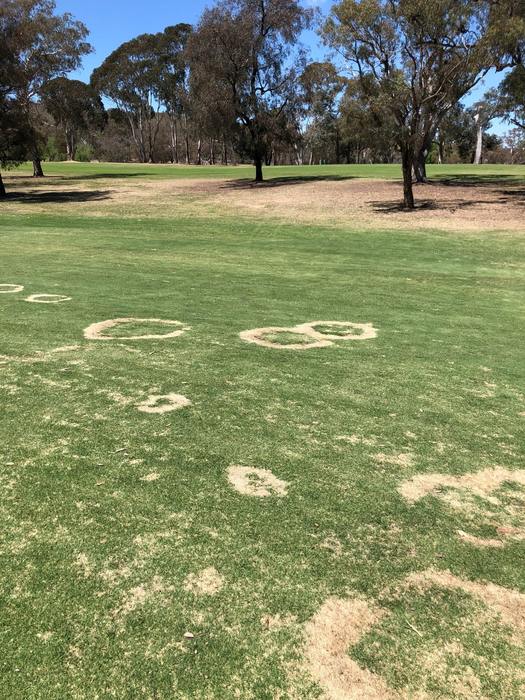
If you manage couch (Cynodon dactylon × C. transvaalensis) in the cooler half of Australia, you know these rings caused by spring dead spot in couch grass. They surface as the turf greens up in late winter and the spring and are bleached, sunken circles scattered across fairways, sports fields and lawns. These range from a few centimetres to well over a metre across. By the time they are obvious, the instinct is to reach for a fungicide.
That instinct is a season too late.
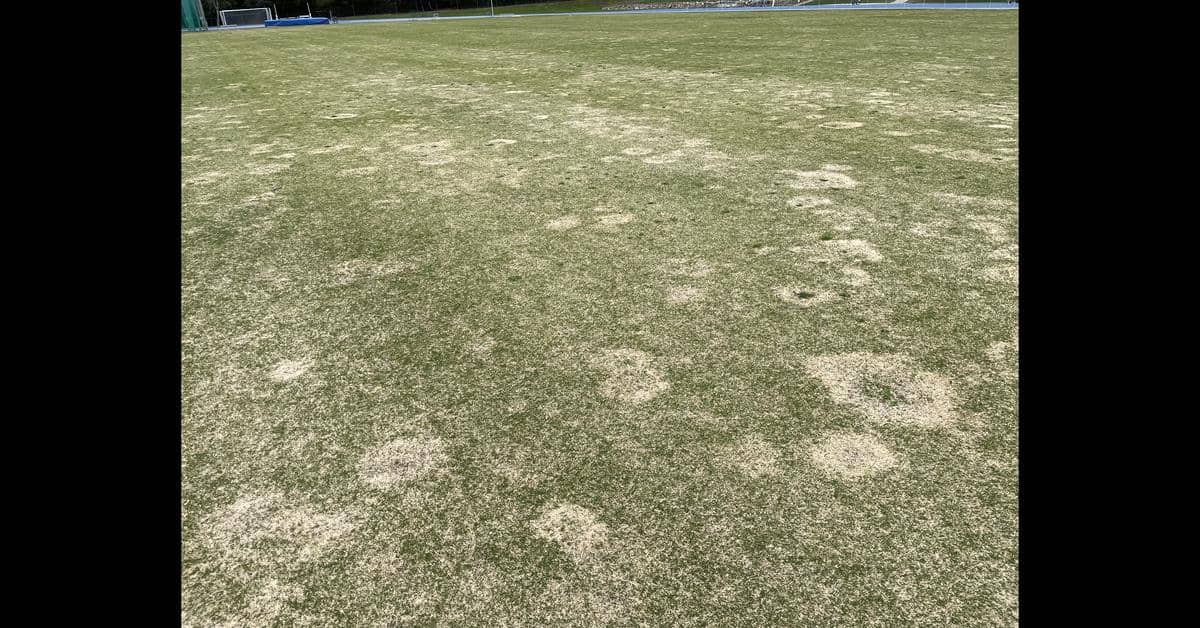
Caption: Spring Dead Spot rings on a couch sports field. Infection occurred last autumn and by the time you see the rings, the prevention window has closed.
What you are actually looking at
Spring Dead Spot (SDS) is the most economically damaging disease of couch at the cool-temperate end of its range. This region includes the ACT and Southern Highlands, much of Victoria, the Adelaide Hills, and cooler parts of southern WA (Beehag & Wong 2023; Beehag et al. 2024). It sits within the broader turf pests and weeds complex alongside other soilborne diseases that are misread and mistreated for the same reason: the symptom and the cause are separated by months.
SDS is caused by soilborne fungi in the genus Ophiosphaerella. In Australia the disease is most commonly associated with O. narmari and O. korrae. O. herpotricha, the dominant species across the United States transition zone, has not been reported here (Beehag & Wong 2023). Other soilborne pathogens, including Magnaporthiopsis-type fungi, can contribute to the broader couch patch-disease complex depending on the site (Wong et al. 2022).
The fungus does not kill the couch directly. It infects roots, rhizomes and stolons in the autumn and compromises cold tolerance. That tissue then dies over winter under cold and frost stress that healthy couch would shrug off (Hutchens, Anders et al. 2025). The ring you see in spring is winter injury to plant tissue that the pathogen weakened months earlier.
The ring is the symptom, not the cause.
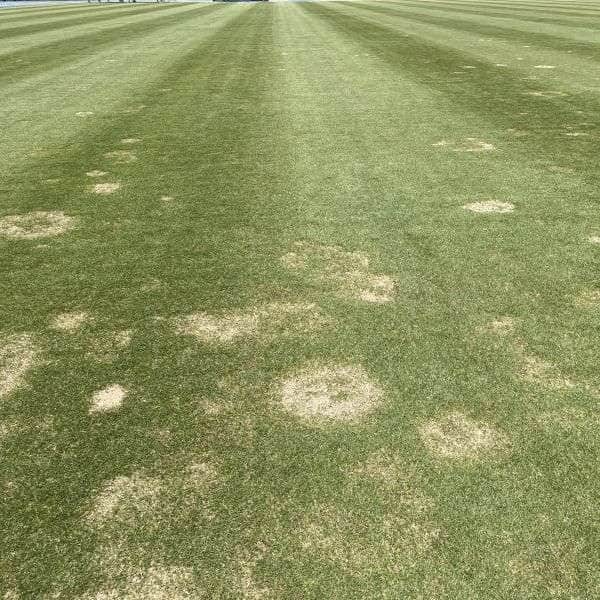
Caption: Multiple SDS patches across a couch sports field in spring. Each ring marks the surface expression of autumn crown and root infection.
The lifecycle on the Australian calendar
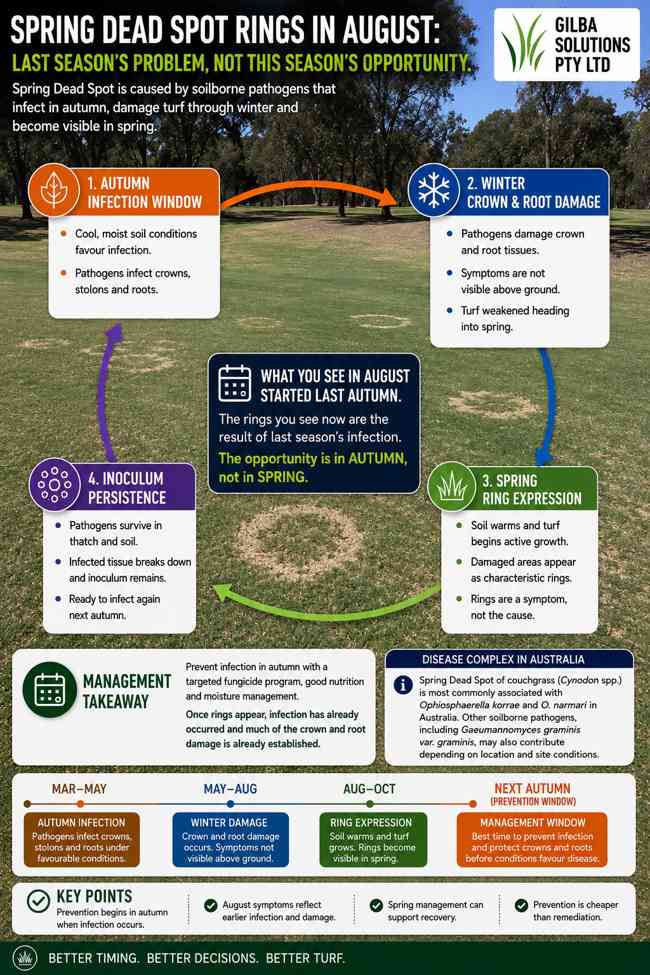
Caption: Spring Dead Spot lifecycle in couch grass from autumn infection through spring ring expression.
Autumn: March to May is the infection window. As the soil cools and stays moist, Ophiosphaerella infects couch crowns, stolons and roots, although at this stage nothing is visible above ground. The turf is still green and the damage is happening in the soil rootzone.
Winter: May to August is when crown and root damage occurs. The pathogen degrades root and crown tissue in the dormant period. Infected plants lose cold hardiness. The stand weakens as it heads into spring with still no visible symptoms above ground.
Spring: August to October is when ring expression occurs. As the soil warms, couch breaks dormancy and tries to grow. Areas with damaged crowns and roots cannot recover and appear as bleached rings. This is the first time the problem is visible and the worst time to act against the pathogen.
Back to autumn: inoculum persistence. The fungus survives in thatch, soil and infected debris through summer, ready to infect the next crop of roots when conditions turn cool and moist the following autumn.
The opportunity to treat the rings you see in August is in the autumn, not in the spring.
Why spring sprays do not work
This is not an opinion but fact. Fungicide applications made in the spring and summer after symptoms appear have been shown to be ineffective across decades of trials (Hutchens, Anders et al. 2025). By the time the rings show, crown and root damage is established and the cold injury has already happened.
A spring fungicide has nothing left to protect. For a full breakdown of fungicide modes of action and resistance groups relevant to turf disease management see the Gilba fungicide mode of action table.
Not every patch of thin spring couch is spring dead spot. Root-feeding nematodes produce the same non-specific decline, and on sand-based surfaces southern sting causes it at very low population densities. If the patches don’t match the autumn infection window, or don’t respond to a correctly timed programme, a soil and root assay is the next step rather than a second fungicide. See turf nematodes on golf greens: how to spot and test for them.
The autumn management programme
Timing
The most precise timing guidance available comes from Hutchens, Booth et al. (2025). Aim to use a protectant fungicide when the 5-day average soil temperature at 0–100mm depth is descending through 13–18°C. In practice:
First application: soil temperature descending through 18°C
Second application: the soil temperature continues to descend through 13°C, one to three weeks after the first
Severe history sites: a third application at around 12–13°C is supported by the trial data (Hutchens, Booth et al. 2025)
This timing was developed on US species. The inference to Australian O. narmari is reasonable but not yet validated with local trial data (Hutchens, Anders et al. 2025). Treat it as the best available current guidance.
Indicative regional calendar
Measure soil temperature at your site as a warm autumn pushes the window later, a cold one pulls it earlier. Two weeks either way is not unusual year to year. These are starting points, not fixed dates:
| Region | First application | Second application |
|---|---|---|
| ACT / Southern Highlands | Late March to mid-April | Mid to late April |
| Victoria — Melbourne / coastal | April | Late April to early May |
| Victoria — inland / elevated | Mid-March to early April | Early to mid-April |
| Adelaide Hills | April to early May | May |
| SW Western Australia | April to May | May |
Do not time applications by calendar month. Instead you should measure the soil temperature at your specific site. Continuous sensors like HydroSight or SoilScout give real-time data as the seasonal window approaches. Use portable probes like Pogo, TDR 300, TDR 350, to spot-check across zones.
Aim to check every 3–4 days once you are in the right seasonal range. The same soil temperature monitoring principles that drive pre-emergent herbicide timing apply here. See Soil Temperature is the Only Pre-Emergent Trigger That Matters for detail on sensor options and monitoring protocols.
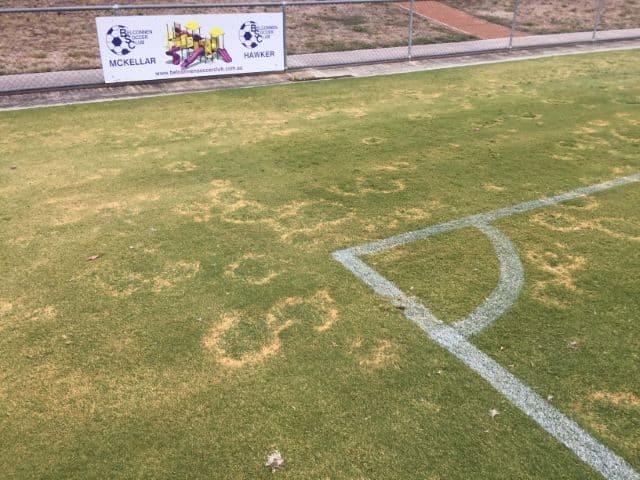
Caption: SDS rings at the corner of a couch football field. Belconnen, ACT.
Products
Three FRAC groups are registered for SDS in Australian turf. Check the Gilba fungicide mode of action table for current resistance risk ratings and registered products before you build your programme. Confirm APVMA registration for your turf species and application site. For registered product details and label rates see the 2024 Turf Pesticides Manual and Turf Chemicals.
| FRAC Group | Chemistry | Registered products (SDS / ERI claim) |
|---|---|---|
| 3 | DMI (triazole) | Propiconazole (Banner Maxx), tebuconazole (Dedicate Forte), mefentrifluconazole (Maxtima) |
| 7 | SDHI | Pydiflumetofen (Posterity) |
| 7 + 11 | SDHI + QoI premix | Fluxapyroxad + pyraclostrobin (Lexicon Intrinsic) |
| 11 | QoI (strobilurin) | Azoxystrobin (Heritage Maxx); DMI + QoI premixes |
FRAC 7 (SDHI):
Pydiflumetofen (Posterity) carries an explicit Spring Dead Spot claim, and fluxapyroxad is registered in the premix Lexicon Intrinsic (FRAC 7 + 11). In US trials SDHI chemistry performed consistently well across both Ophiosphaerella species and trial years, attributed to better soil mobility and rootzone penetration of SDHI fungicides than DMI chemistry (Hutchens, Booth et al. 2025).
In separate UC Riverside field trials on O. narmari, the species that dominates in Australia, DMI plus SDHI tank mixtures were the most consistent treatments tested (Baird, Petelewicz et al. 2017, 2021). Isofetamid, the standout SDHI in the US timing work, is not registered for turf in Australia, so the registered SDHI options here are pydiflumetofen and fluxapyroxad.
FRAC 3 (DMI)
Propiconazole, tebuconazole, and mefentrifluconazole. Mefentrifluconazole has better systemic movement than the older triazoles. Some DMIs that are effective against O. herpotricha have shown variable results on O. korrae (Hutchens, Anders et al. 2025). Efficacy data on Australian O. narmari remains thin, but is no longer absent: in UC Riverside trials on O. narmari, mefentrifluconazole was among the strongest standalone treatments and DMI plus SDHI mixtures were the most consistent (Baird, Petelewicz et al. 2017, 2021). These were US trials on Californian populations, so treat the result as supportive rather than locally validated.
FRAC 11 (QoI)
Azoxystrobin (Heritage Maxx) carries an SDS label claim, but QoI chemistry shows weak and inconsistent standalone efficacy against Ophiosphaerella (Tredway, in Hutchens, Anders et al. 2025). No QoI resistance has been confirmed in Ophiosphaerella. Use azoxystrobin as a rotation and premix partner, not as the standalone main active.
Three rules
1. Water it in. This is a root and crown pathogen. A fungicide on the leaf surface will not reach the target. Post-application irrigation is not optional.
2. Rotate FRAC groups. Rotate across FRAC 3, FRAC 7 and FRAC 11 across seasons. If you use the same mode of action year after year it selects for resistance.
3. Check APVMA registration for your turf species and application site before building a programme.
Soil pH and lime
On acidic profiles (pH below 6.0), an autumn lime application to bring pH toward 6.0–6.5 supports root health and couch cold hardiness going into the infection window. Calcium underpins root cell wall integrity, which is directly relevant to the freeze injury mechanism at the centre of SDS ring expression.
Treat lime as sound agronomy on low-pH sites, not as a disease control in its own right. Inoculated trials have not shown lime to suppress SDS, and the relationship between soil pH and Ophiosphaerella is unresolved, so correct acidity for root and plant health and rely on fungicide timing and cultural measures for the disease itself.
Nitrogen management
Balanced nitrogen through the growing season supports root health going into the infection window. Excessive nitrogen in the late summer and early autumn pushing soft, lush growth into the infection window is counterproductive.
Low-rate nitrogen applications in early autumn have been investigated as a management tool in US research, with inconsistent results across species (Hutchens, Anders et al. 2025; Walker 2025). The two main US species respond in opposite directions to nitrogen source, and O. narmari is untested in those trials. Until equivalent Australian data exists, treat nitrogen-source manipulation as a monitored trial on adjacent areas rather than a programme-wide prescription.
Identify your pathogen
Multiplex PCR through a turf-capable diagnostic laboratory confirms whether you have O. narmari, O. korrae, or a mixed infection. This matters for two reasons:
1. DMI efficacy is species-conditional. Some DMIs that control O. herpotricha have failed on O. korrae (Hutchens, Anders et al. 2025). Knowing your species reduces the risk of an incorrectly targeted programme.
2. Nitrogen-source manipulation, if you choose to trial it, is species-conditional.
The cost of a PCR test is modest compared to an autumn programme aimed at the wrong target.
What spring is actually for
Once rings are present, the spring and summer are for recovery not for control. Recovery happens by lateral spreading of the surviving couch into any dead patches across the growing season. To achieve this the aim is to keep the surrounding turf growing with a sound nutrition program, good moisture management, and compaction relief with aeration if necessary. On slow-filling or severe patches, sprigging or oversowing accelerates fill.
Aggressive cultivation does not accelerate recovery from existing damage (Hutchens, Anders et al. 2025), so save heavy renovation for the autumn. The same disease management principles that apply to other soilborne pathogens in turf apply here. See Pythium in Turf for a parallel case of a disease that is commonly mistreated because the symptom and the cause are misread.
Practical summary
- SDS infection occurs in the autumn. Rings appear in the spring. These are different events separated by a season.
- Spring fungicide applications are ineffective as the damage is already done (Hutchens, Anders et al. 2025)
- Use FRAC 7 (Posterity, Lexicon Intrinsic), FRAC 3 (propiconazole, tebuconazole, mefentrifluconazole) or a DMI + QoI premix. Do this when the soil temperature at 0–100mm is falling through 18°C, with a follow-up at 13°C (Hutchens, Booth et al. 2025)
- Water all applications in immediately
- Measure the soil temperature at your site using continuous sensors or portable probes. Check every 3 to 4 days as the window approaches
- Use the regional timing table as a starting point. Always measure, never guess
- On low-pH sites, apply lime in the autumn to bring pH toward 6.0–6.5
- Avoid excessive nitrogen in late summer and early autumn
- Identify your pathogen species via PCR before you commit to a DMI programme
- Rotate groups FRAC 3, FRAC 7 and FRAC 11 across seasons
- Spring and summer are for recovery via nutrition, and moisture management
Further reading
Turf Pests and Weeds | Fungicide Mode of Action Table | 2024 Turf Pesticides Manual | Turf Chemicals | Pythium in Turf | Soil Temperature is the Only Pre-Emergent Trigger That Matters| Soil and Rootzone Science | Turf physiology and PGRs
Why do Spring Dead Spot rings appear in spring if infection happens in autumn?
Ophiosphaerella infects couch roots, rhizomes and stolons in autumn as soil cools. The infection compromises cold tolerance, and that weakened tissue dies over winter under frost and cold stress that healthy couch would survive. Sometimes you can see bleached rings in August and these are the spring expression of winter injury to tissue the pathogen damaged months earlier. A full season separates the symptom and the cause.
Do spring fungicide applications control Spring Dead Spot?
No. Spring applications after symptoms appear are ineffective. By the time rings show, crown and root damage is established and the cold injury has already occurred. Trials across decades have confirmed this as a spring fungicide has nothing left to protect (Hutchens, Anders et al. 2025). Fungicide applications must be made in the autumn before any infection establishes.
When should I apply fungicide for Spring Dead Spot control?
Apply a protectant fungicide when the 5-day average soil temperature at 0–100 mm depth is descending through 18°C, with a follow-up when it descends through 13°C, one to three weeks later. Sites with a severe history may warrant a third application at around 12–13°C. Measure the soil temperature at your site as a warm autumn pushes the window later, and a cold one pulls it earlier. You should regard regional calendars as starting points only.
Which fungicides are registered for Spring Dead Spot in Australia?
Three FRAC groups carry registered SDS claims in Australian turf. FRAC 7 (SDHI): pydiflumetofen (Posterity) and fluxapyroxad + pyraclostrobin (Lexicon Intrinsic). FRAC 3 (DMI triazole): propiconazole (Banner Maxx), tebuconazole (Dedicate Forte), mefentrifluconazole (Maxtima). Group 11 (QoI strobilurin): azoxystrobin (Heritage Maxx) which you should use as a rotation or premix partner only, not standalone. Always confirm current APVMA registration for your turf species and application site.
Does soil pH affect Spring Dead Spot severity?
On acidic profiles below pH 6.0, an autumn lime application to bring pH toward 6.0–6.5 supports root health and couch cold hardiness. Calcium underpins root cell wall integrity, which is directly relevant to the freeze injury mechanism at the centre of SDS ring expression. Treat lime as sound agronomy on low-pH sites rather than a disease control, as inoculated trials have not shown lime to suppress SDS and the relationship between soil pH and Ophiosphaerella is unresolved.
Which Ophiosphaerella species causes Spring Dead Spot in Australia?
In Australia, SDS is most commonly associated with O. narmari and O. korrae. O. herpotricha, the dominant US species, has not been reported here. Species identification matters because DMI efficacy is species-conditional and some DMIs effective against O. herpotricha have shown variable results on O. korrae. Multiplex PCR through a turf-capable diagnostic laboratory confirms which species is present.
How do I manage couch recovery from Spring Dead Spot rings?
Spring and summer are for recovery, not control. Rings fill through lateral spread of surviving couch across the growing season. The key management tips are to keep the surrounding turf vigorously growing with sound nutrition, consistent moisture management, and compaction relief through autumn aeration. On slow-filling or severe patches, sprigging or oversowing accelerates fill. Aggressive cultivation does not speed recovery from established damage.
References
- Baird, J.H., Petelewicz, P., Orlinski, M., Schiavon, M. & Negm, M. (2017, 2021). Spring dead spot (Ophiosphaerella narmari) fungicide trials, North Ridge CC (2016–17) and Peach Tree GCC (2020–21). UC Riverside Turfgrass Research and Final SDS fungicide trial report 2017
- Beehag, G.W. & Wong, P.T.W. (2023). Patch diseases of warm-season turfgrasses in Australia. Australian Turfgrass Management Journal 25(1), ASTMA.
- Beehag, G.W., Walker, N.R., Wong, P.T.W. & Kaapro, J. (2024). Turfgrass Diseases and Their Management. CABI. https://doi.org/10.1079/9781789246230.0000
- Hutchens, W.J., Anders, J.K., Butler, E.L., Kerns, J.P., McCall, D.S., Miller, G.L. & Walker, N.R. (2025). Spring dead spot of turfgrass: a review. Crop Science. https://doi.org/10.1002/csc2.21367
- Hutchens, W.J., Booth, J.C., Goatley, J.M., Roberson, T.L. & McCall, D.S. (2025). Soil temperature-based fungicide timing for spring dead spot control. Crop Science (ITRC 2025 Special Section). https://doi.org/10.1002/csc2.21411
- Walker, N.R. (2025). Fertiliser inputs and spring dead spot of bermudagrass. International Turfgrass Society Research Journal.
- Wong, P.T.W., Tan, Y.P., Weese, T.L. & Shivas, R.G. (2022). *Magnaporthiopsis* and allied genera associated with patch diseases of turfgrasses in Australia. *Mycosphere* 13(1): 5. https://doi.org/10.5943/mycosphere/13/1/5

Principal agronomist, Gilba Solutions Pty Ltd
BSc Hons Soil Science (Newcastle). Former STRI agronomist. Author of Nutrition of Sports Turf in Australia (CSIRO/Landlinks Press) and The Definitive Guide to Australian Turfgrass Pesticide Management. 35+ years advising on sports turf, golf and stadia across Australia, NZ, UK and Europe.