
Couch Grass Seed for Australian Sports Turf and Lawns
Couch (Cynodon dactylon) is the workhorse warm-season turf across most of Australia. It runs golf fairways, sports fields, racetracks and premium lawns from Brisbane down into the cool transition zone. Most couch is established vegetatively, by sprig, stolon or turf. A smaller group of cultivars are seeded, and those are what this page is about.
At Gilba Solutions we supply three seeded couch varieties that hold current or recent NTEP ratings: Monaco, Rio and Maya. Seed gives you a faster, cheaper establishment route than sprigging for the right job, on the right site, at the right time of year. It is not the right route for everything, and the bulk of this page is about telling those situations apart.
The decision is not about which seed is cheapest per kilogram. It starts earlier, with whether seeded couch suits the site at all, and if it does, which of the three cultivars matches the brief. Establishment speed, cold tolerance, disease resistance, wear tolerance and trial data all pull in slightly different directions, so the right answer changes with the job.
This page covers where seeded couch fits, where sprigs still win, how to read the NTEP bermudagrass data, the establishment window that makes or breaks a seeded couch job, and how Monaco, Rio and Maya differ.
The image above is courtesy of Dave Ramage at Burns Golf Club in Canberra.
Recommended varieties from Gilba Solutions
We stock three seeded couch cultivars, each with a different strength. They are not interchangeable, and the choice usually comes down to your climate zone and your main risk on the site.
Monaco is the all-round quality pick: dark green, fine textured, dense, with good wear tolerance and winter hardiness. It came through the NTEP trials as a top-tier seeded type for overall turf quality and was bred out of the Johnston Seed programme that produced Riviera.
Rio is the establishment and cold-tolerance pick. It was the number one NTEP-rated variety for establishment, germinates fast, and holds up in frost-prone and transition-zone sites better than most seeded couch. If you are seeding late, seeding cool, or seeding somewhere couch is marginal on winter cold, Rio is the safer bet.
Maya is the disease-resistance pick. In its NTEP trial it showed no dollar spot and the least spring dead spot damage of any entry, with good Take-all Patch resistance on top. Where disease pressure is the main worry, Maya is the variety with the genetics to match.
Typical applications across all three: golf fairways, tees and roughs, sports fields, racetracks, parks and premium lawns through the warm-season and transition zones of Australia.
Monaco
All-round quality
The all-round pick where no single risk dominates. Dark green colour, fine leaf texture and good shoot density across the rating period. Good wear tolerance and winter hardiness. Bred from the Johnston Seed programme that produced Riviera.
Fairways • sports fields • premium lawns • warm and mid-transition zones
Rio
Establishment & cold tolerance
The pick for transition-zone and frost-prone sites, and for any job where the seeding window is tight or cool. Rio germinates faster than Monaco or Maya and holds up in cold winters better than most seeded couch. If you are seeding late or seeding somewhere couch is marginal on winter cold, Rio is the safer bet.
Transition zone • frost-prone sites • late or cool seeding windows
Maya
Disease resistance
The pick where disease pressure is the main site risk. Maya recorded no dollar spot and the least spring dead spot damage of any entry in its NTEP trial, with good Take-all Patch resistance from Texas data. No winterkill in Virginia trials. Tested as RAD-CD1, supplied in Australia by Heritage Seeds.
High disease-pressure sites • dollar spot and spring dead spot history • warm and transition zones
Spring Dead Spot is the most economically damaging disease of couch in the cool-temperate half of Australia, and cultivar choice is one of the few management levers available before the fungicide programme begins. Maya’s SDS resistance comes from its genetics, not its management, which means the baseline disease pressure on a Maya stand is lower going into the autumn infection window. On sites in the ACT, Southern Highlands, Victoria or the Adelaide Hills with a known SDS history, that genetic advantage matters. For the full lifecycle, autumn timing protocol and registered fungicide options see Spring Dead Spot in Couch: The Rings You See in August Started Last Autumn.
Where seeded couch fits, and where it doesn’t
Seeded couch earns its place when you want a full couch sward established from seed rather than sprigs: lower cost, faster cover, no planting crew, and no sourcing of vegetative material. For a large area on a sensible timeline, that is a real saving over sprigging.
The catch is that seed only works inside a fairly narrow set of conditions. Couch seed needs warm soil, consistent surface moisture and time. Miss the window and you get patchy establishment, weed invasion and a result that looks like a cultivar problem but is really a timing problem.
When seeded couch is the right call
- New construction or full renovation where you control the timing and can seed into warm soil
- Large areas where sprigging cost is prohibitive
- Sites where you can keep the surface moist through germination and grow-in
- Fairways, sports fields, parks, racetrack surrounds and lawns that do not need the genetic uniformity of a single clone
When to use sprigs or turf instead
- Elite single-clone surfaces. Where you need the exact uniformity, density and ball-roll of a named vegetative hybrid (the TifTuf, TifEagle, Wintergreen class), sprigs or turf are the answer. Seeded couch is genetically variable by nature.
- Golf greens. Seeded couch does not have the growth habit or uniformity for an ultradwarf putting surface. Use TifEagle, MiniVerde or Champion sprigs. Seeded couch belongs on tees, fairways, surrounds, sports fields and lawns, not greens.
- Out-of-season jobs. If the job has to happen outside the warm-soil window, sprigs or turf will establish where seed simply will not germinate.
- Instant cover. Where the surface has to be playable or presentable immediately, turf is the only option.
That last group matters commercially. A client who needs the look of an elite vegetative couch, or who is seeding at the wrong time of year, is better served by being told to sprig than by being sold seed that will disappoint. Seed is a tool with a job, not a universal answer.
The establishment window: the thing that makes or breaks a seeded couch job
More seeded couch failures come from timing than from cultivar choice. Couch is a warm-season grass and the seed behaves like one.
Germination needs soil temperatures of roughly 18°C and rising. Below that, germination is slow, uneven, or simply does not happen. In most of Australia that points to late spring through to mid-summer as the sowing window: warm soil ahead, a full growing season for grow-in, and time to mature before the first cool weather slows it down.
Seed late, or seed into cool soil, and the stand goes into winter immature and weak. That is where Rio’s cold tolerance and establishment speed buy you a margin, but no cultivar fully escapes the rule. Get the timing right and seeded couch establishes well. Get it wrong and the best genetics on the market will still give you a poor result.
Three things travel together for a successful seeded couch job: warm soil, shallow seed placement (cover with no more than about 5 to 6 mm of soil or sand), and consistent surface moisture through germination and early grow-in. Light, frequent irrigation beats heavy, infrequent watering at this stage. Let the surface dry out during germination and you lose the stand.
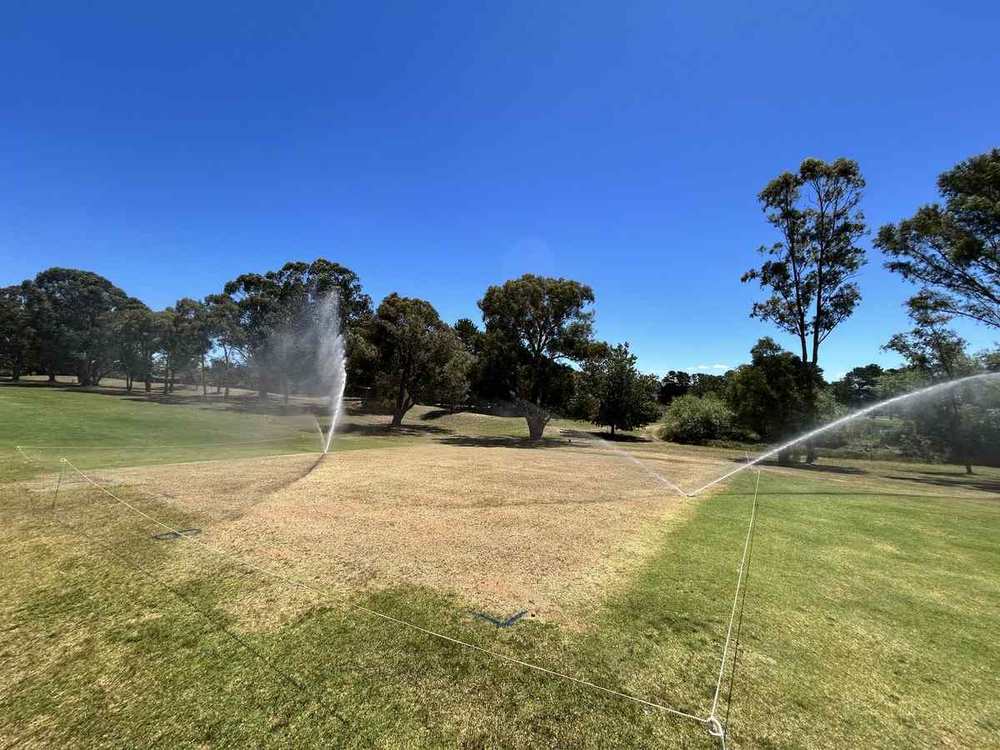
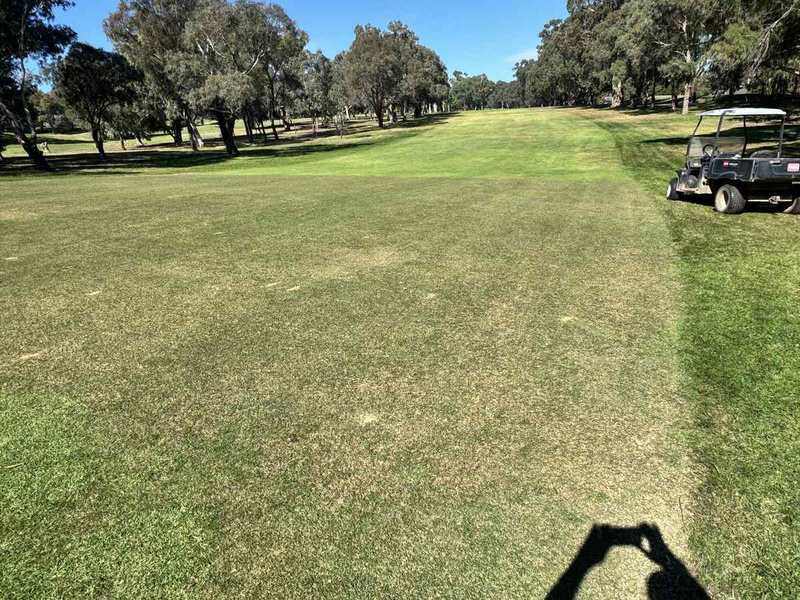
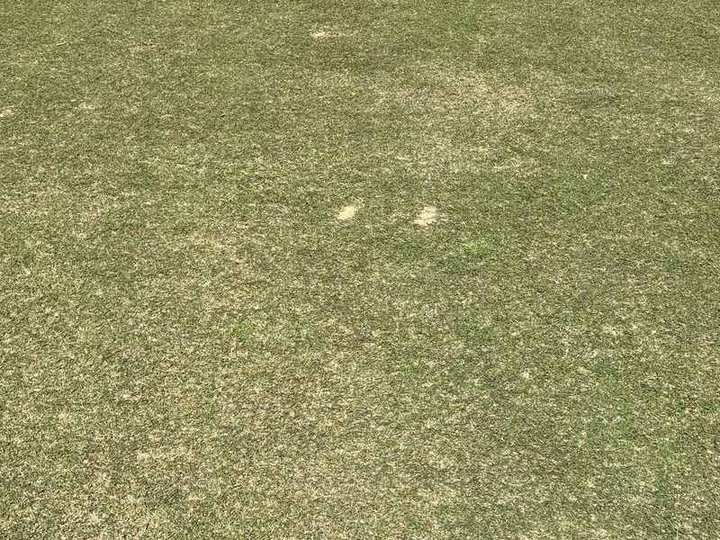
Seeded couch also works for converting an existing sward, once the incumbent is removed. The trial below seeded Maya into a kikuyu fairway after the kikuyu was sprayed out, which is a realistic ACT and cool-transition tactic where you want to shift a fairway from kikuyu to couch.
Field trial: Maya seeded into a kikuyu fairway, Burns Golf Club ACT
This is the clubs own marked-out trial, photographed across the establishment season. It shows both the right way to prepare a seeded couch job and the limit the establishment window puts on a late sowing.
What the trial shows.
Seeded January, photographed May. The seedbed was prepared properly: competition removed, surface marked and irrigated. The couch germinated and established, but a January sowing in the ACT pushes grow-in into autumn, and by May the soil is cooling and the stand is heading into its seasonal slowdown before it has fully knitted. That is the establishment window in action. The same seed sown four to six weeks earlier, into the front of summer rather than the back of it, would have had more warm-season grow-in time to mature before the season turned. The honest lesson from our own trial: get seeded couch in early enough that it matures before autumn, especially at ACT elevation and latitude.
How to read NTEP data for couch (bermudagrass)
The NTEP bermudagrass trials are the best independent dataset on seeded couch performance, but they are US trials and they need reading with judgement, not lifted as a league table.
- Seeded and vegetative types are tested together, and the vegetative clones usually top the quality tables. That is expected, and it does not make the seeded entries poor. Read the seeded types against each other, not against the vegetative hybrids.
- Trial year matters. Monaco, Rio and Maya were assessed in different NTEP cycles (Maya in 2007–2012, Monaco and Rio in later trials). You cannot directly compare a score from one cycle against a score from another as if they were the same trial. Use them to characterise each variety, not to rank one against another to a decimal point.
- Site and management drive the numbers. A US transition-zone site under US management is not Bowral, Brisbane or Perth. NTEP tells you how a cultivar behaves and where its strengths sit. It does not tell you how it will score on your site under your programme.
- One strong category does not make a variety the best overall. Rio wins establishment. Maya wins disease. Monaco wins broad quality. None of those make the other two wrong. Match the winning category to your main risk.
The methodology detail (how plots are rated, what the 1-to-9 scale means, why genetic colour is reported separately from quality) is covered on the perennial ryegrass page and applies the same way here.
Comparison: Monaco vs Rio vs Maya
| Attribute | Monaco | Rio | Maya |
|---|---|---|---|
| Breeder / supplier | Johnston Seed / Barenbrug | Johnston Seed | Heritage Seeds (tested as RAD-CD1) |
| NTEP strength | Top-tier overall quality | #1 establishment | Best-in-trial disease resistance |
| Establishment speed | Good | Fastest of the three | Good |
| Cold / frost tolerance | Good, winter hardy | Strongest, transition-zone capable | Good, no winterkill in Virginia trials |
| Leaf texture | Fine | Fine | Medium-fine |
| Genetic colour | Dark green | Dark green | Good |
| Dollar spot | Good | Good, leafspot and dollar spot tolerant | No dollar spot in trial (9.0) |
| Spring dead spot | Standard | Standard | Least damage in trial (~5%) |
| Wear tolerance | Good | Good | Good, traffic tolerant once established |
| Spring green-up | Quick | Quick | Very good |
| Best-fit brief | All-round quality fairways, sports turf, premium lawns | Late or cool seeding, frost-prone and transition sites | High disease-pressure sites |
Establishment, seeding rates and timing
- New pure stand: roughly 10 to 15 g/m² of coated seed into a firm, well-prepared seedbed
- Seed placement: cover with no more than about 5 to 6 mm of soil or sand, never leave seed bare on the surface
- Soil temperature: sow when soil is at about 18°C and rising, not falling
- Moisture: light and frequent through germination and early grow-in, then taper to deeper, less frequent watering as the stand knits
- Overseeding: We recommend Intense perennial ryegrass if you want to overseed heading into winter.
Coated seed (the Yellow Jacket, Agricote or similar coatings) holds moisture around each seed and improves the odds in the field. It also changes the effective seeds-per-kilogram, so read the rate off the bag for the specific product rather than assuming a generic figure.
Timing in Australia: late spring into summer is the primary window for most of the country, targeting rising soil temperature and a full season of grow-in ahead. Seeding too late pushes an immature stand into autumn cooling, which is where seeded couch jobs most often come unstuck.
Confirm the exact rate with us for your site and product before you order. The bands above are a guide, not a quote.
Commercial take
Seeded couch is the right specification when you are establishing a couch sward from scratch or in full renovation, on a site that does not demand single-clone uniformity, with the timing under your control so you can seed into warm soil. For large fairways, sports fields, parks and lawns on a sensible budget, it is a genuinely good route, and the cultivar genetics now available through Monaco, Rio and Maya are a long way ahead of old common couch seed.
Sprigs or turf are the right specification when you need an elite named hybrid, when the surface is a golf green, when the job falls outside the warm-soil window, or when the site needs instant cover.
Within seeded couch, match the cultivar to the main risk. Monaco for all-round quality. Rio for fast, cold-tolerant establishment. Maya for disease resistance. Choosing on price alone, or treating the three as interchangeable, is where buyers go wrong.
For variety selection and an establishment plan on a particular site, talk to an agronomist.
Can you really establish couch grass from seed, or does it have to be sprigged?
Yes. Monaco, Rio and Maya are true seeded cultivars that establish a full couch sward without sprigging. Seed is cheaper and faster for large areas than vegetative establishment, provided two conditions are met. The soil temperature has to be at or above 18°C and rising when you seed, and the surface must stay consistently moist through germination and early grow-in. Not all couch is available as seed and elite single-clone varieties like TifTuf or Wintergreen are vegetative only. However, the three cultivars Gilba Solutions supplies are excellent for seed establishment across Australian conditions.
When should I sow couch seed in Australia?
Sow from late spring into mid-summer, once the soil temperature reaches 18°C and is still rising. For most of the country that means October through to January. Couch seed needs warmth to germinate reliably, and it needs a full growing season ahead to mature before the first cool weather slows growth. Seeding into cooling autumn soil is the most common cause of a failed seeded couch stand. If the window has narrowed and you are seeding late, Rio is the safer choice because of its faster germination and better cold tolerance compared to Monaco and Maya, but no cultivar removes the underlying temperature requirement.
Is seeded couch suitable for golf greens?
No. Seeded couch is not suitable for golf greens and should not be used on golf greens. Seeded couch varieties are genetically variable and do not produce the uniformity, density or growth habit that an ultradwarf putting surface requires. For greens, use established vegetative ultradwarf cultivars: TifEagle, MiniVerde or Champion. Seeded couch belongs on tees, fairways, surrounds, sports fields, racetracks, parks and lawns, where genetic variation within the stand is acceptable and the lower cost of seed establishment over a large area becomes a practical advantage.
Which seeded couch variety should I choose?
Choose based on your main site risk, not price per kilogram. Monaco is the all-round quality pick. It is lovely looking with dark green, fine-textured leaves, with top NTEP turf quality scores and good wear tolerance. It is ideally suited to fairways, premium sports fields and lawns in the warm and mid-transition zones. Rio is the establishment and cold-tolerance pick. It ranked first for establishment speed in NTEP trials and handles frost-prone and transition-zone sites better than Monaco or Maya, making it the right call for late or cool seeding windows. Maya is the disease-resistance pick. In its NTEP trial it recorded no dollar spot and the least spring dead spot damage of any entry, which matters on sites with a documented history of either disease.
What seeding rate should I use for seeded couch?
Use 10 to 15 g/m² of coated seed into a firm, well-prepared seedbed covered with no more than 5 to 6 mm of soil or sand. Coated seed alters the effective seed count per kilogram, so the rate on the bag for your specific batch takes precedence over any generic figure. Seedbed preparation matters as much as rate. You need firm contact between the seed and soil, shallow placement, and light frequent irrigation during germination. This ensures more uniform establishment than a higher seeding rate into a poorly prepared surface.
References
[1] National Turfgrass Evaluation Program (NTEP). 2007–2012 National Bermudagrass Test: Final Report. Maya tested as RAD-CD1.
[2] National Turfgrass Evaluation Program (NTEP). 2013–2018 National Bermudagrass Test: Final Report (bg13_18-14f). Monaco and Rio evaluated as seeded entries across 17–19 US locations. Rio (JSC 2013-10S) rated #1 among seeded entries for establishment at 15 of 15 locations in 2013. Monaco evaluated for overall turf quality, colour, texture and density.
[3] National Turfgrass Evaluation Program (NTEP). 2019–2023 National Bermudagrass Test: Final Report (bg19_23). Monaco included as seeded commercial standard.
[4] Rimi, F., Macolino, S., Richardson, M.D., Karcher, D.E. and Leinauer, B. (2021). Base temperatures affect accuracy of growing degree day model to predict emergence of bermudagrasses. Agronomy Journal, 113.
[6] Evers, G.W. (2006). Seeded bermudagrasses and their establishment. Texas A&M AgriLife Extension / Forage Fax.
[7] Patton, A.J., Richardson, M.D., Karcher, D.E., Boyd, J.W., Reicher, Z.J., Fry, J.D., McElroy, J.S. and Munshaw, G.C. (2008). A guide to establishing seeded bermudagrass in the transition zone. Applied Turfgrass Science, 5(1).
https://doi.org/10.1094/ATS-2008-0122-01-MD
[8] Evers, G.W. and Parsons, M.J. (2009). Temperature influence on seeded bermudagrass germination. Texas Journal of Agriculture and Natural Resources, 22: 74-80.
[8] Giolo, M., Pornaro, C., Onofri, A., & Macolino, S. (2020). Seeding Time Affects Bermudagrass Establishment in the Transition Zone Environment. Agronomy, 10(8), 1151.
[9] Barenbrug USA. Germination temperature guidance for warm-season turfgrasses.
[10] Vista Seed Partners. Maya Bermudagrass Technical Data Sheet.

Principal agronomist, Gilba Solutions Pty Ltd
BSc Hons Soil Science (Newcastle). Former STRI agronomist. Author of Nutrition of Sports Turf in Australia (CSIRO/Landlinks Press) and The Definitive Guide to Australian Turfgrass Pesticide Management. 35+ years advising on sports turf, golf and stadia across Australia, NZ, UK and Europe.