
A Major FIFA World Cup 2026 Stadium Sourced Vertmax Duo from Gilba Solutions — Here’s the Science Behind the Decision
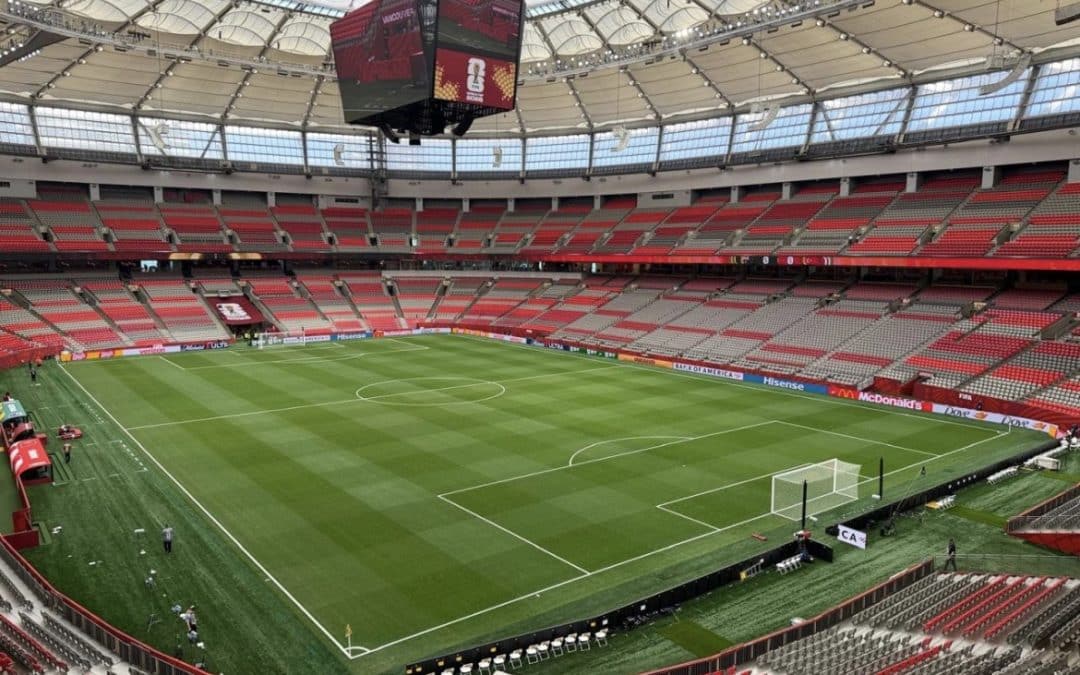
One of the FIFA World Cup 2026 host stadiums in North America is a domed venue running a temporary Kentucky bluegrass/perennial ryegrass surface under grow lights. This venue sourced Vertmax Duo directly from Gilba Solutions for their turf program. This post explains the specific stresses that surface faced, and why a copper phthalocyanine pigment paired with a salicylic acid biostimulant was a rational choice for managing them.
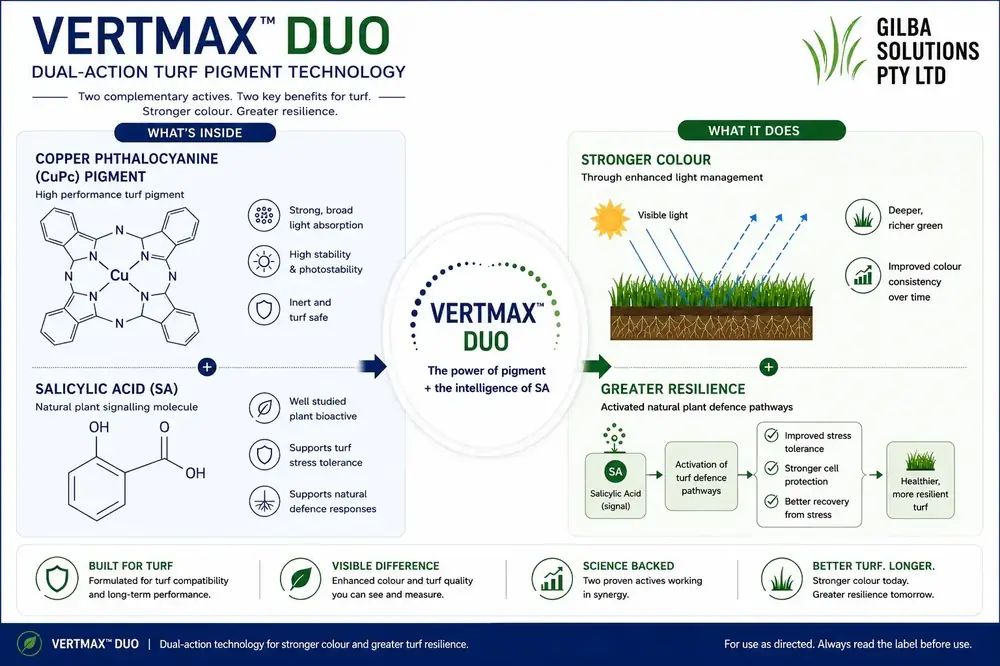
Caption: Vertmax Duo combines copper based pigment for colour retention with salicylic acid for systemic acquired resistance. Two actives, two complementary outcomes.
The FIFA World Cup 2026 turf story has been well-covered. Turfgrass scientists from the University of Tennessee and Michigan State developed two main systems. The first uses couch for warm climates, and the second a mix of Kentucky bluegrass and perennial ryegrass for cooler ones.
For domed venues in cooler climates, this meant installation of a living cool-season surface over artificial turf on a temporary sand-based build, and then keeping it alive for weeks under supplemental lighting.
That is an unusual agronomic problem. The inputs required to solve it are equally specific.
What the Surface Was Actually Up Against
This was not a renovation or recovery scenario. The grass was grown at a sod farm, transported refrigerated, then installed inside a stadium on a temporary build, and then put under tournament pressure. Grow lights were needed to keep the turfgrass healthy for the duration and Stogger LED rigs provided supplemental PAR light alongside whatever daylight the translucent roof admits. SGL provided the industrial fans that run continuously to manage airflow and suppress any disease.
Combined summer ambient temperatures and repeated match-day foot traffic on a shallow sand rootzone, meant that the surface faced a stress profile that differs substantially from an outdoor field.
The core problems
Heat and humidity load inside an indoor venue. Vancouver’s outdoor summers are mild by host-city standards, but a roofed stadium changes this equation. It restricts airflow, and the radiant load from grow lights, and crowds let the canopy temperature and humidity build above ambient.
Perennial ryegrass is heat-sensitive, with a shoot growth optimal of around 15 to 24°C. As temperatures increase the quality declines. This means that even in a moderate enclosed-venue heat load matters on a cool-season surface. On a temporary rootzone with limited thermal buffering, managing canopy stress becomes a genuine concern.
Traffic stress resilience on a temporary rootzone. The pitch was built on an HG Turf HERO stabilised carpet-mat system over a rootzone which is shallow relative to a permanent outdoor field. Recovery between matches depends heavily on the plant’s physiological state. A surface that already carries an increased heat and traffic load has less recovery capacity when the next match arrives.
Vertmax Duo speaks to this stress profile through two separate mechanisms: salicylic acid priming for physiological stress tolerance, and copper phthalocyanine pigment for a stable surface colour when the canopy is under pressure.
How Copper Phthalocyanine Pigment Helps This Specific Surface
Copper phthalocyanine (CuPc) is a synthetic organic pigment with excellent photostability and strong broad-spectrum light absorption.(1) When you apply it to leaf tissue, it forms a uniform, durable coat that delivers a consistent natural green colour at the canopy surface.
Colour continuity.
On a surface where chlorophyll content is under constant pressure from heat and traffic, the natural pigment system works harder than it would on an outdoor field. CuPc supplements the visual green signal, so the surface appears consistent on camera. This is even when natural pigmentation is under stress. For a televised tournament, a uniform surface that holds its colour through the event is a real, deliverable benefit.
CuPc is photostable. This means that the colour benefit persists through repeated light exposure rather than breaking down rapidly like some conventional pigments do.(1) For an event that runs over several weeks with no opportunity to re-establish the surface, that durability matters.
Non-transfer once dry.
A practical problem with turf pigments is transfer. Heavy-pigment colorants are known to rub off onto tyres, footwear, and playing kit for weeks after application.(5)
On a televised pitch a pigment marking players’ kit, boots, or the match ball is unacceptable. Vertmax Duo is formulated to bind to the leaf as it dries and not transfer once dry. A side-by-side field test at a Premier League club, applied at 1 L/ha at 6°C and assessed after four hours’ drying, shows the difference directly.
On white playing kit, Vertmax Duo (left) left only soil and grass smudging, while a competitor pigment (right) transferred heavy green staining under identical conditions.
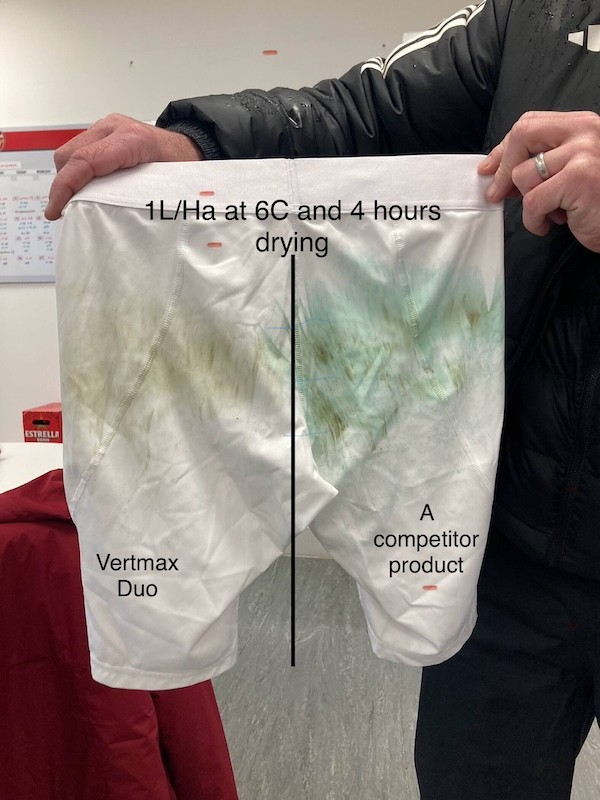
This is field-demonstration evidence rather than a controlled peer-reviewed trial, and it runs counter to the general colorant literature precisely because the formulation is engineered against transfer.
A note on scope: the pigment’s job here is colour stability, not to cool the canopy. Field studies on turf pigments show they do not reduce canopy temperature, and in full sun can raise it as they lower the canopy albedo. (4) The honest claim for CuPc is consistent surface colour under stress, and that is the claim made here.
How Salicylic Acid Primes the Surface for What’s Coming
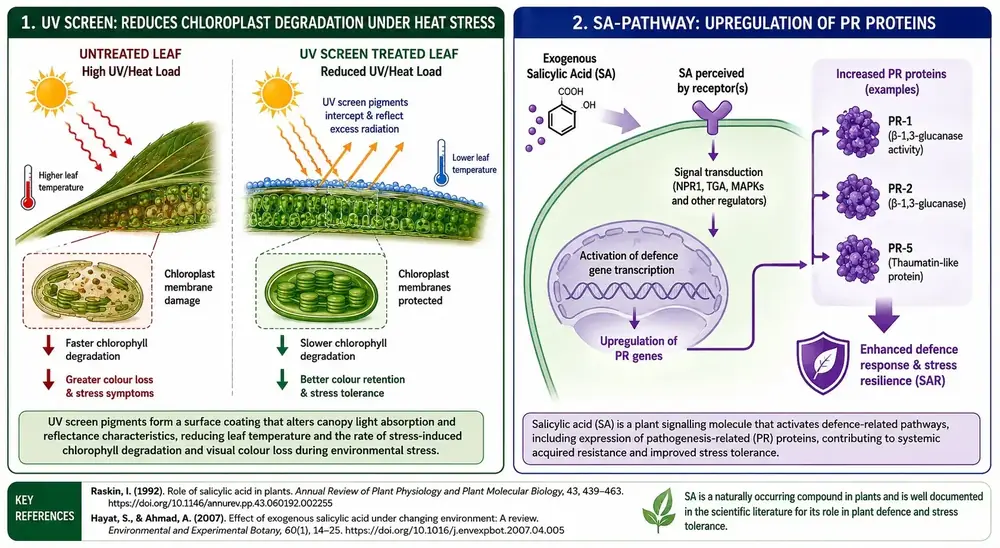
Salicylic acid (SA) is a naturally occurring plant signalling molecule. Chemical priming and exogenous application of organic molecules are well-known strategies for reducing stress damage by regulating metabolic processes. SA sits at the centre of this, and activates the systemic acquired resistance (SAR) pathway, which is the plant’s pre-emptive whole-organism defence state.(2)
The mechanism runs from receptor binding through signal transduction (NPR1, TGA transcription factors, MAPK cascades) to defence gene transcription in the nucleus. This results in upregulation of pathogenesis-related (PR) proteins. PR-1, PR-2 (beta-1,3-glucanase), and PR-5 (thaumatin-like protein) are among the most studied, with roles in both pathogen resistance and broader abiotic stress tolerance.(2,3)
For a tournament surface, this means:
- Better heat and traffic stress tolerance before an event occurs
- Stronger cell membrane integrity under oxidative load
- Faster recovery between matches
Evidence for Salicylic acid on turfgrass
The most directly relevant evidence comes from perennial ryegrass itself. In a peer-reviewed greenhouse study, foliar SA applied before stress onset preserved turf quality, chlorophyll content, and photosynthesis, and upregulated the antioxidant enzyme system (SOD, APX, POD) in salt-stressed perennial ryegrass.(6)
That trial tested salinity rather than heat, but the machinery it engaged, antioxidant defence, membrane stabilisation, and maintained photosynthesis under stress, is the same system that limits heat and oxidative injury. Review syntheses report SA priming improving these same stress markers across a range of abiotic stresses.(7)
One finding from that work matters operationally: the effect is dose-sensitive. A low SA rate was protective, while a high rate was ineffective or injurious. SA is not a more-is-better input, which is why it belongs in a calibrated formulation rather than applied by guesswork.
The timing of SA application is also relevant. The primed antioxidant state and PR protein upregulation take days to establish, so the benefit requires lead time before stress. Applied ahead of the tournament match schedule, SA is doing its job before the surface is asked to perform.
The timing of SA use is relevant here. PR protein upregulation takes days to happen because the priming benefit requires a lead time before stress. When you use it ahead of the tournament match schedule, SA is doing its job before you ask the surface to perform.
Why the Two Actives Work Together
CuPc and SA operate at different levels of the stress response:
| Copper Phthalocyanine (CuPc) | Salicylic Acid (SA) | |
|---|---|---|
| Mode | Manage light at leaf surface | Biochemical signalling through gene expression |
| Target | Canopy radiation | Cell receptors, defence gene transcription |
| Primary benefit | Colour continuity | Stress tolerance, SAR activation |
| Timing of effect | Immediate post-application | Days required for PR protein upregulation |
| Duration | Photostable across weeks of light exposure | Persists while plant maintains SAR state |
The pigment manages the physical environment around the leaf. The SA prepares the cellular machinery inside it. On a temporary domed-stadium surface that faces summer heat stress and intensive match traffic, both are doing work that the other cannot.
A Note on the Australian Agronomy Behind the Product
Vertmax Duo is a Gilba Solutions product, developed in Australia and distributed internationally. The selection of an Australian agronomic product by a world-class North American stadium facility was based on the formulation science and not proximity or marketing. The mechanisms described in this post are not proprietary claims. They are published plant physiology, cited below, used to develop a product designed to deliver them in a stable, turf-compatible formulation.
There is a second Australian thread here. The HERO stabilised carpet-mat system the pitch was built on comes from HG Turf Group of Melbourne. This is one of the carpet-mat systems screened against FIFA specification for surface hardness, rotational resistance, and ball rebound in the FIFA-funded Michigan State and University of Tennessee trial work. So both the playing surface and the product used on it were engineered in Australia and chosen on performance, on the biggest stage in world sport.
The product has now been used at the highest level of professional football, on a surface specifically engineered to meet FIFA’s pitch performance requirements for the world’s most-watched sports event.
Enquiries for supply, use rates, and program integration: [email protected]
References
- Christie, R.M. (2001). Colour Chemistry. Royal Society of Chemistry, Cambridge. (Copper phthalocyanine photostability and broad-spectrum light absorption, Chapter 7.)
- Raskin, I. (1992). Role of salicylic acid in plants. Annual Review of Plant Physiology and Plant Molecular Biology, 43, 439-463. https://doi.org/10.1146/annurev.pp.43.060192.002255
- Hayat, S., & Ahmad, A. (2007). Effect of exogenous salicylic acid under changing environment: A review. Environmental and Experimental Botany, 60(1), 14-25. https://doi.org/10.1016/j.envexpbot.2007.04.005
- McCarty, L.B., Gore, A.W., Brown, P.J., Martin, S.B., & Wells, C.E. (2017). Pigment and sunscreen product effects on creeping bentgrass and bermudagrass. International Journal of Plant & Soil Science*, 15(3), 1-13. https://doi.org/10.9734/IJPSS/2017/32337
- Briscoe, K., Miller, G., & Brinton, S. (2010). Evaluation of green turf colorants on putting greens. *North Carolina Turfgrass* (Turfgrass Council of NC), July/August 2010, 20-22. (Documents pigment transfer to equipment and footwear as a known operational issue.)
- Wang, Z., Dong, S., Teng, K., Chang, Z., & Zhang, X. (2022). Exogenous salicylic acid alleviates salt stress in perennial ryegrass (*Lolium perenne* L.). *Agronomy*, 12(8), 1920. https://doi.org/10.3390/agronomy12081920
- Song, W., Shao, H., Zheng, A., Zhao, L., & Xu, Y. (2023). Advances in roles of salicylic acid in plant tolerance responses to biotic and abiotic stresses. *Plants*, 12(19), 3475. https://doi.org/10.3390/plants12193475
Further Reading
This article is part of the Sports Turf Agronomy and Turf Physiology and PGRs series. Related reading:
About the Author
Jerry Spencer is Principal Agronomist at Gilba Solutions Pty Ltd, an independent agronomic consultancy based in Bowral, NSW. He holds an Honours degree in Soil Science from the University of Newcastle Upon Tyne and has 35+ years of experience in turf and soil management. He is the author of a CSIRO/Landlinks Press monograph on sports turf nutrition and serves as an LGP panel agronomist.
Principal agronomist, Gilba Solutions Pty Ltd
BSc Hons Soil Science (Newcastle). Former STRI agronomist. Author of Nutrition of Sports Turf in Australia (CSIRO/Landlinks Press) and The Definitive Guide to Australian Turfgrass Pesticide Management. 35+ years advising on sports turf, golf and stadia across Australia, NZ, UK and Europe.