
Why Aquatic Weeds and Algae Take Over Dams
Aquatic weeds and algae in irrigation dams are managed through an integrated program: identify the cause (usually excess nutrients and sunlight), reduce nutrient inputs, then apply registered aquatic herbicides or biological control matched to the weed and water use. Selective desiccants like diquat clear floating weeds fast; flumioxazin (Clipper) handles submerged and emergent species in still water. Water source quality and aquatic weed control go hand in hand; this guide sits alongside our broader pillar on irrigation water quality for sports turf, which covers salinity, sodicity and the nutrient loads that feed algal blooms.
You should only control aquatic plants when they interfere with the use of a specific aquatic environment or when there is a statutory obligation to take action.
When you address the problem you need to consider several factors. These include:
- The plant source.
- Why it is causing a problem,
- What is the water body used for?
- What options are availble to mage the problem.
- Ongoing costs and benefits.
It may be possible to reduce or eliminate an aquatic weed through well planned management strategies, such as diverting inflow of nutrients. The weed problem may also be seasonal and naturally fluctuate and disappear over time. Often the best option for controlling aquatic plants is to take the necessary actions to prevent the problem from occurring in the first place.
When do aquatic weeds become a problem?
Aquatic plants become a problem when they:
- Cover the entire water surface. This may cause oxygen depletion and kills aquatic species.
- Compete with native species and reduce biodiversity.
- Impact on the aquatic habitat of bird species and cause them to relocate.
- Interfere with commercial and recreational activities.
- Cause pump blockages or impede water uptake. The foot valve has to have a mesh cages to keep it away from the weed.
- Contaminate and taint irrigation water.
- Cause bad odours.
What Conditions Favour Aquatic Weeds
There are certain conditions that favour the growth of Aquatic weeds.
- Abundant nutrients.
- Sunlight.
- A lack of competition from native plants.
- Water conditions.
- Temperature
- pH
- Fertilizer leaching
Nutrients
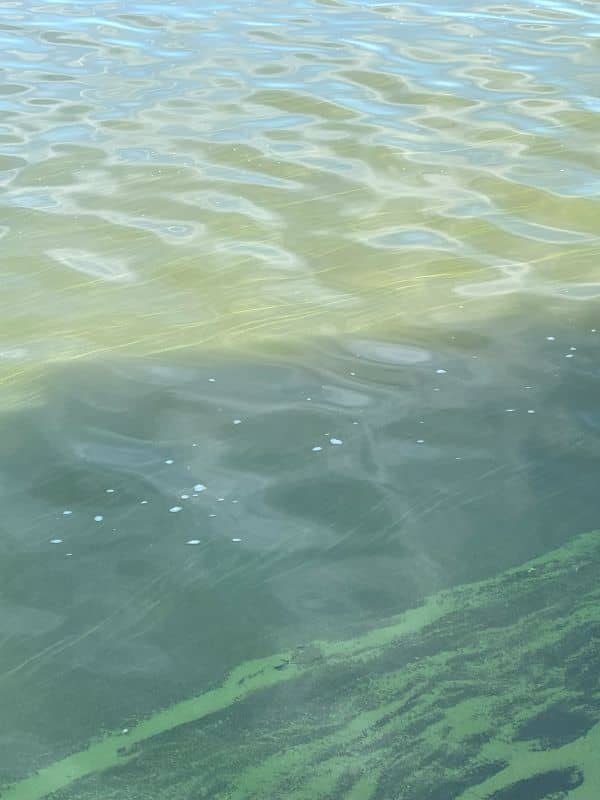
Water rich in nutrients, often from fertilizer provides a food source for aquatic weeds and algae. Algal blooms are usually driven by nutrient load in the water, especially phosphorus and nitrogen; see irrigation water quality for how recycled and dam sources carry these nutrients.
Sunlight
As with all plants Aquatic weeds require sunlight for photosynthesis.
This means that conditions that allow light to penetrate into the water will favour weed growth.
Water
Conditions like still or slow-moving water, also favour aquatic weeds.
Lack of Competition
If native plants are unable to compete effectively for resources (like nutrients and sunlight), aquatic weeds can outgrow them and dominate the area.
Introduction of Alien Species
Alien species, that are intentionnally or accidentally introduced can can quickly become established and spread rapidly. This is especially the case if they are well-adapted to the local conditions.
Temperature
Most aquatic weeds begin to grow in the early Spring when water temperatures are 12.8 to 15.5 °C.
the water temperature also effects how effective herbicides are. Aquatic herbicdes tend to not be very effective when the water is too cold.
Water pH
Certain aquatic weeds can thrive in various pH levels. Some prefer alkaline water and others are more tolerant of acidic conditions.
For example:
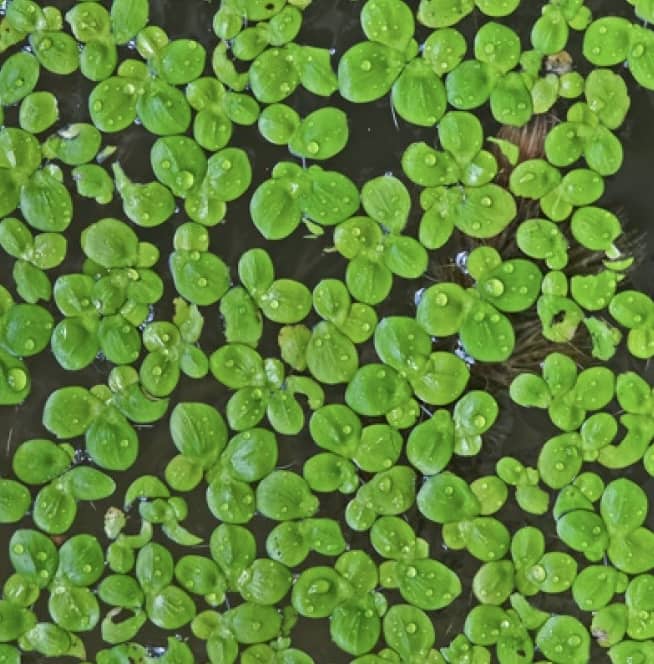
- Duckweed tolerates a pH range of 3.0–10.0, but grows best at a water pH of between 5.0–7.0.It thrives in still or slow-moving water bodies, especially where nutrients are high.
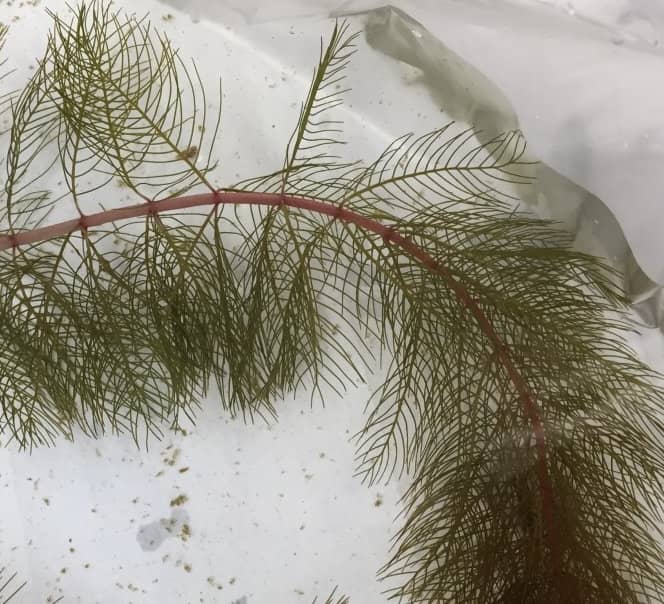
- Hornwort is a submerged aquatic plant that tolerates a wide pH range.
- Hydrilla is relatively tolerant of high water pH levels.
- Water Milfoil favours a slightly alkaline water pH and is is adapted to waters with a high nutrient content.
- Water hyacinth tolerates a wide pH range but prefers alkaline to mildly acidic water.
- Water lettuce also thrives in acidic environments.
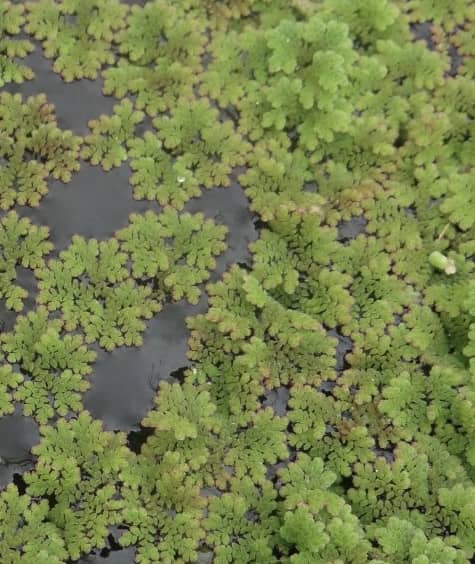
- Salvinia prefers nutrient-rich water with a slightly acidic pH.
- Photosynthesis by some aquatic plants, like Elodea, can actually increase pH levels in the water.
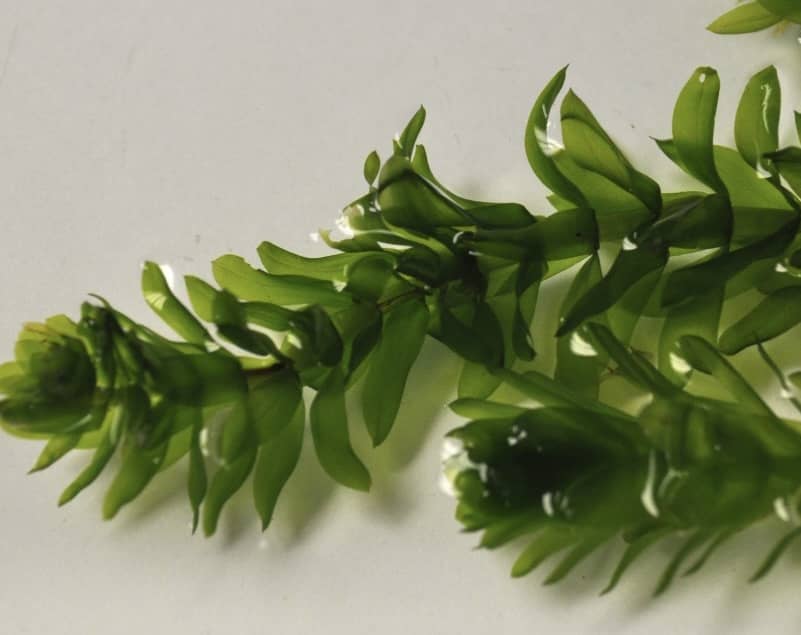
Managing Aquatic Weeds
A successful weed control program depends on:
- The available resources.
- The weeds present.
- The ability to carry out effective control methods.
There are several steps to making any decision when you are managing aquatic weeds.
Identify why there is a problem
If you know why there is a problem it is a major first step into being able to focus on the best way to manage it.
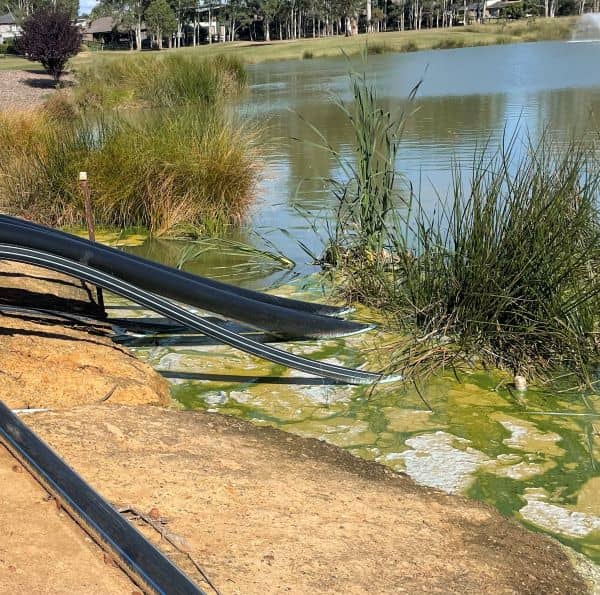
If algae or weeds completely cover a dam identify why this is the case. Nutrient runoff and/or a lack of shade around a dam may create ideal conditions for both of these due to high nutrient levels and bright sunlight.
In this case treat the cause of the problem. If you plant appropriate vegetation around the dam it creates shade, and you can prevent nutrient runoff if you limit nutrient inputs or use slow release nutrient sources.
Do you need to totally get rid of the plant or only partially? Some plants may become a major issue in some seasons but not in others and are therefore only a short term nuisance. Others may proliferate because of temporary conditions, such as low water levels due to drought, but in normal circumstances are less of a problem.
If aquatic weed growth depletes water oxygen levels, and causes fish to die you may need to treat the weed.
However, if your control measures leave dead and decaying plants in the water this can also cause deoxygenation of the water. Large amounts of decomposing plant material lower the dissolved oxygen levels in the water affecting fish and other aquatic organisms.
Whatever approach you take you must consider the long-term consequences of any control method. Using the wrong method could make the problem worse.
Integrated Program to control of Aquatic weeds and algae
The following is an example of a step-by-step integrated program to control aquatic weeds or algae.
- As soon as you see weeds start to mechanically or physically remove them.
- If any plants remain, spot treat with a recommended herbicide. See below.
- If possible dredge the dam to deepen it. Deep water limits sunlight penetration and discourages the growth of plants that root at the bottom.
- Use biological control agents where available, and are practical.
- Create shade around the dam and reduce available sunlight by planting trees to shade the dam. This helps to discourage algae. Failing this consider the use of AgriTec to manage blue-green algae.
- Strategic placement of barriers or booms to contain the weeds and to prevent them from spreading can be highly effective.
Biological Control of Aquatic Weeds
Water Lettuce
Water lettuce (Pistia stratiotes) is controlled biologically by the host-specific weevil Neohydronomus affinis, released in Australia in 1982. It can reduce infestations by 40% or more within 12 to 18 months, but it performs reliably only in tropical and subtropical regions. In cooler southern districts its effect fluctuates with the seasons, so do not rely on this as a stand-alone method south of the subtropics. Biosecurity Queensland can advise on collection sites and release protocols.
The registered herbicides below are part of our wider range of turf and aquatic chemicals; always match the product to the weed, the water use, and the label’s aquatic approval.
Aquatic Weed Herbicides
Scuba 300 Herbicide
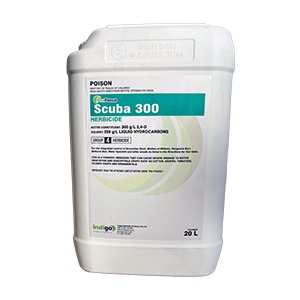
Scuba 300 (Indigo) is a systemic, selective Group 4 (synthetic auxin) herbicide that contains 300 g/L 2,4-D, present as the dimethylamine and diethanolamine salts. It controls emergent and floating broadleaf aquatic weeds such as water hyacinth, and is taken up by foliage and translocated through the plant. It is registered for emergent aquatic weed application by knapsack, hand gun, sprinkler sprayer and helicopter only, applied directly to the weed foliage but not to the point of runoff. Treat no more than half a body of water at one time, with at least 7 days between retreatments, to avoid oxygen depletion as the weed mass breaks down.
Effectiveness drops where target or water pH exceeds 8; an aquatic-approved acidifying surfactant can be added to lower spray-tank pH. As a 2,4-D product it can cause severe damage to susceptible off-target plants (cotton, grapes, tomatoes, ornamentals) through spray drift, so observe drift-management restraints. Always read the label before use.
- A 2,4-D formulation that you can mix with Indigo aquatic products: ProForce 800 Glyphosate, ProForce Slinger 240 (240 g/L Picloram), ProForce Wallop 600 (600 g/L Clopyralid), MetForce 600 WG (600 g/kg Metsulfuron-methy), Flumioxazin, Diquat, Triclopyr or Carfentrazone.
- For Aquatic and Terrestrial use.
- Irrigation Witholding Period: 7 Days.
Clipper Herbicide
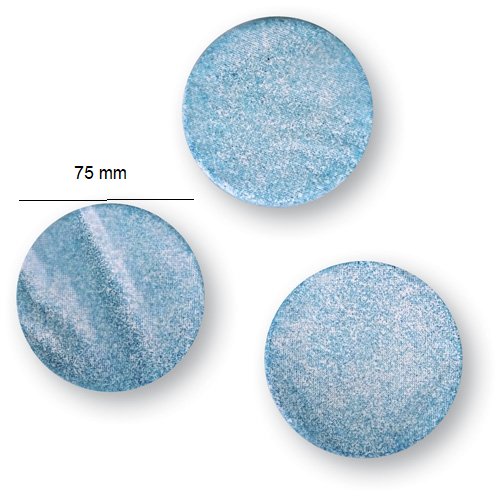
Clipper is a fast-acting contact herbicide containing flumioxazin (15 g/tablet), a Group 14 (PPO-inhibitor) mode of action. It controls a range of submerged, emergent and floating aquatic weeds in non-flowing fresh water and the margins of slow-moving or quiescent dams, lakes and channels. It works best on young, actively growing weeds in water below pH 8 — breakdown accelerates and efficacy drops as pH rises. Flumioxazin is not persistent in water, with a moderately fast breakdown.
Clipper is for use by accredited persons only. The label carries a health warning : flumioxazin causes birth defects in laboratory animals, and women of child-bearing age should avoid mixing, loading or spraying the product. Observe the withholding period of 2 days between treatment and using treated water to irrigate pasture for grazing. Always read the label before use.
- Fast acting Contact herbicide that comes in a 3 Kg Box that contains 20 * 150g tablets.
- For submerged and emergent weeds in still water, Clipper aquatic herbicide (flumioxazin) is a fast-acting contact option.
- Irrigation witholding period: 4 Days.
Diquat Herbicide

Reglone (Syngenta) is a non-selective contact herbicide containing 200 g/L diquat, present as diquat dibromide monohydrate. It acts within the chloroplast, diverting electron flow during photosynthesis to generate free radicals that rupture cell membranes, producing rapid desiccation and defoliation of the green tissue it contacts. It requires light and green leaf to work, kills only the parts of the plant it touches (no translocation), and is inactivated on contact with soil and organic matter, so it leaves negligible residue and poses a low leaching risk.
Reglone contains no wetting agent; a non-ionic surfactant must be added to the spray mixture unless the label specifies otherwise. For submerged aquatic weeds it can be applied below the surface with weighted hoses. Where filamentous algae are present alongside submerged weeds, control improves if the water is pre-treated with a copper-based algaecide. There is no listed stock-drinking-water withholding period, though removing livestock from the treated area for 24–48 hours after spraying is good practice. Always read the label before use.
Rapid Fire 800 Herbicide
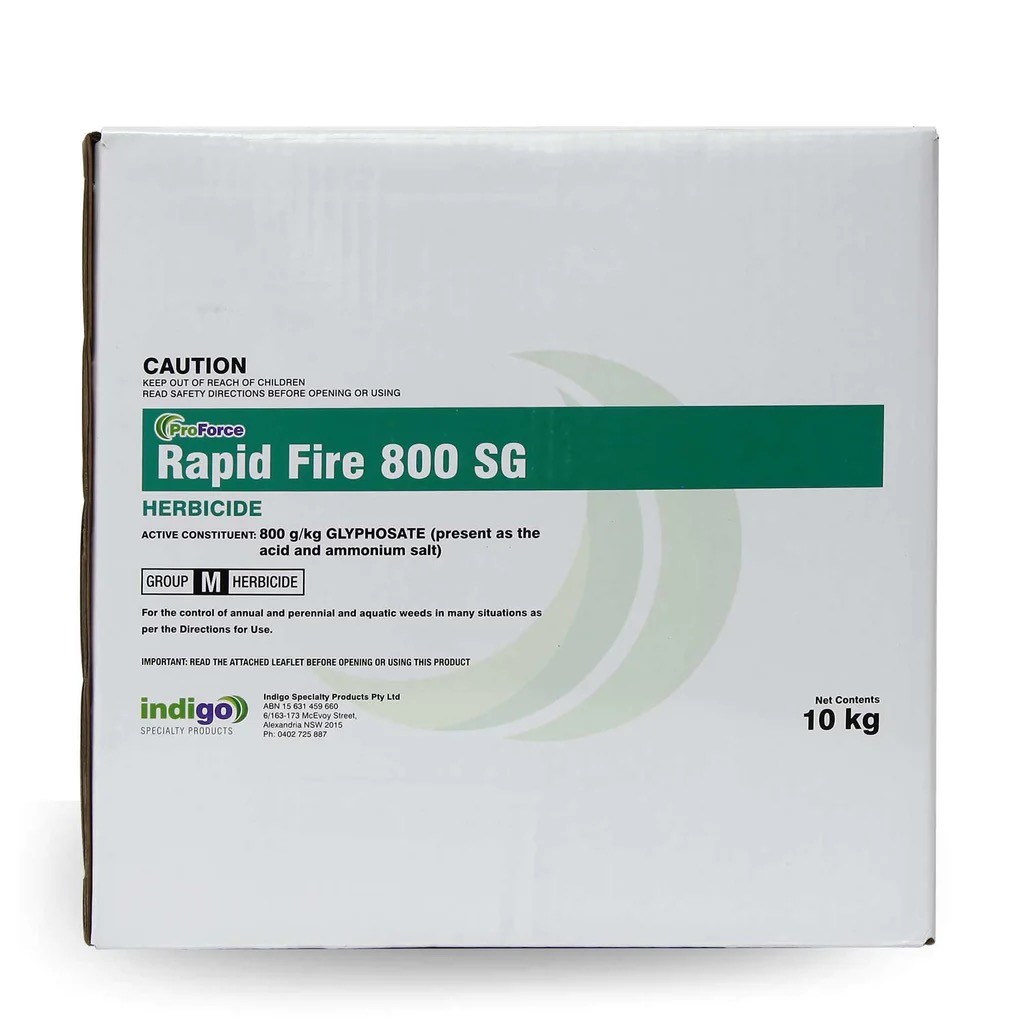
Rapid Fire 800 SG (Indigo) is a non-selective, water-soluble granule containing 800 g/kg glyphosate, present as the acid and ammonium salt, formulated with a high loading of aquatically approved adjuvant so no separate surfactant is required. Unlike contact desiccants, glyphosate is systemic: it is absorbed through foliage and green stems and translocated to the root system, giving slower but more complete kill of perennial and emergent weeds. It is inactivated immediately on contact with soil and provides no residual control.
Glyphosate’s aquatic use is tightly restricted by the APVMA. Standard registered use is limited to dry drains and channels and the dry margins of dams, lakes and streams; application to weeds growing in or over water is only permitted where the specific product formulation is approved as low-risk to the aquatic environment, and some open-water uses are governed by APVMA permit rather than the standard label. Confirm the current label and any applicable permit before any over-water application. Always read the label before use.
In Summary
Hopefully, having read this you are in a better position to know your target weeds and your best options to control them. Not all herbicides have the same spectrum of broadleaf weed control. This means that it is important to know what herbicides can and cannot do, so that you get the best possible results and don’t waste your money.
Herbicide Efficacy vs Aquatic Weeds
Brand and (HRAC Group) | Agritec Copper Pentahydrate | 2,4-D Scuba 300 Herbicide (4) | Clipper Herbicide (14) | Diquat (22) | Glyphosate (9) | ||
Rate | 0.2-1 mg/L Copper | Knapsack: 50 ml/10L Handgun 1L/200L | 27 Tablets /ML water | Knapsack: 50 mL/15 L Handgun: 200 ml/200L | Knapsack: 35-100g/15 L Handgun: 0.5-1.4Kg/200L | ||
Documents | Label MSDS | ||||||
Withholding Period - No Restrictions (NR) | 7 | 4 | 10 | NR | |||
Selective (S) or Non- Selective (NS) | Yes | Yes | No | No | |||
Filamentous Algae | E | P | P | G | P | 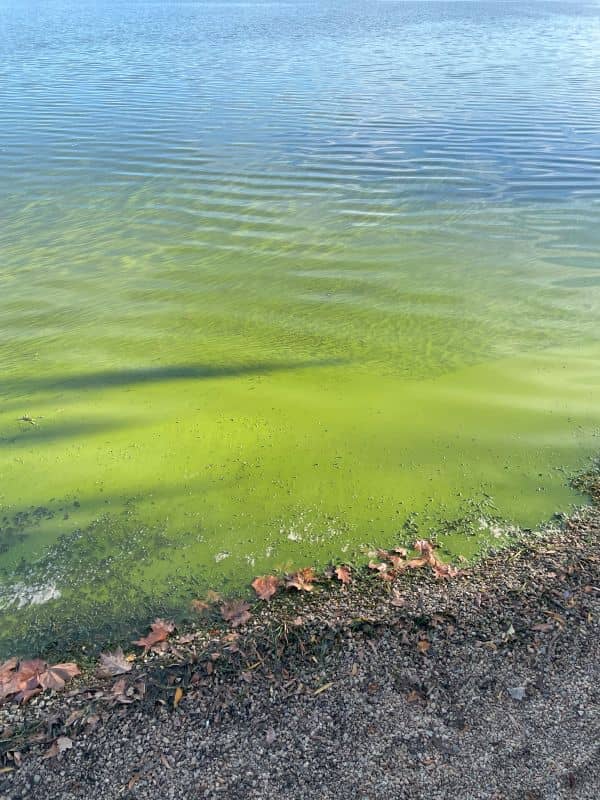
| 
|
Planktonic algae | E | P | P | F | P | ||
Branched (Chara) | E | P | P | G | P | ||
Floating Weeds | No | Yes | Yes | Yes | Yes | ||
Duckweeds | P | E | G | P |
| ||
Water lettuce | P | E | E | E | E | 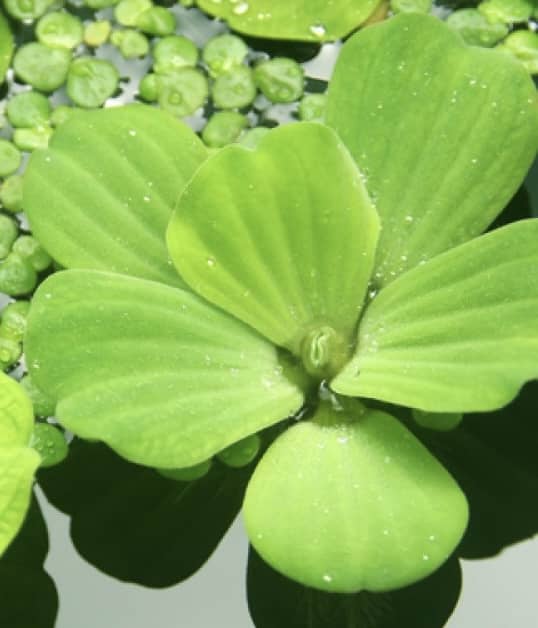
| |
Water hyacinth | P | E | P | E | G | ||
Salvinia | P | E | E | G | E | ||
Red Azolla | P | E | E | G | E |
| |
Water Caltrop | |||||||
Submerged Weeds | No | Yes | Yes | No | |||
Broadleaf watermilfoil | P | - | E | E | P | ||
Elodea | P | - | E | E | P |
| |
Cabomba | - | ||||||
Eurasian watermilfoil | P | E | E | E | P |
| |
Fanwort | P | F | E | G | P | ||
Hydrilla | P | P | E | G | P | ||
Hornwort | |||||||
Pondweed | P | P | E | G | P |

Principal agronomist, Gilba Solutions Pty Ltd
BSc Hons Soil Science (Newcastle). Former STRI agronomist. Author of Nutrition of Sports Turf in Australia (CSIRO/Landlinks Press) and The Definitive Guide to Australian Turfgrass Pesticide Management. 35+ years advising on sports turf, golf and stadia across Australia, NZ, UK and Europe.