
Soil & Rootzone Science For Sports Turf

by Jerry Spencer, Principal Agronomist at Gilba Solutions. BSc (Hons) Soil Science, Newcastle Upon Tyne. Former STRI agronomist. Author of Nutrition of Sports Turf in Australia (CSIRO / Landlinks Press). 35+ years advising on golf, stadia and council sports turf across Australia, New Zealand, the UK and Europe. See case studies of past client work.
Published: 17 May 2026
Soil and rootzone science is the basis for every decision in professional turf management. The physical, chemical and biological condition of the rootzone controls drainage, nutrient uptake, gas exchange, root depth and the long-term stability of the playing surface under traffic.
To effectively manage this you need to understand soil test data, sufficiency frameworks such as MLSN, cation exchange capacity, organic matter build-up, and infiltration behaviour and amendment response on both sand and soil-based profiles. Without this foundation, nutrition programs misfire, drainage problems persist, and surface performance becomes inconsistent.
This pillar combines peer-reviewed soil science with field-tested practice. It covers MLSN nutrient sufficiency, rootzone physics, sodium and infiltration management, organic matter control, biological amendments and the practical use of gypsum, compost and mycorrhiza in intensively managed turf systems.
For day-to-day use of these frameworks on a specific site, the GAIP Hub integrates soil test interpretation, MLSN recommendations and amendment calculators in one platform.
What This Topic Covers
MLSN and Soil Nutrition
Precision fertility management for intensively managed turf, that is built on minimum sufficiency levels rather than conventional SLAN ranges. This reduces over-use, leaching and inputs while sustaining surface performance.
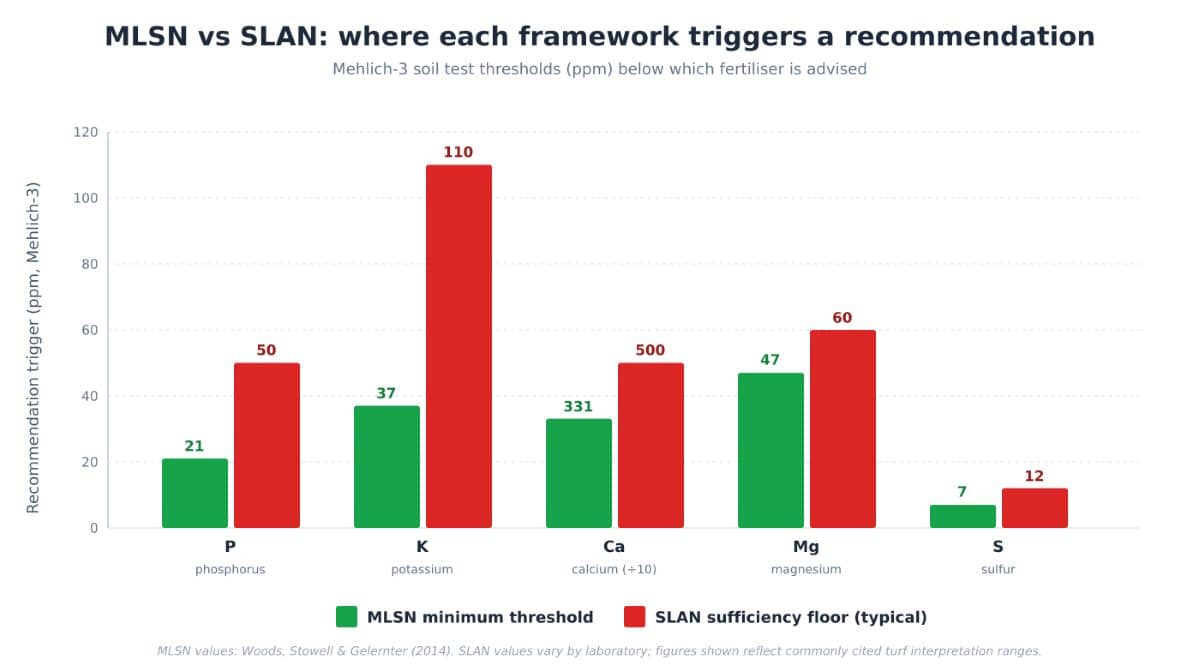
The MLSN framework sets fertiliser use rates at the actual minimum soil levels below which turf shows a response. Numbers in ppm Mehlich-3 extraction.
- How to manage turf nutrition
- Soil test interpretation
- Precision fertility programs
- Sand rootzone performance
Rootzone Chemistry and Physics
The physical and chemical drivers of infiltration, gas exchange, water retention and surface firmness. This includes aeration response, the impact of fines on sand profiles, and how compaction and hydrophobicity develop over time.
- Soil aeration
- Rootzone permeability
- Soil compaction
- Hydrophobicity in sand profiles
Sodium, Calcium and Salinity Management
Sodium build-up and SAR effects on rootzone structure, the role of gypsum and other calcium sources, and recovery protocols for flooded or saline-irrigated turf systems.
- How to manage SAR and drainage
- Gypsum and calcium management
- Recycled irrigation water
- Flood recovery in turf systems
Organic Matter Management
Organic matter build-up in the soil rootzone is the dominant cause of falls in infiltration and soft golf greens. Includes dilution strategies, aeration intensity and topdressing programs.
- Organic matter build-up in the upper rootzone
- Sand dilution rates and topdressing
- Loss-on-ignition (LOI) testing by depth
- Couch decline and OM-driven disease pressure
Soil Biology and Amendments
The role of soil microbiology, mycorrhizae, organic fertilisers and biological stimulants in turf systems. Evidence-based assessment of where biologicals work, where they fail, and what limits their performance.
- Organic fertilisers in turfgrass
- Mycorrhizae in turfgrass
- Soil amendments for sand constructions
- Rootzone biology and microbial function
Cation Exchange and Soil Chemistry
Cation exchange capacity, base saturation interpretation, pH management and the chemistry of nutrient availability in both sand and soil-based rootzones.
- CEC and exchangeable cations
- Base saturation interpretation (BCSR vs MLSN)
- How to manage soil pH on sand profiles
- Nutrient supply and pH interactions
- Soil Manganese
- Interpreting soil tests
- Soil sulphur
- Magnesium in the soil
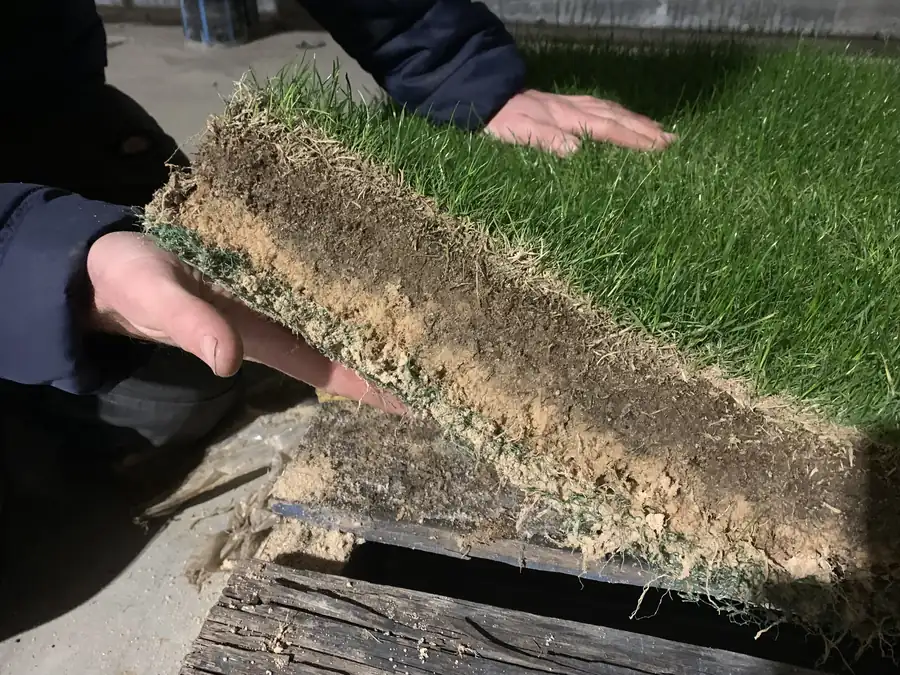
When should gypsum be used on sports turf soils?
Gypsum corrects sodium build-up or low calcium where there is a breakdown in soil structure, infiltration loss, surface instability or dispersion shows in the rootzone. It supplies soluble calcium with no increase in soil pH, displaces sodium from cation exchange sites, and restores aggregation and permeability.
It works best where soil tests or irrigation water confirm sodium is high relative to calcium and magnesium. This is common with recycled or saline water, and on sand-based sports fields and golf courses where the drainage drives surface performance.
Don’t apply it blindly. How effective gypsum is depends on SAR, ESP, drainage capacity, and whether the leaching fraction is enough to flush displaced sodium out of the rootzone. Without drainage, gypsum mobilises sodium but doesn’t remove it.
You calculate the use rate from soil test data (exchangeable Na, Ca, Mg) and water analysis (SAR, residual sodium carbonate). Fine-particle gypsum outperforms agricultural grade on established turf.
How does excess organic matter affect putting greens?
Organic matter build-up in the top 0 to 40 mm of a golf green is the single most common cause of poor drainage, surface softness and uneven moisture. As organic matter builds up, pore spaces shrink, capillary water retention rises, and oxygen diffusion drops. This results in shorter roots. If this build-up continues, a layer forms at the organic matter to sand interface, and that’s where a perched water table develops. Under irrigation or rainfall, this layer holds moisture, softens the surface, and creates conditions that favour root pathogens such as Pythium spp.
Sand-based USGA greens are particularly sensitive. Their physical properties (infiltration rate, air-filled porosity, capillary porosity) are calibrated to a specific particle size distribution. Above about 4% organic matter by weight in the top 25 mm, these properties start to break down. Proper management is based on dilution: coring, hollow-tine aeration, deep scarification and regular sand topdressing. Annual sand inputs of 1.0 to 1.5 m³/100m² are typical on intensively managed greens. LOI testing by depth should set the intensity, not the calendar.
Where organic matter accumulation drives water repellency, the interaction between thatch breakdown and the build-up of hydrophobic compounds becomes the main cause of localised dry spot.
Do biological soil amendments improve turf performance?
Biological amendments can improve turf performance in some cases. However, the results are inconsistent, and they depend heavily on the rootzone. For example, products with mycorrhizae, plant growth-promoting rhizobacteria (PGPR), Trichoderma spp., humic substances and compost-derived stimulants are sold to boost root growth, nutrient cycling and stress tolerance.
In the field, though, the response varies. It shifts with the rootzone, with phosphorus availability (because high P suppresses mycorrhizae), with fungicide use, and with organic matter, irrigation and soil temperature. Moreover, in intensively managed turf, the limiting factor is usually physical or chemical rather than biological. On the physical side, that means compaction, layering or lost drainage. On the chemical side, it means sodium build-up, salinity or pH extremes. In other words, the size of the microbial population is rarely the problem.
Mycorrhizae show this clearly. As a rule, they establish poorly on mature, fertilised turf, since native populations already exist and high P inputs suppress the symbiosis. By contrast, they are far more likely to deliver a measurable benefit on new constructions, sterile sand profiles or low-input systems.
Therefore, you should evaluate biological products alongside physical and chemical management, not as a substitute for it. After all, where rootzone physics is the limit, no biological input will compensate. Ultimately, the only reliable test is a site trial: use control plots, and measure clear endpoints.
How does sodium reduce infiltration in sand-based rootzones?
Sodium breaks down soil structure by causing dispersion, but this depends on having dispersible fines present. The particles involved are clay, silt and organic colloids. As sodium builds up on the cation exchange sites, it pushes off calcium and magnesium and weakens the bonds that hold soil aggregates together. As a result, the fines migrate and block pore spaces, so infiltration and hydraulic conductivity drop.
This matters most on push-up greens and native-soil profiles, where there is plenty of clay to disperse. To quantify the risk, the sodium adsorption ratio (SAR) puts a number on the sodium imbalance in the water. For reference, the FAO-29 model reads SAR alongside salinity: in the SAR 3 to 6 band it flags a moderate to severe infiltration risk, but mainly on structured soils irrigated with low-salt water (below about 1.0 dS/m EC).
A clean USGA sand rootzone behaves differently. Obear and Soldat (2014) found that increasing exchangeable sodium did not reduce saturated hydraulic conductivity in five of six sand rootzone mixes; only a mix containing about 4.8% clay lost conductivity as ESP rose. In other words, with very little clay to disperse, sand greens are largely insensitive to the sodium thresholds derived from agricultural soils. The authors note that they did not test unsaturated flow or localised clay lenses, so the finding argues for adjusting the thresholds on sand, not ignoring sodium altogether. On sand, then, the concerns that actually matter are salinity and osmotic stress, ion toxicity, bicarbonate raising the effective SAR, and dispersion in the organic-rich surface mat as the green ages. Manage those through EC monitoring, leaching, and surface organic-matter control rather than by chasing a single SAR number.
For situations where watering programming intersects with sodium management, the irrigation calculator helps.
What is MLSN and how does it differ from traditional soil testing?
MLSN (Minimum Levels for Sustainable Nutrition) is a soil test interpretation framework developed by Woods, Stowell and Gelernter at PACE Turf and the Asian Turfgrass Center for intensively managed turfgrass. It identifies the minimum soil nutrient levels at which turf performance holds up, and then it bases recommendations on projected plant uptake plus a buffer that keeps soil reserves above that minimum.
In practical terms, the MLSN minimum guidelines (Mehlich-3 extraction) sit at roughly: phosphorus 21 ppm, potassium 37 ppm, calcium 331 ppm, magnesium 47 ppm, and sulphur 7 ppm. Importantly, these figures came from analysis of thousands of soil samples taken from healthy turf, which in turn pinpointed the limits where performance still stayed acceptable.
By contrast, Sufficiency Level of Available Nutrients (SLAN) interpretations call for nutrient additions to reach a target sufficiency range. However, this target often sits well above the level at which turf actually responds. As a result, on sand-based rootzones with little capacity to hold nutrients, SLAN can push overuse and lift leaching losses.
For that reason, MLSN is most relevant on sand-based golf greens and high-performance turf, where precision matters, leaching is real, and input cost is significant. Today, the framework is widely adopted across golf course agronomy and is also applied to other intensively managed turf systems. Even so, it does not replace soil testing; rather, it simply changes how the results are read and turned into recommendations.
For MLSN-aligned fertiliser products calibrated to sand-based rootzones, see the Gilba Solutions range.
How is cation exchange capacity used in turf soil management?
Cation exchange capacity (CEC) measures how well a soil holds positively charged ions (calcium, magnesium, potassium, sodium and ammonium) on the negatively charged surfaces of clay and organic matter. In terms of units, you record the CEC in centimoles of charge per kg (cmolc/kg) or milliequivalents per 100 grams (meq/100g), and the two are identical.
Sand-based rootzones tend to sit below 5 cmolc/kg, and sometimes below 2. In contrast, loam and clay soils run from 10 to 40. When the CEC is low, the soil holds few nutrients, so any fertiliser that you apply is more likely to leach out of the rootzone. On top of that, the soil also resists pH change less well. For these reasons, sand-based greens need more frequent, lower-rate fertiliser applications, along with closer attention to pH, than push-up soil greens.
Base saturation, meanwhile, is the share of CEC taken up by the base cations (Ca, Mg, K, Na), and it is sometimes used to set fertiliser ratios. For instance, the Basic Cation Saturation Ratio (BCSR) approach targets specific proportions, such as 65% Ca and 10% Mg. However, research to support BCSR in turf is thin, and in practice it often leads to over-fertilising. By contrast, MLSN-based interpretation works from absolute nutrient levels rather than ratios, which makes it more defensible.
Finally, the most useful base-saturation number in turf is exchangeable sodium percentage (ESP), which is the share of CEC taken up by sodium. Above 15%, conditions are sodic, and the risks include damage to soil structure and reduced permeability.
What causes hydrophobicity in sand-based rootzones?
Hydrophobicity, also called water repellency or localised dry spot, develops when waxy compounds coat sand particles and stop water from moving into the rootzone. As a result, you get patchy, irregular dry areas that resist both irrigation and rainfall, even when the ground next to them is waterlogged.
The main cause is organic compounds. These come from microbial decomposition, root exudates and thatch breakdown, and chemically they are long-chain fatty acids and aliphatic compounds. In addition, fungi play a major role. In particular, basidiomycetes in the order Agaricales, the fairy-ring fungi, produce waxy by-products that bind tightly to sand particles.
Several factors raise the risk:
- Sand-dominant rootzones, because their large pores dry out quickly.
- Warm temperatures, which drive microbial activity.
- Drought stress.
- High organic matter in the upper profile.
In practice, sand particles dry from the surface inward. This then exposes the waxy coatings, and once dry, those surfaces resist rewetting.
To manage the problem, three things work together:
- Surfactant programs, using soil wetting agents based on block copolymers, alkyl polyglucosides or related chemistries.
- Cultural practices that keep organic matter in check.
- Irrigation strategies that hold surface moisture without overwatering.
Curative wetting-agent applications can recover affected areas. However, preventive programs run through the season are more reliable. To quantify severity, meanwhile, use either the molarity of ethanol droplet (MED) test or the water drop penetration time (WDPT) test. Both measure how strongly a surface resists wetting. In turn, that result tells you how aggressive the program needs to be.
How is soil compaction managed in intensively used sports turf?
Compaction reduces total pore space, and especially air-filled pores. Heavy traffic squeezes soil aggregates and pores together, and as a result, you get slow water infiltration, short roots, low oxygen, weak growth and lower wear tolerance. On sports fields and high-traffic areas of golf courses, you can’t avoid compaction. Therefore, it has to be actively managed.
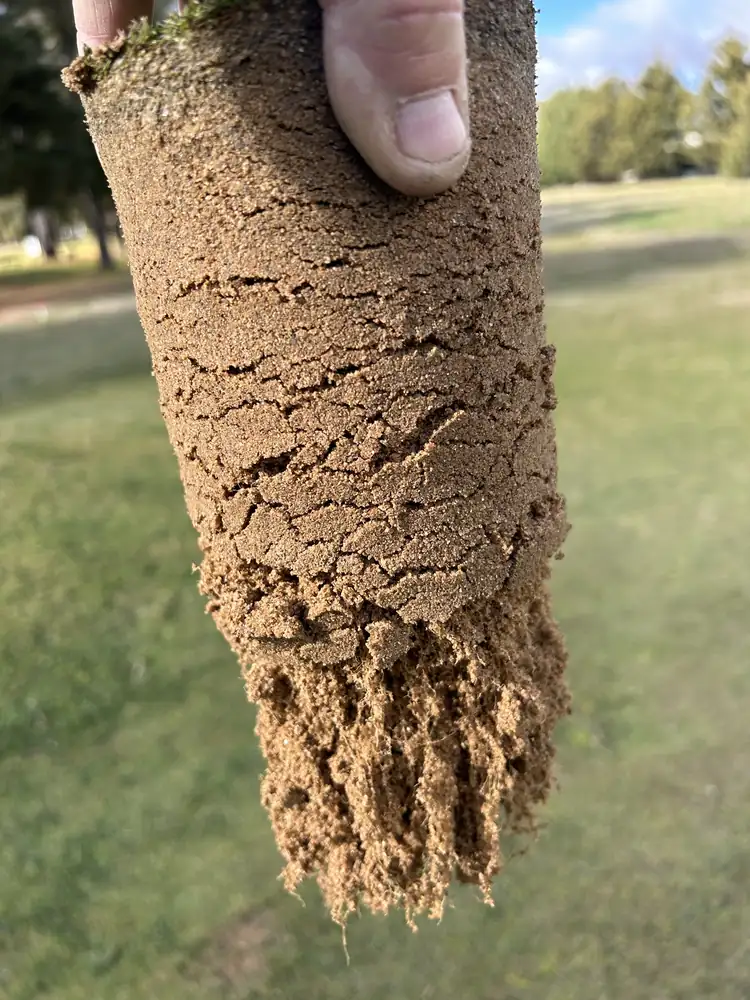
Soil core from a new green with a good agronomic program.
For diagnosis, combine penetrometer readings, infiltration rate testing (with an infiltrometer), bulk density samples, and a visual check of root depth and rootzone colour. As a guide, bulk density above 1.4 g/cm³ in sandy soils, or above 1.6 g/cm³ in loams, points to compaction that’s holding back root growth.
Mechanical aeration uses several methods:
- Hollow-tine coring, which removes cores so topdressing can backfill the holes
- Solid-tine aeration, which fractures the soil without removing a core
- Deep tine aeration at 200 to 300 mm depth, which targets deep seated compaction
How often you aerate depends on traffic. For instance, golf greens are often aerated two to four times a year. In contrast, sports fields are aerated after each season, and in the season when access allows.
Ultimately, prevention beats recovery. To help prevent this, traffic management (rotate practice areas, move goals, restrict access when the surface is wet), correct mowing, and encouraging deep roots all reduce how easily a surface compacts. Notably, sand-based rootzones resist compaction better than soil-based rootzones, which is the main reason high-performance surfaces are built on sand profiles.
For more detail on relief programs, see the science behind soil aeration.
Key Considerations Across Soil & Rootzone Management
Physical Properties
- Particle size and construction specifications (USGA, sand-soil, native)
- Total porosity, air-filled and capillary porosity
- Saturated and unsaturated water flow
- Bulk density and penetration resistance
- Drainage rate under field conditions
- Rootzone layering and perched water tables
- Organic matter content by depth (loss-on-ignition)
Chemical Properties
- Soil pH and buffer capacity
- Cation exchange capacity and exchangeable cations
- Mehlich-3 or Olsen available nutrients
- Sodium adsorption ratio and exchangeable sodium percentage
- Electrical conductivity and total soluble salts
- Bicarbonate and residual sodium carbonate (irrigation water)
- Magnesium use in dispersive soils
- Trace elements (Fe, Mn, Zn, Cu, B)
- Soil pH, calcium and rootzone health over winter.
Biological Properties
- Microbial biomass and respiration rate
- Mycorrhizal considerations
- Thatch decomposition rate and quality
- Root pathogens (Pythium, Magnaporthe)
- Earthworms in soil-based profiles
- Response history to microbial amendments
Management Drivers
- Traffic intensity and timing
- Irrigation water quality and uniformity
- Mowing height, frequency and clipping returns
- Fertiliser source, rate, timing and placement
- Topdressing and aeration frequency
- Surfactant and amendment program design
- Climate, ET demand and seasonal stress patterns
References
Bond, R.D. (1969). Factors responsible for water repellence of soils. Water Repellent Soils.
Carrow, R.N. and Duncan, R.R. (2012). Salinity and Turfgrass Management.
Carrow, R.N., Waddington, D.V. and Rieke, P.E. (2001). Turfgrass Soil Fertility and Chemical Problems: Assessment and Management.
Dane, J.H. and Topp, G.C. (eds) (2002). Methods of Soil Analysis, Part 4: Physical Methods. Soil Science Society of America.
Doerr, S.H., Shakesby, R.A. and Walsh, R.P.D. (2000). Soil water repellency: its causes, characteristics and hydro-geomorphological significance. Earth-Science Reviews, 51(1-4): 33-65.
Karnok, K.J. and Tucker, K.A. (2001). Wetting agent-treated hydrophobic soil and its effect on color, quality and root growth of creeping bentgrass. International Turfgrass Society Research Journal, 9: 537-541.
McCarty, L.B., Gregg, M.F. and Toler, J.E. (2007). Thatch and mat development in seven creeping bentgrass cultivars and roughstalk bluegrass under heavy traffic. Crop Science, 47(5): 2073-2080.
Murphy, J.A., Rieke, P.E. and Erickson, A.E. (1993). Core cultivation of a putting green with hollow and solid tines. Agronomy Journal, 85(1): 1-9.
Obear, G.R. and Soldat, D.J. (2014). Saturated hydraulic conductivity of sand-based golf putting green root zones affected by sodium. Soil Science 179(8): 376-382.
Soil Science Society of America (2008). Glossary of Soil Science Terms. SSSA.
Stier, J.C., Horgan, B.P. and Bonos, S.A. (eds) (2013). Turfgrass: Biology, Use, and Management. Agronomy Monograph 56. ASA-CSSA-SSSA, WI.
USGA Green Section Staff (2018). USGA Recommendations for a Method of Putting Green Construction. USGA.
Woods, M.S., Stowell, L.J. and Gelernter, W.D. (2014). Minimum soil nutrient guidelines for turfgrass developed from Mehlich 3 soil test results. PACE Turf and Asian Turfgrass Center.
York, C.A. and Baldwin, N.A. (1992). Dry patch on golf greens: a review. Journal of the Sports Turf Research Institute, 68: 7-19.

Principal agronomist, Gilba Solutions Pty Ltd
BSc Hons Soil Science (Newcastle). Former STRI agronomist. Author of Nutrition of Sports Turf in Australia (CSIRO/Landlinks Press) and The Definitive Guide to Australian Turfgrass Pesticide Management. 35+ years advising on sports turf, golf and stadia across Australia, NZ, UK and Europe.