

When your soil test says ‘deficient’ but the grass is fine
A soil test result is an index, not a verdict. The same green can come back “deficient” from one laboratory and “adequate” from another without a single thing changing in the ground. That’s because two decisions sit between the soil and your recommendation:
- Which chemical extractant the lab used, and
- which interpretation model reads the numbers.
Mehlich III, ammonium acetate and Colwell each extract from a different-sized pool. This means that their parts-per-million figures are not interchangeable. On top of that, three interpretation schools disagree about what “enough” even means: base cation saturation (BCSR), sufficiency (SLAN), and the minimum levels for sustainable nutrition (MLSN).
On a sand rootzone with low cation exchange capacity, base-saturation ratio targets tend to create deficiencies that a sufficiency or mass-balance interpretation does not. Before you act on any “deficient” flag, check the extractant, compare the value against a method-matched benchmark, and treat saturated-paste “available” numbers with caution.
That is the whole article in a paragraph. The rest is why each piece matters, and how to pull your own report apart before it pulls money out of your budget.
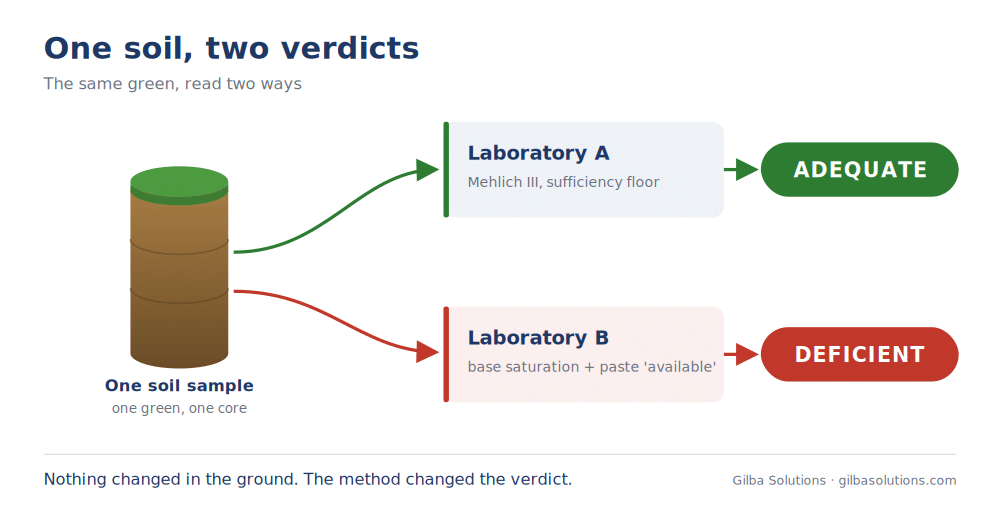
The same soil, two verdicts
I have seen the same green tested by two suppliers within a single season and seen the calcium return as “optimal” on one report and “deficient” on the other. Nobody was lying. They used different extractants.
An extractant is the chemistry the lab uses to strip nutrients out of the soil so it can measure them. Mehlich III is aggressive and pulls a larger pool. Ammonium acetate reports the exchangeable cations. Colwell, the old Australian standard for phosphorus, pulls something different again.
Feed the same soil to different methods and the same nutrient comes back as different numbers. None of these are wrong, and none of them are comparable. So the first question on any report is not “what does it say”, it is “how did they measure it”. If the method is not printed on the page, ring the lab and ask before you read a single value.
This is also why switching suppliers can look like a soil change when it is only a method change. A club moves from Lab A to Lab B, the potassium figure drops, and everyone assumes the soil crashed over winter. Usually the soil did nothing. The extractant changed.
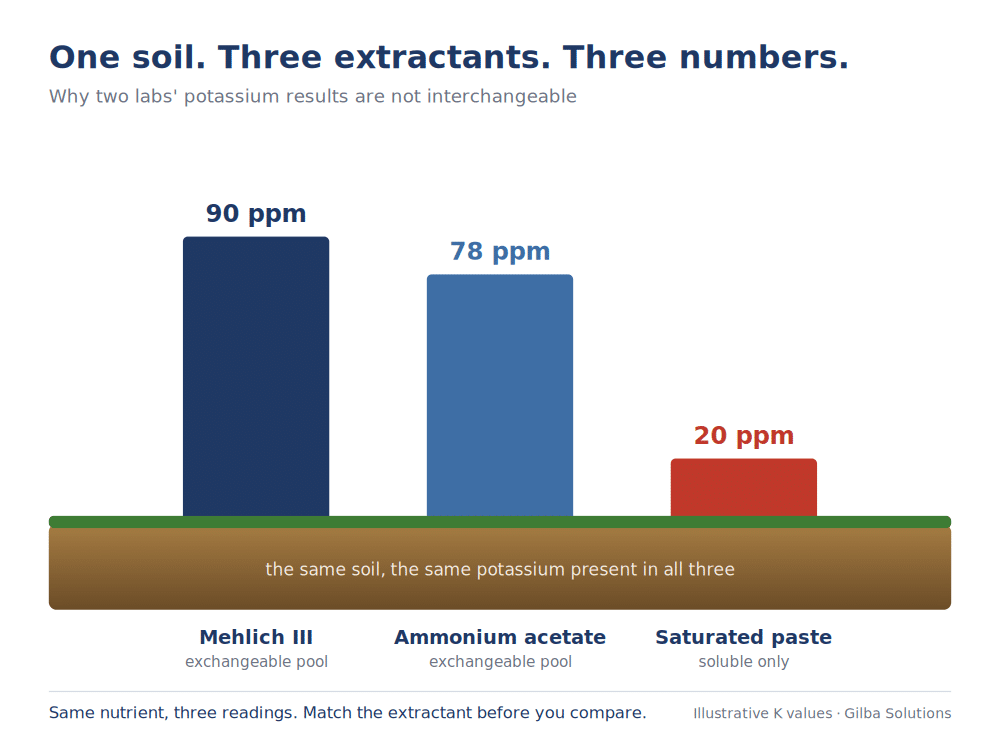
Three ways to read the same number
Once you have a number, the interpretation model decides whether it is a problem.
Base cation saturation ratios (BCSR) chase an “ideal” balance of calcium, magnesium and potassium as percentages of the exchange. For example this is something like 65 to 80% for calcium and so on. It is the traditional school of thought and the one most likely to give a deficiency. This is simply because a soil rarely lands on the textbook ratio. The trouble is that the ideal-ratio idea was never well supported by the data. University soil labs have been saying for decades that fertilising to reach a prescribed calcium-to-magnesium ratio is not justified by any turf response.
Sufficiency (SLAN) asks a simpler question: is there enough of each nutrient in the pool for the plant, yes or no. No ratio chasing, just a threshold.
MLSN is the newest and to many, the most defensible on modern sand-based turf. It sets a minimum level below which turf quality suffers. It then works out the amount of fertiliser from a mass balance equation. Estimate what the plant removes, add a reserve, and credit whatever the soil already supplies above the floor.
The published Mehlich III floors are calcium 331, magnesium 47, potassium 37, phosphorus 21 and sulphur 6 parts per million (Woods, Stowell and Gelernter 2014). Those numbers are the thing to hold a Mehlich III result against. A green sitting at 620 ppm calcium is not calcium-deficient by that yardstick, whatever the base-saturation pie chart implies. It is nearly double the floor.
One caveat so I am not overselling it: MLSN was released through preprint and extension channels rather than a peer-reviewed journal. Its strength is that you can see the dataset and the logic and argue with them, and independent peer-reviewed trials have since tested it against sufficiency and broadly support holding turf quality at lower inputs. Transparency and replication, not a journal badge, are what stand behind it.
The ‘total versus available’ trap
Some reports split each nutrient into a “total” figure and an “available” figure. They then quietly base the recommendation on the low “available” number. The available fraction usually comes from a saturated paste extract, which reads the nutrients dissolved in the soil solution at the moment of sampling.
A paste test is genuinely useful for what it is good at. That’s spotting soluble salt, sodium and chloride build-up. It is a poor basis for a bulk fertiliser recommendation, because the soil solution swings with moisture, recent rainfall and irrigation. If you sample after a dry spell, the “available” calcium levels will look alarming. Water in and it changes.
If a report tells you the total is fine and the available is deficient, and then sells you a large bulk application off the available nutrient, be sceptical. You are being shown the most volatile measurement on the page and asked to treat it as the truth.
Why base saturation falls apart on sand
Cation exchange capacity is the soil’s capacity to hold nutrients on its surfaces. A push-up green heavy in clay might have a CEC of 15 or 20. A modern sand rootzone often sits at 3 to 7. That difference matters more than most reports tell you.
On a low-CEC sand there simply are not many exchange sites. As a result the base saturation percentages you spread across them are noisy and easy to over-read. An “ideal” target of 1300 ppm calcium is physically a “waste of effort” on a sand that can only hold a fraction of that. The honest labs say so on the page. I have seen a good report print, next to the base-saturation chart on a very low-CEC green, a plain note that the saturation levels are irrelevant until the CEC improves, and make no product recommendation at all. That is the correct call.
A report that keeps chasing ideal ratios on a CEC of 3 is applying a clay-soil framework to a sand and inventing work.

How to sanity-check your own report
You do not need a soil science degree to catch the common over-calls. Check any report against these:
- Find the extractant. If it is not stated, get it before you interpret anything.
- Hold Mehlich III nutrients against the MLSN floors above.Anything comfortably over the floor is not deficient, whatever the ratio commentary says.
- Distrust any recommendation driven by a saturated-paste “available” number while the total is actually fine.
- Check the CEC. Under about 6, treat base-saturation “ideal ratios” as background noise, not targets.
- Ask whether the recommended product happens to be the supplier’s own. Interpretation and sales sitting in the same hand is not a reason to ignore the advice, but it is a reason to get a second read.
What actually limits the grass
The irony of the deficiency-hunting report is that it buries the real problem under invented ones. On many coastal greens I see, the genuine constraint is rarely a missing cation. It is sodium and chloride from the irrigation water, and it is nitrogen-driven growth. When two different testing methods on the same site both flag sodium, that agreement is worth more than any single fancy number, and that is where I would spend the first dollar.
If your last soil report left you with a shopping list and a vague unease that half of it might be unnecessary, that instinct is usually right. I read across all the major testing systems, normalise them onto a common footing, and tell you which flagged deficiencies survive a method-matched check and which do not. Often the honest answer is a lighter, cheaper program than the one you were handed. Send me the report and I will show you on your own numbers.
Jerry Spencer is the principal agronomist at Gilba Solutions, an independent sports turf and agronomy consultancy. BSc (Hons) Soil Science, 35 years in the field, published through CSIRO/Landlinks Press.
Further Reading
This article is part of the Sports Turf Agronomy and Turf Physiology and PGRs series. Related reading:
- GAIP Hub
- MLSN in turfgrass systems
- CEC in root zone media
- Sodium in turf soils
- Managing nutrients in turfgrass
- The dumbing down of turfgrass agronomy
About the Author
Jerry Spencer is Principal Agronomist at Gilba Solutions Pty Ltd, an independent agronomic consultancy based in Bowral, NSW. He holds an Honours degree in Soil Science from the University of Newcastle Upon Tyne and has 35+ years of experience in turf and soil management. He is the author of a CSIRO/Landlinks Press monograph on sports turf nutrition and serves as an LGP panel agronomist.

Principal agronomist, Gilba Solutions Pty Ltd
BSc Hons Soil Science (Newcastle). Former STRI agronomist. Author of Nutrition of Sports Turf in Australia (CSIRO/Landlinks Press) and The Definitive Guide to Australian Turfgrass Pesticide Management. 35+ years advising on sports turf, golf and stadia across Australia, NZ, UK and Europe.