
Pre-Emergent and Post-Emergent Herbicide Timing Chart for Australian Turf
A pre-emergent timing chart that shows when to apply post-emergent and pre-emergent herbicides to common Australian turf weeds, month by month. Orange cells mark the post-emergent window when weeds are actively growing and taking up herbicide. Blue cells mark the pre-emergent window, when herbicide must be applied before germination begins.
The original data comes from Clemson University HGIC 2334 (Smith & Gore), shifted six months for the Southern Hemisphere. Several windows have been adjusted based on field observations across NSW, VIC, and QLD. Timing will vary with latitude and seasonal conditions. For precision, monitor soil temperature at 50 mm depth rather than relying on calendar dates.
All products must hold current APVMA registration. Check at portal.apvma.gov.au before use.
How to Read This Chart
The chart is divided into three sections: grass weeds, broadleaf weeds, and sedges. Each row shows one weed species with its common and scientific name, life cycle classification, any special notes, and a 12-month calendar running from July to June (the Australian financial year, which aligns with the seasonal transition from winter dormancy through summer growth and back).
Grass Weed Timing
| Weed | Latin Name | Life Cycle | Notes | Jul | Aug | Sep | Oct | Nov | Dec | Jan | Feb | Mar | Apr | May | Jun |
|---|---|---|---|---|---|---|---|---|---|---|---|---|---|---|---|
| Bahia Grass | Paspalum notatum | WSP | |||||||||||||
| Barnyard Grass | Echinochloa crus-galli | SA | |||||||||||||
| Common Couch Grass | Cynodon dactylon | WSP | |||||||||||||
| Summer Grass / Crabgrass | Digitaria spp. | SA | |||||||||||||
| Crowsfoot / Goosegrass | Eleusine indica | SA | |||||||||||||
| Dallisgrass / Paspalum | Paspalum dilatatum | WSP | |||||||||||||
| Panicum Grass | Panicum spp. | SA | |||||||||||||
| Foxtail | Setaria spp. | WSP | |||||||||||||
| Parramatta Grass | Sporobolus africanus | WSP | |||||||||||||
| English Couch | Elymus repens | CSP | |||||||||||||
| Ryegrass, Annual | Lolium rigidum | WA | |||||||||||||
| Winter Grass / Poa annua | Poa annua | WA | |||||||||||||
| Sand Burr / Hedgehog Grass | Cenchrus spp. | SA | |||||||||||||
| African Lovegrass | Eragrostis curvula | WSP | |||||||||||||
| Windmill Grass | Chloris truncata | SA | |||||||||||||
| Guildford Grass | Romulea rosea | CSP |
Broadleaf Weed Timing
| Weed | Latin Name | Life Cycle | Notes | Jul | Aug | Sep | Oct | Nov | Dec | Jan | Feb | Mar | Apr | May | Jun |
|---|---|---|---|---|---|---|---|---|---|---|---|---|---|---|---|
| Bindweed | Convolvulus arvensis | WSP | |||||||||||||
| Bittercress | Cardamine spp. | WA | |||||||||||||
| Mexican Clover | Richardia brasiliensis | WSP | Requires 2+ applications | ||||||||||||
| Capeweed | Arctotheca calendula | WA | |||||||||||||
| Catsear / Flatweed | Hypochaeris radicata | CSP | |||||||||||||
| Chickweed, Common | Stellaria media | WA | |||||||||||||
| Chickweed, Mouse-ear | Cerastium spp. | CSP | |||||||||||||
| Clover, White | Trifolium repens | CSP | |||||||||||||
| Creeping Oxalis | Oxalis corniculata | WA/CSP | |||||||||||||
| Cudweed | Gamochaeta spp. | WA/B | |||||||||||||
| Dandelion | Taraxacum officinale | CSP | |||||||||||||
| Dichondra | Dichondra repens | WSP | |||||||||||||
| Dock, Broadleaf | Rumex obtusifolius | CSP | |||||||||||||
| Dock, Curly | Rumex crispus | WSP/CSP | |||||||||||||
| Dollar Weed / Pennywort | Hydrocotyle spp. | WSP | |||||||||||||
| Fleabane | Conyza spp. | SA/WA | |||||||||||||
| Geranium, Carolina | Geranium carolinianum | WA/B | |||||||||||||
| Henbit | Lamium amplexicaule | WA | |||||||||||||
| Bindii / Onehunga Weed | Soliva sessilis | WA | |||||||||||||
| Knotweed, Prostrate | Polygonum aviculare | SA | |||||||||||||
| Lambs Tongue / Plantain | Plantago lanceolata | CSP | |||||||||||||
| Lespedeza | Kummerowia striata | SA | |||||||||||||
| Medic, Black / Burr Medic | Medicago spp. | SA/B | |||||||||||||
| Nettle, Dead / Purple | Lamium purpureum | WA | |||||||||||||
| Onion Weed | Nothoscordum spp. | CSP | 2 applications needed | ||||||||||||
| Parsley Piert | Aphanes arvensis | WA | |||||||||||||
| Pigweed | Amaranthus spp. | SA | |||||||||||||
| Plantain, Broadleaf | Plantago major | WSP | |||||||||||||
| Purslane, Common | Portulaca oleracea | SA | |||||||||||||
| Smartweed | Persicaria spp. | SA | |||||||||||||
| Sorrel, Red / Sheep | Rumex acetosella | CSP | |||||||||||||
| Sowthistle | Sonchus oleraceus | WA | |||||||||||||
| Spurge / Asthma Weed | Euphorbia spp. | SA | |||||||||||||
| Ox-eye Daisy | Leucanthemum vulgare | CSP | |||||||||||||
| Creeping Buttercup | Ranunculus repens | CSP | |||||||||||||
| Khaki Weed | Alternanthera pungens | SA | |||||||||||||
| Caltrop | Tribulus terrestris | SA | |||||||||||||
| Birdseye Speedwell | Veronica persica | WA |
Sedge and Other Weed Timing
| Weed | Latin Name | Life Cycle | Notes | Jul | Aug | Sep | Oct | Nov | Dec | Jan | Feb | Mar | Apr | May | Jun |
|---|---|---|---|---|---|---|---|---|---|---|---|---|---|---|---|
| Mullumbimby Couch | Kyllinga brevifolia | WSP | 2 applications needed | ||||||||||||
| Nutgrass, Purple | Cyperus rotundus | WSP | 2 applications needed | ||||||||||||
| Nutgrass, Yellow | Cyperus esculentus | WSP | 2 applications needed | ||||||||||||
| Moss | - | Cultural control preferred |
Application Safety Notes
Source: Adapted from Clemson University HGIC 2334 (Smith & Gore). Timing shifted +6 months for Southern Hemisphere. Verify with local conditions and current APVMA registrations. View our turf chemicals range. Chart prepared by Gilba Solutions Pty Ltd.
Download
Download the printable version of this timing chart for your shed wall or spray cabinet.
Download Timing Chart (PNG)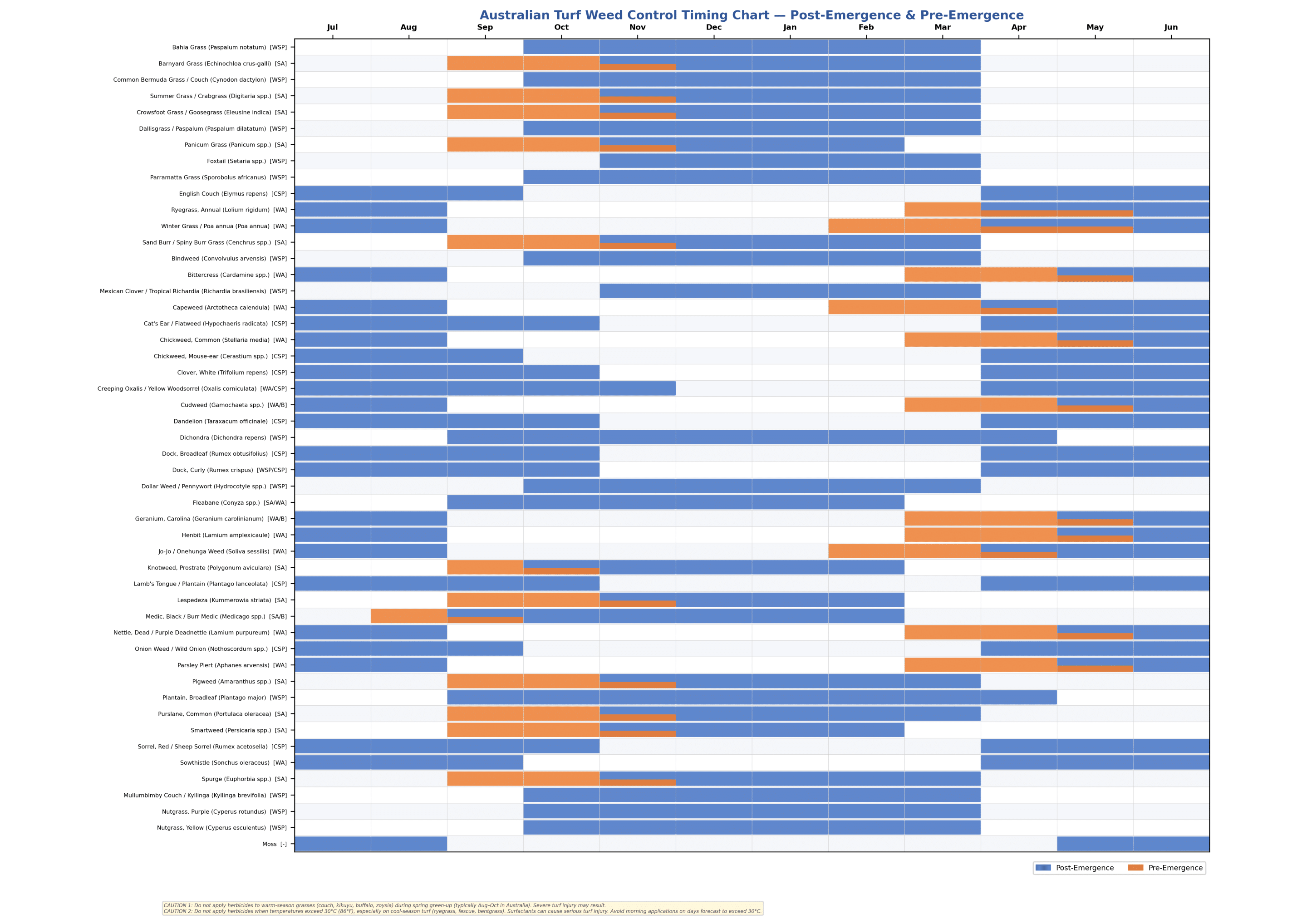

Principal agronomist, Gilba Solutions Pty Ltd
BSc Hons Soil Science (Newcastle). Former STRI agronomist. Author of Nutrition of Sports Turf in Australia (CSIRO/Landlinks Press) and The Definitive Guide to Australian Turfgrass Pesticide Management. 35+ years advising on sports turf, golf and stadia across Australia, NZ, UK and Europe.