
There is no shortage of claims about couch cultivar wear performance. “Dense growth habit.” “Rapid recovery.” “Ideal for high-traffic areas.” Every cultivar datasheet says roughly the same thing, and almost none of it is backed by controlled trial data.
This article is an attempt to cut through that. It compiles and grades the actual research on couch (Cynodon spp.) wear performance, identifies what the evidence genuinely supports for Australian sportsfield and stadium specifications, and is honest about where the evidence runs out.
| Cultivar | Independent Traffic Data | Australian Field History | Confidence |
|---|---|---|---|
| Celebration | High | Low -Moderate | High |
| TifTuf | High | Moderate | High |
| Tahoma 31 | High | Moderate | High |
| Santa Ana | Low | High | Moderate |
| IronCutter | Moderate | Low | Moderate |
Confidence rating reflects the strength of combined evidence from peer-reviewed traffic studies, NTEP evaluations and documented Australian sportsfield performance. High confidence does not necessarily indicate superior performance; it indicates greater certainty in the available evidence.
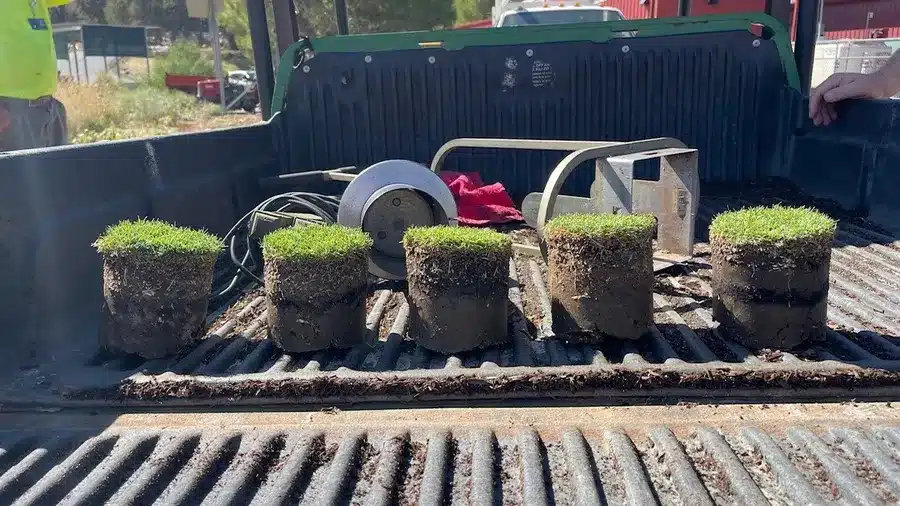
Caption: Field assessment in practice — core samples and Clegg hammer ready for sportsfield wear evaluation. L to R Tahoma 31, Tiftuf, Latitide 36, Ironcutter. Photo: Adam Russell, MVP Genetics / Mountain View Seeds. Yocha Dehe Golf Club, California.
What wear tolerance actually means
Three measurable parameters determine whether a playing surface is fit for use under traffic:
Bare ground percentage.
This is the most direct measure. McAuliffe & Roche (2009) established the AU benchmark that above 15% bare ground, a surface is unfit for play. Cultivar rankings based on a single bare-ground snapshot can in fact be misleading. For example, a cultivar with high wear damage but fast recovery may rank worse than a slow-recovering cultivar at a single measurement point, and better over a season.
Shear strength (SS).
Measures root-zone resistance to cleat rotation. This is the traction players need to push off safely. Dickson (2018) established the hybrid couch threshold at ≥18 Nm for acceptable athlete footing. Under cleated traffic, shear strength declines universally across all cultivars. Cultivar selection modulates how fast it falls and from what starting point.
Surface hardness (Gmax via Clegg hammer).
Measures impact attenuation. Henderson (2009) AFL BMP thresholds: 70–80 ideal; ≥120 concerning; ≥200 dangerous. Surface hardness rises under traffic, also universally. The critical point here which is discussed below under management rules is that Gmax is not a heritable trait. Cultivar selection cannot solve a surface hardness problem.
What makes a couch cultivar wear-tolerant?
Roche et al. (2009, International Turfgrass Society Research Journal 11:449–459) identified four structural traits associated with wear tolerance across eight Cynodon cultivars on a sand profile near Brisbane:
- High shoot density. This distributes traffic load across more tillers, and reduces per-tiller stress.
- Dense stolon mat, that is well-anchored to the surface. This resists scuffing and divoting. A weak surface attachment is the failure mode in stoloniferous-only species.
- High total cell-wall content. This ensures structural toughness against shear and cleat-cut.
- High lignin content. The biochemical signature of wear-resistant tissue.
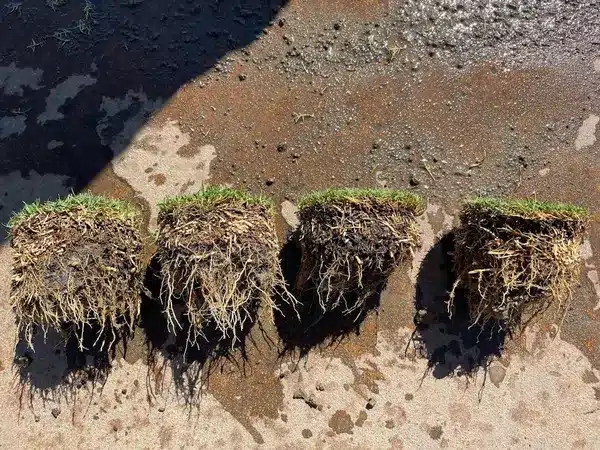
One non-obvious implication of this is that resistance and recovery are not the same trait, and their relative importance shifts with season. In the summer when turf is actively growing recovery dominates. In contrast over the winter under cleated traffic with suppressed growth, resistance (cell-wall toughness, stolon mat density) is what holds the surface.
Single-snapshot rankings taken over the summer will undervalue the stolon-mat traits that matter most for winter football. A methodological note for anyone running their own trials: Roche (2012) sampled leaf tissue and found no lignin/NDF correlation with wear ranking which seems to contradict Roche (2009).
The resolution is that structural strength resides in the stolon/thatch/crown fraction, not the leaf. So you should sample below the cleat-shear line.
Cultivar rankings: best to worst
These rankings integrate AU and US evidence. Where sources conflict, the conflict is noted. All these rankings are for cleated traffic (AFL, NRL, soccer, touch football) unless stated otherwise.
Top tier — recommended for high-wear specification
OZ TUFF (green couch)
AU primary rank #1 under both simulated and actual wear in Roche’s four-year Queensland study (Roche 2012, HAL TU08018). The strongest AU-specific evidence for any cultivar in this list. Sub-tropical sites; ranking does not extend to cool-temperate environments.
Celebration Hybrid
The most evidence-consistent high-traffic vegetative couch grass across three independent studies using different traffic methods. NTEP 2024 Raleigh NC: #1 at 86.0% ground cover under traffic. Singh et al. (2024, HortTechnology): least-affected cluster under 60 cleated events across two years. Trappe, Patton & Richardson (2009): TPI ≥9/10 top tier across 42 cultivars under Cady forward-pass simulation. Cross-method consistency (cleated Brinkman + Cady forward-pass + NTEP protocol) is the strongest confidence signal available. AU-licensed.
TifTuf (hybrid)
Top-group US Autumn traffic performance (Singh/Yu 2024). NTEP 2024 Raleigh NC: 80.7% cover under traffic (statistically equivalent to Tahoma 31, Celebration, Latitude 36). One important nuance: NTEP non-trafficked data shows TifTuf has delayed spring green-up versus Tahoma 31, but Yu (2024) shows the reverse under autumn-traffic load. This was attributed to late-season stolon sugar translocation. Specify TifTuf where the site carries autumn/winter traffic load. AU-licensed and well-supplied nationally.
IronCutter (hybrid)
A recent entrant to the AU market that belongs in this list. Bred by Dr Charles Taliaferro (Oklahoma State University) over a ten-year programme. Available US data indicate IronCutter belongs in the top traffic-performance group, although direct comparison with Tahoma 31, TifTuf and Celebration is complicated by differing trial protocols and test years. The honest caveat: IronCutter’s NTEP traffic data is 2013–2017 vintage and uses different protocols to the Singh/Yu 2024 cleated studies. It does not appear in the NTEP 2019 test that runs to 2023. Until AU trial data is published or the 2019 NTEP results become available, IronCutter sits high in the top tier on US evidence with AU confirmation pending.
Tahoma 31 (hybrid)
US high shear-strength group (Singh 2024). NTEP 2024 Raleigh NC: 82.7% cover under traffic. Strong spring green-up under non-trafficked conditions. This is the opposite of TifTuf under autumn traffic. Specify for sites with spring event loads rather than late-autumn/winter traffic. AU-licensed.
Latitude 36 / NorthBridge (OSU hybrids)
Least-affected cluster under Singh (2024) cleated traffic. Latitude 36 NTEP 2024 Raleigh NC: 85.0% (top tier, equivalent to Celebration). Limited AU commercial supply. Confirm availability before specifying.
Grand Prix / Hatfield (green couch)
AU rank 2–3 under actual wear in Roche (2012). A practical choice for sub-tropical community sportsfields where OZ TUFF supply is limited.
Riviera (seeded)
Most evidence-consistent seeded couch across four studies: Trappe (2009) top tier; Sancar (2023) #1 shear strength Mediterranean; Williams (2007) top quality Kentucky; Bayrer (2006) best percent cover Kentucky. NTEP 2024 Raleigh NC: 78.0% (mid-top tier).
AU supply note: the main seeded couch cultivars currently available in Australia are Monaco, Rio and Maya. Monaco and Rio are both developed from the same Johnston Seed Company breeding programme that produced Riviera. Monaco uses five parental clones versus Riviera’s three; Rio is described by Stover Seed as “the successor variety to Riviera.” They are related but distinct cultivars. The wear data for Riviera does not automatically transfer to Monaco or Rio and no peer-reviewed cleated-traffic study appears to cover either.
Maya is from a separate Barenbrug/Blackjack lineage with no wear study in the research literature. For AU seeded couch specification, Monaco and Rio are plausible candidates based on pedigree, but should be treated as evidence-gap cultivars until comparative data exists.
Mid tier — use case dependent
Wintergreen (green couch)
Performed well in AU actual-wear trials (Roche 2012). However: Wintergreen has not held PBR registration since McMaugh’s 1969 selection, and multiple common couches are commercially sold under this name. Without verified provenance, Wintergreen specification carries identity risk.
Do not specify for a high-value stadium installation without confirming cultivar identity through the morphological framework described below.
Avoid for cleated-traffic specification
Conquest (Riley’s Evergreen). The Weakest commercial Cynodon in the AU dataset (Roche 2012).
Legend (C1)
Split evidence. Ranked adequately on sand profile (RRF) but dropped from the Roche RTA Phase 2 dataset for poor actual-wear performance on heavier soil. Do not generalise a single Legend number across soil profiles.
Princess 77 (seeded)
Worst shear strength in both years of Sancar (2023) under Mediterranean cleated traffic. Performed adequately in non-cleated Kentucky conditions (Bayrer 2006, Williams 2007). Avoid for AU football codes.
Santa Ana. The absent cultivar
Santa Ana deserves specific mention because it is widely established across Australia, has a long track record on sportsfields here, and appears in none of the controlled wear studies cited in this article. Santa Ana is a C. dactylon × C. transvaalensis hybrid released by the University of California, Riverside in 1966 from breeding work by Dr Victor Youngner.
It was introduced to Australia by CSIRO in 1976, and has a reputation for wear tolerance and rapid recovery among turf managers in southern Austalia. The problem is that Santa Ana pre-dates the modern era of structured couch grass wear research. By the time systematic cultivar traffic trials developed in the 1990s–2000s, the US research focus had shifted to the Tifton programme hybrids and then OSU cultivars. Santa Ana was never included. It does not appear in Singh/Yu 2024, Trappe 2009, the NTEP 2019 test, or Roche 2012’s Queensland panel.
A 2023 USGA article on new UCR releases noted that the new cultivar Presidio “seems to handle heavy golf cart traffic better than Santa Ana and TifTuf,” but this was a field-day observation explicitly described as unconfirmed by data.
The honest position is that Santa Ana has a strong practitioner reputation in southern AU with zero controlled comparative wear data placing it against TifTuf, Tahoma 31, OZ TUFF, IronCutter or any other current cultivar.
For SA/NSW/VIC grounds managers specifying a renovation, Santa Ana is an option with a long track record but you are relying on that track record, not trial data.
Three management rules that do not change with whatever cultivar you use:
Surface hardness is not a cultivar decision
Gmax responds to aeration, topdressing and soil moisture and not cultivar selection. Singh & Yu (2024, HortScience, n=89 entries) found a heritability index i²=0 for surface hardness. So ignore any vendor that claims cultivar X “reduces compaction.” Manage Gmax through your agronomic programme.
Moisture drives Gmax more than aeration frequency
Roche’s four-year Queensland dataset included 43 verti-drain applications. There was no consistent surface hardness benefit beyond annual aeration. Irrigation management had a stronger effect on Gmax than mechanical intervention frequency.
Wear trajectory under cleated traffic is universal
Shear strength declines and surface hardness rises under cleated traffic, across every cultivar studied. The choice of cultivar helps to impact the magnitude of these changes but it won’t reverse the upward trend. Sancar (2023) Mediterranean: traffic reduced shear strength 11% at two games per week and 20% at four games per week; surface hardness tracked inversely with green cover (r = −0.75).
The bottom line is that your agronomic programme matters as much as your cultivar choice.
Winter management for dormant couch sites
For AU semi-arid sportsfields (Adelaide, Perth) and southern coastal sites where couch goes dormant in winter, there are four conclusions that you can make from the research:
- PRG winter overseed gives the least Gmax rise under traffic. Hargey et al. (2016, HortScience 51(5)) compared untreated dormant Tifway, fall colorant, PRG overseed and annual rye overseed over two Texas winters. PRG was the most surface-hardness-protective option. An active cool-season canopy buffers cleat impact.
- Colorant is cosmetic. Pigment treatments make dormant couch look green but provide no measurable reduction in surface hardness rise under traffic.
- Traffic raises Gmax regardless of winter treatment. All four Hargey treatments showed Gmax increase under traffic in year two. Winter PRG reduces the magnitude, not the direction.
- PRG requires chemical removal before spring renovation. Jellicorse et al. (2009) demonstrated that dormant-seeded couch fails to germinate when overseeded PRG is present, even with aggressive scalping and continued traffic. PRG canopy reduces PAR below the couch germination threshold. Selective chemical removal (foramsulfuron or equivalent) is required, as mechanical suppression alone tends to be insufficient.
- Net recommendation for AU semi-arid sites: PRG overseed for winter playability and Gmax protection, followed by foramsulfuron-equivalent PRG removal before spring renovation.
Mowing height and wear tolerance
Mowing height (2.5 versus 5.0 cm) does not affect shear strength on Cynodon (Sancar 2023, two years, six cultivars, Mediterranean). Set height of cut on recovery, density and aesthetic grounds — there is no traction penalty in either direction within this range. This contradicts McNitt’s finding on tall fescue; do not carry the tall-fescue rule across species.
Cultivar identity: the Wintergreen problem and beyond
Cultivar identity verification is not a minor concern in AU. Wintergreen has not held PBR registration since 1969 and multiple common couches are sold under the name. The consequences of specifying a named cultivar and receiving something different range from underperformance in low-traffic situations to catastrophic wear failure on a stadium surface.
Roche (2013, UQ MPhil thesis) characterised 35 AU-commercial Cynodon varieties at the DAFF Redlands station using a six-informative-trait morphological framework underpinned by BLUP analysis. This framework provides a stable descriptor vocabulary independent of vendor claim language and underpins PBR/DUS comparative testing. Use it as a verification tool before accepting supply — particularly for Wintergreen.
One limitation: the Roche 2013 panel covers cultivars available at the time of the 2002–2004 trial. TifTuf, Tahoma 31, NorthBridge, Latitude 36, Bimini and IronCutter post-date that work and have not been characterised within the same framework.
Specification shortlist by use case
| Use case | Recommended cultivars |
| Sub-tropical community sportsfield | OZ TUFF, Grand Prix, Hatfield, TifTuf, Celebration |
| Stadium-volume cleated traffic | TifTuf, Tahoma 31, Celebration (AU-licensed); IronCutter (AU trials underway); Latitude 36 / NorthBridge if supply confirmed |
| Semi-arid southern AU with winter dormancy | Santa Ana (practitioner track record, no comparative data); TifTuf, Tahoma 31 where supply available; PRG overseed programme regardless of cultivar |
| Seeded establishment | Monaco or Rio (Riviera-lineage, AU available; wear data gap acknowledged); Maya (no wear data) |
| Surface hardness lever | Not a cultivar decision — aeration + moisture programme |
| Cool-temperate site | Warm-season data does not answer this question |
The evidence gaps and a call for AU field data
The gaps in this evidence base are significant and worth being direct about.
There is no AU peer-reviewed head-to-head comparing TifTuf, Tahoma 31, Wintergreen, Legend and OZ TUFF under AFL or NRL traffic loads on any soil type. The Singh/Yu 2024 US studies are the best available comparative data for the modern hybrid cultivars, but they are transition-zone Oklahoma, fall-traffic-only, single soil.
Santa Ana has no controlled comparative wear data globally. IronCutter has strong US NTEP evidence but no published AU trial data. Monaco, Rio and Maya — the commercially available seeded options in AU — have no wear trial data in the literature at all.
This is a genuine gap that practitioner-led field observation could begin to fill.
Gilba Solutions Practitioner Observational Network — invitation
We are developing a structured field observation protocol for AU sportsfield managers to run on-site across multiple states. This is not a replicated controlled trial. It is a standardised observational dataset.
The minimum protocol covers:
- Cultivar identity verification using the Roche 2013 morphological framework before recording begins
- Bare ground measurement via digital image analysis (CanopeoApp or equivalent) at fixed intervals. This removes observer subjectivity
- Surface hardness via Clegg hammer at fixed soil moisture reference points
- Traffic load recording. Sport type, events per week, approximate player numbers, season
- Soil profile descriptor. Sand-based, clay-loam, renovated or native
- Shear strength where a shear device or equivalent is available
Reported as a multi-site observational dataset with those controls, collated and published by Gilba Solutions, this would constitute the best available evidence globally for Santa Ana, IronCutter and many other cultivars wear performance under AU football code traffic. Data would be attributed to participating facilities.
If you manage an AU sportsfield on any of the cultivars discussed in this article and are interested in participating, contact us.
Seeded-type breeding lines to watch
Sancar (2023) included three experimental seeded-type bermudagrass lines (A4-4, B3-6, C12-133) that matched vegetative Riviera for shear strength under Mediterranean cleated traffic. If any of these reach commercial release, they would change the AU sportsfield establishment economics significantly. The current view is that seed is generally regarded as lower quality than vegetative, which is why TifTuf and Tahoma 31 dominate new fields.
References
- Roche M.D, Penberthy, C. & O’Brien, L. ( 2012). HAL TU08018.
- Roche, M.B., Loch, D.S., Jonothan, D.L., Penberthy, C., Durant, R. and Troughton, A.D. (2009). Factors contributing to wear tolerance of Bermudagrass (Cynodon dactylon (L.) Pers., C. dactylon x C. transvaalensis Burtt-Davey) on a sand-based profile under simulated sports field conditions.
ITSRJ 11:449–459. - Roche, M.D. (2013). UQ MPhil thesis.
- Singh, S., Xiang, M., Fontanier, C. H., Wu, . Y., Martin, D. L., & Kajla, A. (2024). Persistence and Surface Playability of Nine Bermudagrass Cultivars under Simulated Fall Traffic. HortTechnology, 34(1), 92–100.
- NTEP 2024. 2019 National Bermudagrass Test 2019–2023 Progress Report, NTEP No. 24-11.
- NTEP 2013–2017. IronCutter traffic data.
- Trappe, J.M., Patton, A.J. and Richardson, M.D. (2011), Bermudagrass Cultivars Differ in Their Summer Traffic Tolerance and Ability to Maintain Green Turf Coverage Under Fall Traffic. Applied Turfgrass Science, 8: 1-10.
- Bayrer, T.A. (2006). UKentucky MS thesis #411.
- Williams, D. W., Burrus, P. B., & Cropper, K. L. (2010). Seeded Bermudagrass Tolerance to Simulated Athletic Field Traffic as Affected by Cultivars and Trinexapac-ethyl. HortTechnology, 20(3), 533–538.
- Sancar, B., Mutlu, S.S., Basar, E.K. (2023). Traffic tolerance of bermudagrass (Cynodon spp.) as affected by cultivar and mowing height. Grass Research 3:15
- Hargey, D., Wherley, B., Reynolds, C., White, R., & Parker, G. (2016). Performance of Winter Overseeded and Colorant-treated ‘Tifway’ Bermudagrass Receiving Weekly Irrigation and Simulated Traffic. HortScience, 51(5), 580–587.
- Jellicorse, W., Richardson, M., Patton, A., Karcher, D., McCalla, J. (2009). Arkansas Turfgrass Report 2008. p. 22-24.
- Brosnan, J.T., Deputy, J. (2008). Bermudagrass. Honolulu (HI): University of Hawaii. 6 p. (Turf Management; TM-5).
- Henderson, C. (2009). HAL AFL playing-surface BMP.
- Gómez de Barreda, D., Azcárraga, C., Pornaro, C., & Macolino, S. (2022). Performance of turf-type bermudagrass cultivars in the upper and lower limits of the European transition zone. Agronomy Journal, 114, 3544–3553.
Further Reading
This article is part of the Sports Turf Agronomy and Turf Physiology and PGRs series. Related reading:
- Overseeding and Transition
- Managing Turfgrass for Off-Season Events
- Current state of Australian turfgrass agronomy
About the Author
Jerry Spencer is Principal Agronomist at Gilba Solutions Pty Ltd, an independent agronomic consultancy based in Bowral, NSW. He holds an Honours degree in Soil Science from the University of Newcastle Upon Tyne and has 35+ years of experience in turf and soil management. He is the author of a CSIRO/Landlinks Press monograph on sports turf nutrition and serves as an LGP panel agronomist.

Principal agronomist, Gilba Solutions Pty Ltd
BSc Hons Soil Science (Newcastle). Former STRI agronomist. Author of Nutrition of Sports Turf in Australia (CSIRO/Landlinks Press) and The Definitive Guide to Australian Turfgrass Pesticide Management. 35+ years advising on sports turf, golf and stadia across Australia, NZ, UK and Europe.