

Sodium damage in turf soils takes two distinct forms: direct ion toxicity to the plant, and structural dispersion of the soil itself. The two failure modes have different thresholds, different diagnostics, and different remedies, and they are routinely conflated in turf practice. Direct sodium toxicity is uncommon in well-managed turf at typical fertiliser and irrigation rates. The dominant problem is structural. Sodium adsorbed onto clay surfaces forces clay platelets apart when wet, collapsing soil aggregates, sealing the surface, and destroying infiltration.
Australian soils disperse at an exchangeable sodium percentage (ESP) of 6 or above (Rengasamy and Olsson 1991), well below the USDA threshold of 15 inherited from US irrigated agriculture. Whether gypsum will fix a sodic soil depends on which mechanism is driving the problem and on the soil’s threshold electrolyte concentration, not on ESP alone.
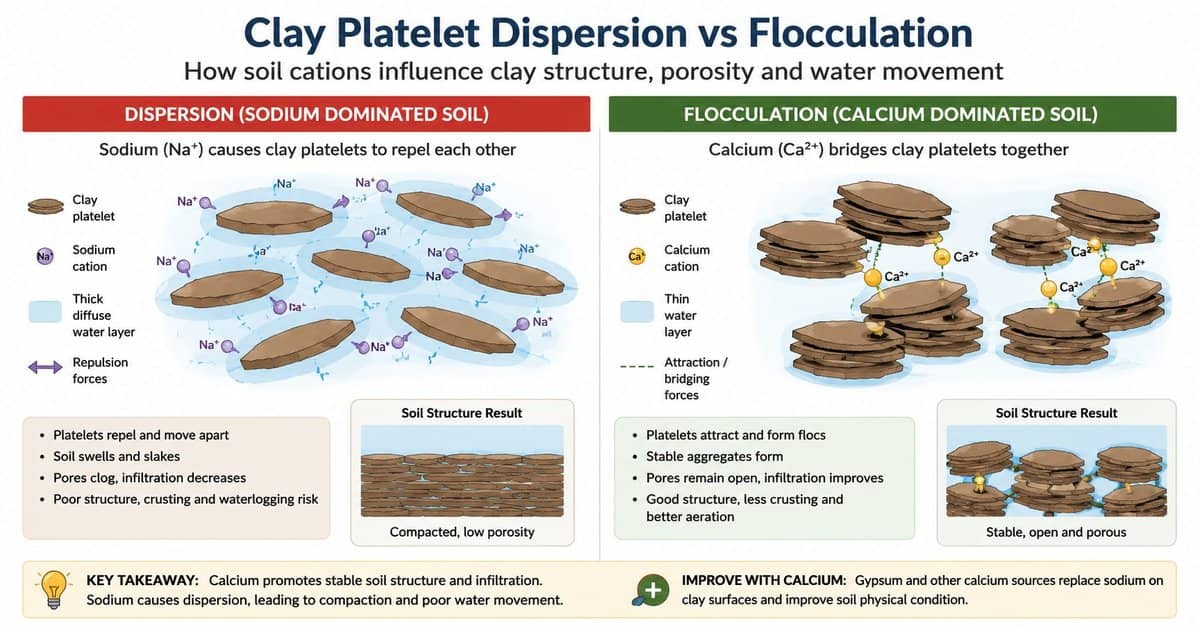
The two ways sodium damages turf soils
A field with surface ponding, hard crusting, and patchy turf in low spots looks like a drainage problem. Run a soil test and the diagnosis often comes back as the cause being high sodium levels. The soil isn’t poisoning the plant directly. Instead the soil has lost the ability to hold its own structure. Distinguishing the two mechanisms matters because the remedy for one is not the remedy for the other.
Direct ion toxicity (rare in turf)
Sodium can enter the plant through the roots, accumulate in shoot tissue, and disrupt potassium-dependent enzymes and stomatal regulation. In crops irrigated with saline water this is a real and measurable problem. In maintained turf, with regular mowing removing tissue and typical fertiliser rates that supply competing cations, direct toxicity is uncommon below an irrigation water EC of around 3 dS/m. Where it does occur (coastal venues with saline water sources, or sites on recycled water with high residual sodium), the diagnostic signal is leaf-tip burn and chlorosis on younger leaves, and not surface sealing.
Structural dispersion (the actual problem)
The dominant sodium problem in turf is structural. Sodium ions on the clay exchange complex are weakly bound and surrounded by a large hydration shell. When the soil wets up with low-electrolyte water (rainfall, low-EC irrigation), the clay platelets repel each other, the aggregates collapse, and the dispersed clay clogs pores or seals the surface. Infiltration drops. Surface ponding follows. The dispersed clay translocates downward and forms a dense layer at depth that further restricts drainage.
Dispersion can occur at ESP levels as low as 10 to 20 when the soil solution electrolyte concentration drops below approximately 10 meq/L, even before swelling becomes appreciable (Frenkel et al. 1978). In Australian soils, with their illite and kaolinite mineralogy and low background electrolyte loads, dispersion thresholds are lower again.
ESP and SAR: what each measures, and when to use which
Two indices dominate sodium soil chemistry, and they measure different things.
Exchangeable sodium percentage (ESP) measures sodium on the soil itself. This is the percentage of cation exchange sites that are occupied by Na⁺. To calculate this from a soil test: ESP = (exchangeable Na ÷ effective CEC) × 100. ESP describes current state.
Sodium adsorption ratio (SAR) measures sodium in solution. This is the relative concentration of Na⁺ against the calcium and magnesium pool: SAR = Na ÷ √((Ca + Mg)/2), concentrations in mmol/L. SAR describes what the irrigation water or soil saturation extract will do to the soil over time. In Australia we typically use the SAR of a 1:5 soil-water extract (Rengasamy et al. 1984); US practice uses the saturation paste extract (SARe).
The two are linked. Irrigation water with a given SAR will, over time, push the soil toward an equilibrium ESP. The Richards (1954) empirical equation relating SARe to ESP is still the default in many soil reports, but it was derived from US irrigated soils and underpredicts dispersion risk in Australian conditions.
The threshold debate
USDA Handbook 60 (Richards 1954) set ESP > 15 (equivalent SAR ≈ 13) as the sodic threshold. This figure dominates global soil reporting and still appears on most soil test result sheets.
Australian research has shown the threshold is too high for local soils. Western Australian Department of Agriculture guidance classifies soils with ESP 6 to 10 as slightly dispersive and ESP > 15 as highly dispersive. McIntyre (1979) found dispersion at ESP > 5; Northcote and Skene (1972) at ESP ≥ 6; Rengasamy and Olsson (1991) at SAR ≥ 3. Australian soils disperse at roughly one-third the sodium load tolerated by the soils on which Handbook 60 was calibrated.
For turf in Australian and New Zealand conditions, treat ESP 6 as the action threshold. Soil tests reporting “non-sodic” against the USDA 15% criterion can still produce surface sealing, runoff, and infiltration failure in the field.
Diagnostic workflow for suspected sodium problems
A defensible sodium diagnosis requires four data points, in this order:
- Soil test for exchangeable cations and ESP. Request exchangeable Ca, Mg, Na, K and effective CEC. ESP is calculated from these. Action threshold: ESP ≥ 6 in Australia and New Zealand, ≥ 15 under the legacy US framework. See the CEC interpretation spoke for how to read effective CEC against soil texture.
- Irrigation water analysis for SAR, EC, bicarbonate. Calculate RSC. If RSC > 1.25 meq/L, the water is pushing the soil toward sodicity even if current ESP is below threshold.
- EC of soil saturation extract or 1:5 extract. Compare against ESP using ESI (EC1:5 ÷ ESP). ESI < 0.05 confirms a dispersive condition.
- Field dispersion test. Place a 3 to 5 mm air-dry aggregate in distilled water without disturbance. If a milky halo forms within an hour the soil is spontaneously dispersive. If dispersion only follows mechanical disturbance the soil is moderately stable.
Without all four data points, a sodium diagnosis is incomplete. A soil test showing ESP 4 does not rule out a dispersion problem if irrigation water RSC is high and ESI is below 0.05.
How sodium chemistry connects to the rest of the soil cluster
Three sibling concepts are mechanistically tied to sodium chemistry:
- Cation exchange capacity governs how much sodium the soil holds and therefore how much calcium is needed to displace it. Low-CEC sand profiles respond to gypsum quickly; high-CEC clay loams require much larger gypsum loads. See the CEC interpretation spoke.
- Minimum Levels for Sustainable Nutrition (MLSN) sets sufficiency baselines for calcium, magnesium, and potassium. Sodium competes for the same exchange sites, so MLSN-sufficient calcium can be functionally inadequate against a dominant sodium load. See the MLSN interpretation spoke.
- Magnesium-induced dispersion is the sibling failure mode. High Mg:Ca ratios drive dispersion through the same swelling and platelet-repulsion mechanism, often misdiagnosed as sodium because the field symptoms are identical.
Frequently asked questions about sodium in turf soils
What ESP level is too high for turf in Australia?
ESP of 6 or higher is the Australian threshold for sodic classification (Rengasamy and Olsson 1991). The USDA threshold of 15 originates in US irrigated agriculture and significantly underestimates dispersion risk in Australian and New Zealand soils.
Will gypsum fix every sodic soil?
No. Gypsum works on two mechanisms: raising soil solution electrolyte and displacing exchangeable sodium. The displacement effect requires actual drainage to remove the released sodium. Heavily sealed sodic soils may need mechanical incorporation (coring, hollow-tine) before gypsum can dissolve and act.
How is SAR different from ESP?
ESP measures sodium already on the soil’s cation exchange complex. SAR measures sodium in the irrigation water or soil solution relative to calcium and magnesium. ESP describes current state; SAR projects the soil’s future state under continued irrigation with that water.
Can dispersion happen without sodium being high?
Yes. High magnesium relative to calcium can drive dispersion through the same swelling mechanism, even at low sodium. This is the magnesium-induced dispersion failure mode and is common on sites irrigated with recycled water or borewater high in magnesium bicarbonate.
Why does rainfall sometimes make my sodic field worse?
Rainfall carries almost no dissolved electrolyte. On a soil already near the threshold electrolyte concentration, rain leaches out the salts that were holding the clay flocculated, and the clay disperses. The worst dispersion events on sodic turf typically follow the first heavy winter rain, not the irrigation season.
Gypsum: what it actually does, and when
Gypsum (calcium sulphate, CaSO₄·2H₂O) is the default amendment to use on sodic soils. Two mechanisms work simultaneously, and the dominant one depends on the soil condition.
Mechanism 1: Electrolyte effect (fast)
Dissolved gypsum raises soil solution EC above the threshold electrolyte concentration and flocculates the clay. This occurs within days of use and dominates on surface seals and recent dispersion. It also explains why gypsum can improve infiltration on soils that are not classically sodic. It raises the electrolyte load regardless.
Mechanism 2: Cation displacement (slow)
Calcium from dissolved gypsum displaces sodium from the cation exchange complex, lowering ESP. The displaced sodium must then leach below the root zone, which requires actual drainage that a sealed sodic soil does not have. Heavy gypsum applications to badly dispersed soils often fail short-term for this reason: the soil cannot drain the sodium out fast enough for calcium to occupy the freed sites.
To effectively use on turf aim to apply:
- 2.5 to 5 t/ha as a single application on moderately sodic surfaces (ESP 6 to 10). Aim to incorporate this mechanically if possible.
- Split applications over 2 to 3 seasons on heavily sodic profiles (ESP > 15). The aim is to allow to leach before the next.
- Cores-pulled or hollow-tine integration on greens and stadium fields to physically deliver gypsum below the surface seal. This is because gypsum cannot work where it cannot dissolve and infiltrate.
Not all gypsum is equal. Granular gypsum varies in dissolution rate by an order of magnitude across products, which materially changes application timing and rate. Particle size, purity, and moisture content all matter. These factors are covered in the spoke on granular gypsum quality.
References
- Frenkel H, Goertzen JO, Rhoades JD (1978) Effects of clay type and content, exchangeable sodium percentage and electrolyte concentration on clay dispersion and soil hydraulic conductivity. Soil Science Society of America Journal 42, 32–39.
- McIntyre DS (1979) Exchangeable sodium, subplasticity and hydraulic conductivity of some Australian soils. Australian Journal of Soil Research 17, 115–120.
- Northcote KH, Skene JKM (1972) Australian soils with saline and sodic properties. CSIRO Soil Publication 27, Melbourne.
- Quirk JP, Schofield RK (1955) The effect of electrolyte concentration on soil permeability. Journal of Soil Science 6, 163–178.
- Rengasamy P, Greene RSB, Ford GW, Mehanni AH (1984) Identification of dispersive behaviour and the management of red-brown earths. Australian Journal of Soil Research 22, 413–431.
- Rengasamy P, Olsson KA (1991) Sodicity and soil structure. Australian Journal of Soil Research 29, 935–952.
- Richards LA (Ed.) (1954) Diagnosis and improvement of saline and alkali soils. USDA Agriculture Handbook 60, Washington DC.
- Suarez DL (1981) Relation between pHc and sodium adsorption ratio (SAR) and an alternative method of estimating SAR of soil or drainage waters. Soil Science Society of America Journal 45, 469–475.
- Marchuk A, Rengasamy P (2012) Threshold electrolyte concentration and dispersive potential in relation to CROSS in dispersive soils. Soil Research 50, 473–481.
- GRDC GroundCover (2024) Diagnosing soil dispersion and transient soil salinity. Grains Research and Development Corporation, Australia.
Part of the Soil and Rootzone Science series. Also see MLSN soil test interpretation and cation exchange capacity for turf.

Principal agronomist, Gilba Solutions Pty Ltd
BSc Hons Soil Science (Newcastle). Former STRI agronomist. Author of Nutrition of Sports Turf in Australia (CSIRO/Landlinks Press) and The Definitive Guide to Australian Turfgrass Pesticide Management. 35+ years advising on sports turf, golf and stadia across Australia, NZ, UK and Europe.