

Raw sodium adsorption ratio (SAR) on its own underestimates the dispersion risk of an irrigation water source by 20 to 40 percent when bicarbonate is present. Three indices are needed to read an irrigation water report properly: SAR, adjusted SAR (SAR_adj), and residual sodium carbonate (RSC). SAR measures the sodium-to-calcium-and-magnesium ratio in the water itself.
SAR_adj corrects SAR for the calcium and magnesium that will precipitate out during evapotranspiration as bicarbonate carbonates form. RSC quantifies the residual sodium load that survives that precipitation. An irrigation water with raw SAR of 6 can carry the practical sodium loading of SAR 9 or higher once bicarbonate is accounted for. Turf practitioners working only from headline SAR routinely miss this and the soil becomes sodic against expectation. The Suarez (1981) adjusted SAR remains the most defensible water-quality metric for turf use.
What sodium adsorption ratio (SAR) actually measures
SAR is a calculated ratio that compares the sodium concentration in a water sample against the geometric mean of calcium and magnesium concentrations. The formula:
SAR = Na ÷ √((Ca + Mg) ÷ 2), with all concentrations in mmol/L
The value is dimensionless. It is not measuring sodium directly; it is measuring sodium relative to the divalent cations that compete with it for clay exchange sites. A water with high absolute sodium but proportionally even higher calcium will have a low SAR and pose little dispersion risk. A water with moderate sodium and depleted calcium will have a high SAR and significant risk.
SAR predicts where the soil will end up after long-term irrigation, not what the soil is now. Apply a water with SAR 8 for several seasons and the soil exchangeable sodium percentage (ESP) will rise toward an equilibrium dictated by that SAR. The soil dispersion mechanism that follows is covered in detail in the impact of sodium on turf soils.
SAR is reported three different ways
Soil and water labs report SAR using three different sample preparations, and the numbers are not directly comparable:
- SAR of irrigation water. Measured on the water as supplied. This is the figure most relevant for selecting and managing water sources.
- SARe (saturation paste extract). Measured on a soil sample saturated with water to a defined consistency. The US default since Richards (1954). Best for predicting soil behaviour at field capacity.
- SAR of 1:5 soil-water extract. Australian default since Rengasamy et al. (1984). The dilution is greater than a saturation paste, so the absolute number is lower for the same soil. Use Australian threshold values with Australian extracts, US thresholds with US extracts. Mixing the two is a common error.
SAR_adj: correcting for the bicarbonate problem
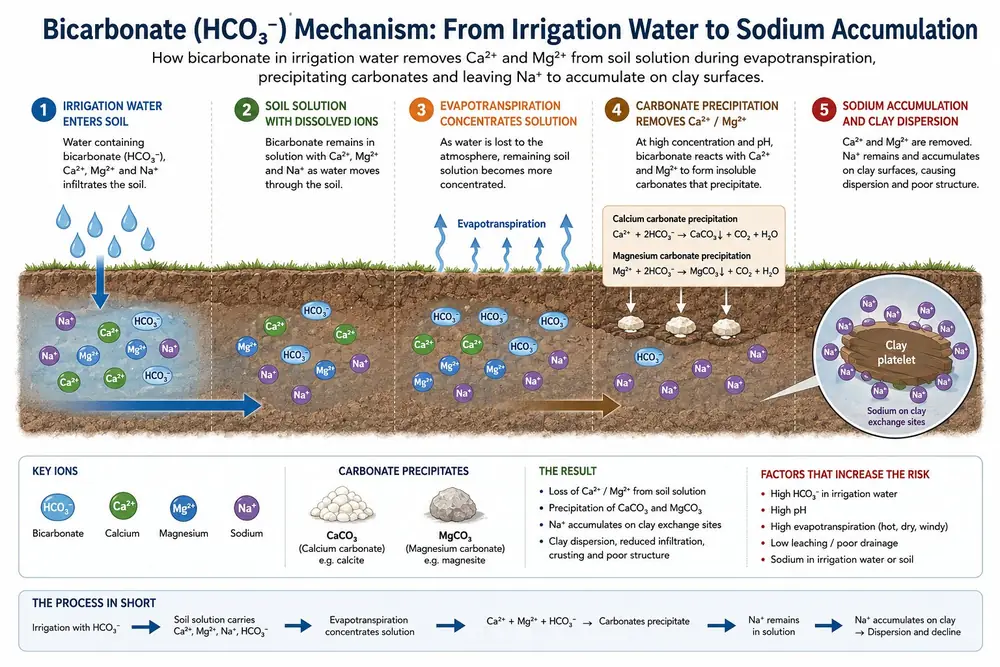
Raw SAR assumes the calcium and magnesium in the irrigation water remain available to occupy clay exchange sites once the water enters the soil. That assumption fails when bicarbonate (HCO₃⁻) is present.
During evapotranspiration the irrigation water concentrates in the rootzone. Bicarbonate combines with calcium and magnesium, precipitating them out of solution as calcium carbonate and magnesium carbonate. The divalent cations that should have competed with sodium for exchange sites have left the solution as solid carbonates. Sodium remains in solution and proportionally dominates.
The Suarez (1981) adjusted SAR (SARadj) corrects for this by recalculating the calcium concentration that will actually remain available, given the bicarbonate load, the carbon dioxide partial pressure in the rootzone, and the calcium-bicarbonate equilibrium. The adjusted value is consistently higher than raw SAR, and the gap widens as bicarbonate rises.
A typical magnitude check: a recycled irrigation water with raw SAR of 6 and HCO₃⁻ of 4 meq/L will have SARadj closer to 8 or 9. The soil sees the higher figure, not the lower one. Turf irrigation programmes that work to a target raw SAR of 6 but supply water with high bicarbonate routinely produce sodic soils within two to three irrigation seasons.
Older calculations used Bower (1968) “adjusted SAR” which overcorrects in calcareous conditions and undercorrects elsewhere. Suarez (1981) and its later refinements are the defensible current standard.
RSC: the third index every irrigation water report needs
Residual sodium carbonate quantifies the sodium load that survives the bicarbonate precipitation reaction. The formula:
RSC = (CO₃²⁻ + HCO₃⁻) − (Ca²⁺ + Mg²⁺), all in meq/L
A positive RSC means the bicarbonate load exceeds the divalent cation load. After all available calcium and magnesium have precipitated, sodium is left to dominate the residual solution and the clay exchange sites it contacts.
Standard thresholds (Ayers and Westcot 1985):
- RSC < 1.25 meq/L. Water is suitable for irrigation, sodicity risk is low.
- RSC 1.25 to 2.5 meq/L. Marginal. Suitable with management practices including periodic gypsum amendment, monitoring of soil ESP, and avoiding accumulation on closed-system irrigation.
- RSC > 2.5 meq/L. Unsuitable without water-side amendment. Continued irrigation will produce sodic soil regardless of SAR.
RSC is the index that catches what raw SAR misses. A water with raw SAR of 4 (which looks acceptable) and RSC of 3 (which signals high bicarbonate burden) is more sodic in its long-term effect than a water with raw SAR of 8 and RSC of zero.
RSC: the third index every irrigation water report needs
Residual sodium carbonate quantifies the sodium load that survives the bicarbonate precipitation reaction. The formula:
RSC = (CO₃²⁻ + HCO₃⁻) − (Ca²⁺ + Mg²⁺), all in meq/L
A positive RSC means the bicarbonate load exceeds the divalent cation load. After all available calcium and magnesium have precipitated, sodium is left to dominate the residual solution and the clay exchange sites it contacts.
Standard thresholds (Ayers and Westcot 1985):
- RSC < 1.25 meq/L. Water is suitable for irrigation, sodicity risk is low.
- RSC 1.25 to 2.5 meq/L. Marginal. Suitable with management practices including periodic gypsum amendment, monitoring of soil ESP, and avoiding accumulation on closed-system irrigation.
- RSC > 2.5 meq/L. Unsuitable without water-side amendment. Continued irrigation will produce sodic soil regardless of SAR.
RSC is the index that catches what raw SAR misses. A water with raw SAR of 4 (which looks acceptable) and RSC of 3 (which signals high bicarbonate burden) is more sodic in its long-term effect than a water with raw SAR of 8 and RSC of zero.
Three water source classifications
Most turf irrigation water falls into one of three risk classes. Recognising which class a given source belongs to drives the management response.
Low-risk: high-quality bore or surface water
Raw SAR below 3, EC below 0.7 dS/m, RSC below 0.5 meq/L. Suitable for routine irrigation with no specific sodium management required. Standard maintenance gypsum applications based on soil test, not water chemistry. Typical of fresh groundwater from non-marine sedimentary aquifers, alpine surface water, and most municipal supplies in catchments with limestone bedrock.
Marginal: recycled water and moderate bore
Raw SAR 4 to 9, EC 0.7 to 2.0 dS/m, RSC 1 to 2.5 meq/L. The dominant category for sports turf in Australia, particularly councils using Class A recycled water and venues on regional bore systems. Manageable but not passive. Requires water analysis every 6 to 12 months, soil ESP monitoring annually, gypsum applications calibrated to bicarbonate load rather than soil test alone, and irrigation scheduling that allows leaching during seasonal rainfall.
High-risk: bicarbonate-dominated waters
Raw SAR can be deceptively moderate (3 to 6), but RSC exceeds 2.5 meq/L and bicarbonate often exceeds 5 meq/L. Common in carbonate-aquifer borewater and some long-residence-time dam water in limestone catchments. Continued irrigation produces sodic soil regardless of SAR appearance. Requires water-side amendment (acid injection to suppress bicarbonate, or calcium dosing to raise the divalent load) before reaching the field. Soil-side gypsum alone cannot keep pace with the chronic sodium accumulation.
Remediation: water-side and soil-side options
Water-side amendments
Acid injection. Sulphuric acid (98%) or urea-sulphuric acid blends dosed into the irrigation main reduce water pH, converting bicarbonate to carbonic acid which releases CO₂ and water. Lower bicarbonate means less calcium precipitation and lower effective RSC. Dose rates depend on target pH and bicarbonate load. Requires correct injection equipment, safety infrastructure, and operator training. Common on golf irrigation systems in the US south-west, less common in Australia.
Calcium nitrate or calcium chloride dosing. Raises the calcium concentration in the water, lowering raw SAR directly and pushing RSC toward zero by adding to the divalent pool. Calcium nitrate carries the additional benefit of supplying nitrogen. Calcium chloride is cheaper but adds chloride which can become a separate problem on chloride-sensitive species.
Gypsum slurry injection. Finely ground gypsum suspended in the irrigation supply delivers calcium continuously rather than as a soil application. Effective on sodic conditions but requires agitation equipment to keep gypsum in suspension and is mechanically demanding compared to acid or calcium dosing.
Soil-side gypsum
Surface-applied or incorporated gypsum remains the default response on marginal water sources. The mechanism, dose rates, and limitations are covered in the granular gypsum quality spoke. The key constraint is that soil-side gypsum cannot keep pace with high-RSC waters. Above RSC 2.5 the sodium load arriving with each irrigation event exceeds what surface gypsum can displace and leach in the same timeframe.
How SAR connects to the rest of the irrigation and soil cluster
Reading irrigation water is one half of sodium management. The other half is what happens once that water reaches the soil:
- Sodium effects in turf soils covers the ESP threshold debate, threshold electrolyte concentration, and the structural dispersion mechanism that follows from accumulated sodium. See the sodium effects spoke.
- Cation exchange capacity governs how much sodium the soil can hold from a given irrigation load. Low-CEC sands respond faster to both accumulation and remediation than high-CEC clay loams. See the CEC spoke.
- Gypsum quality and dose determines whether soil-side remediation will actually work on a marginal water source. See the granular gypsum spoke.
Frequently asked questions about SAR and irrigation water
Why do I need three indices instead of SAR alone?
Raw SAR assumes calcium and magnesium remain available in the soil solution. Bicarbonate causes them to precipitate out as carbonates during evapotranspiration, leaving sodium proportionally higher. SARadj corrects for this, and RSC quantifies the residual sodium load. Using SAR alone underestimates dispersion risk by 20 to 40 % on bicarbonate-rich waters.
What is the difference between SAR and SARadj?
SAR measures sodium against calcium and magnesium as they appear in the water sample. SARadj recalculates the ratio after accounting for calcium and magnesium that will precipitate out as carbonates in the soil. SARadj is consistently higher than raw SAR and is the more accurate predictor of long-term soil sodicity.
What RSC value is too high?
RSC above 1.25 meq/L is marginal and requires management. RSC above 2.5 meq/L makes the water unsuitable for irrigation without water-side amendment (acid injection or calcium dosing). At RSC values above 2.5, soil-side gypsum cannot keep pace with the continuous sodium loading from each irrigation event.
Can I rely on the soil test instead of testing the water?
No. The soil test tells you where the soil currently sits. The water test tells you where the soil will end up under continued irrigation. Both are required: soil ESP for current state, water SAR/RSC/SARadj for trajectory. A clean soil test on a marginal water source means the soil is on its way to becoming sodic, not that the irrigation is safe.
How often should I test irrigation water?
Bore water on a stable aquifer: annually. Recycled water from a municipal supply: every 6 months, more often if the supplier changes treatment protocols. Surface water with seasonal variation: each season. Any water source after a significant change in supply (new bore, new treatment plant, drought drawdown): immediately.
References
- Ayers RS, Westcot DW (1985) Water quality for agriculture. FAO Irrigation and Drainage Paper 29, Rev. 1. Food and Agriculture Organization of the United Nations, Rome.
- Bower CA, Wilcox LV, Akin GW, Keyes MG (1968) An index of the tendency of CaCO₃ to precipitate from irrigation waters. Soil Science Society of America Proceedings 29, 91–92.
- Carrow RN, Duncan RR (1998) Salt-Affected Turfgrass Sites: Assessment and Management.
- Harivandi MA (1999) Interpreting turfgrass irrigation water test results. University of California Cooperative Extension Publication 8009.
- Rengasamy P, Greene RSB, Ford GW, Mehanni AH (1984) Identification of dispersive behaviour and the management of red-brown earths. Australian Journal of Soil Research 22, 413–431.
- Richards LA (Ed.) (1954) Diagnosis and improvement of saline and alkali soils. USDA Agriculture Handbook 60.
- Suarez DL (1981) Relation between pHc and sodium adsorption ratio (SAR) and an alternative method of estimating SAR of soil or drainage waters. Soil Science Society of America Journal 45, 469–475.
- Suarez DL, Wood JD, Lesch SM (2006) Effect of SAR on water infiltration under a sequential rain-irrigation management system. Agricultural Water Management 86, 150–164.
Part of the Irrigation and Water Quality series. Also see sodium effects in turf soils, cation exchange capacity for turf, and the Turf Irrigation Calculator tool.
About the author: Jerry Spencer is Principal Agronomist at Gilba Solutions Pty Ltd, an independent agronomic consultancy based in Bowral, NSW. He holds an Honours degree in Soil Science from the University of Newcastle Upon Tyne and has 35+ years of experience in turf and soil management. He wrote a CSIRO/Landlinks Press monograph on sports turf nutrition and serves as on the LGP panel.

Principal agronomist, Gilba Solutions Pty Ltd
BSc Hons Soil Science (Newcastle). Former STRI agronomist. Author of Nutrition of Sports Turf in Australia (CSIRO/Landlinks Press) and The Definitive Guide to Australian Turfgrass Pesticide Management. 35+ years advising on sports turf, golf and stadia across Australia, NZ, UK and Europe.