

When the “magnesium fix” makes your soil worse: dispersion, dolomite, and what reps keep getting wrong
There’s a recurring pattern in turf advisory work that bothers me. A super gets a soil test back showing low pH and what looks like “low” Ca on a base saturation report. The rep walks the site, glances at the numbers, and recommends dolomite. Or kieserite if the magnesium reading is also flagged low. Job done, invoice raised, problem “solved.” Except in a lot of cases — particularly on heavier soil profiles — the magnesium addition has driven magnesium soil dispersion and made the structural problem worse. The turf goes off. Infiltration drops. The next soil test shows the same low pH plus a new high-Mg reading, and the cycle repeats.
This post unpacks why magnesium soil dispersion happens, why it matters more on soils than on sands, and why the dolomite-for-low-pH reflex needs retiring on a lot of sites where it’s currently standard practice.
What magnesium dispersion actually is
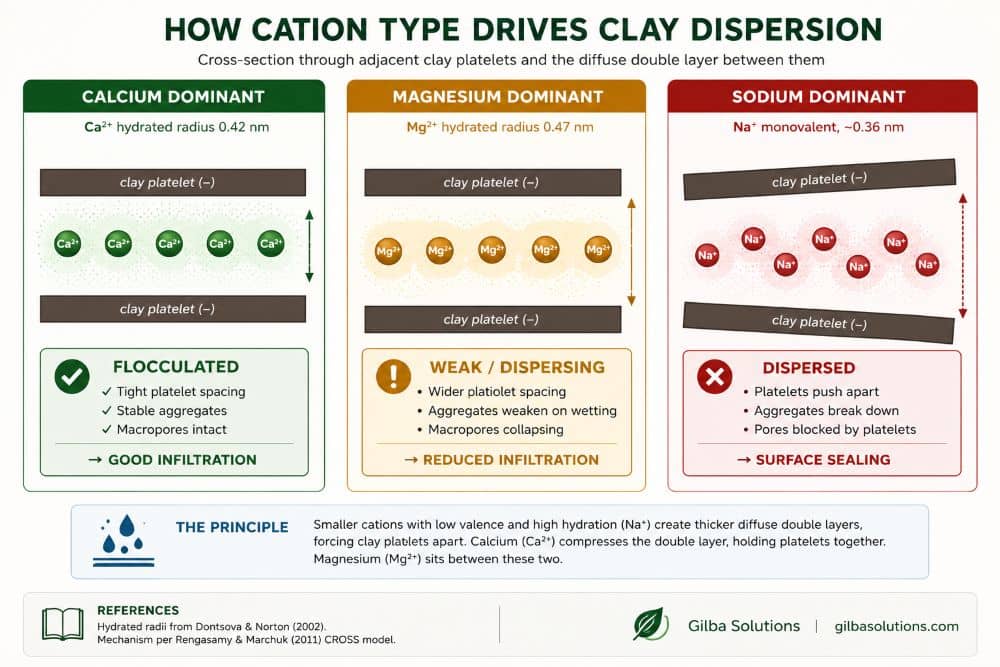
Clay particles carry a negative surface charge. Positively charged ions (cations) are drawn to those surfaces and sit in a layer called the diffuse double layer. How thick that layer is depends on which cation dominates, and that’s what determines whether the soil holds together or falls apart.
Calcium (Ca²⁺) is small and tightly hydrated. It pulls clay particles close together (flocculation). Aggregates stay intact, pores stay open, water and roots move through.
Sodium (Na⁺) does the opposite. As a monovalent ion with a wider hydrated shell, it pushes clay surfaces apart. Aggregates break down, pores clog, the surface seals. This is sodicity and is well understood in turf.
Magnesium (Mg²⁺) sits in between. It’s divalent like calcium, so on paper it should flocculate. But Mg²⁺ has a larger hydrated radius (0.47 nm versus calcium’s 0.42 nm) and holds onto its water shell more tightly. When Mg dominates the exchange instead of Ca, clay surfaces sit slightly further apart, the diffuse layer is wider, and aggregates are weaker. Add a wetting event with low-EC water and the soil disperses.
This isn’t a fringe finding. Rengasamy and Marchuk (2011) developed the Cation Ratio of Soil Structural Stability (CROSS) precisely because the older SAR equation ignores magnesium. CROSS treats Mg as about 0.6 times as dispersive as Na, and K as about 0.56 times. Practical implication: a soil with 25% Mg on the exchange is structurally compromised even when Na is well below the sodicity threshold.
Smith et al. (2015) found Mg concentrations need to be roughly 10 times those of Ca to deliver the same flocculating effect — a strong quantitative statement of the asymmetry that SAR misses. Dontsova and Norton (2002) showed clay flocculation drops sharply at Ca:Mg ratios below 1:1.
Why magnesium dispersion matters on turf
Turf rootzones live and die by porosity. Aggregated soil with stable peds has macropores for drainage and aeration, mesopores for plant-available water, and micropores for stored water. Disperse the aggregates and you lose the macropores first. Water sits. Roots suffocate. ERI pathogens move in. Surface seals form. Infiltration crashes. The turf looks fine for a season then collapses under stress.
I see this most often on:
- Council sportsfields built on native heavy clay loams that get dolomite “for pH” every year or two.
- Bowling greens on imported soil profiles where the original mix was Ca-balanced but successive Mg-heavy fertilisers have shifted the ratio.
- Racing surfaces (greyhound and gallops) where the brief is “keep the pH up” and dolomite is the cheap option.
- Older golf course fairways on native soil that have had decades of dolomitic limestone applications.
The diagnostic signature is usually patchy infiltration, surface crusting after rain, localised dry spot that doesn’t respond well to standard wetting agents, and Ca:Mg ratios below 3:1 on the exchange — sometimes as low as 1:1 or worse.
The dolomite-for-low-pH trap
Dolomite is calcium magnesium carbonate, CaMg(CO₃)₂. Pure dolomite is roughly 22% Ca and 13% Mg by weight, giving a Ca:Mg ratio of about 1.7:1 on the mineral itself. When it dissolves in acid soil it releases Ca²⁺, Mg²⁺, and CO₃²⁻. The carbonate neutralises H⁺ and raises the soil pH.
The pH fix is real. The structural cost is rarely discussed.
Application of dolomite at rates of 2 to 5 t/Ha on a soil already at 20% Mg base saturation will push that figure higher. You’re add a disperser at the same time as you fix the acidity. On a sandy soil with low CEC this may not matter much because the absolute quantity of Mg the soil can hold is small. On a clay loam this matters a lot.
Kieserite (MgSO₄·H₂O) is even worse from a structural perspective when used in the same situation. It just adds Mg without the carbonate.
What the test report often shows that triggers the bad recommendation:
- Low Ca base saturation (say 45%, against an “ideal” of 65–70%).
- Mg base saturation flagged as “desired” or even “low” in absolute ppm terms (say 100 ppm).
- pH 5.5 or below.
What the rep concludes: “Low Ca, low Mg, low pH. Dolomite will fix all three.”
What’s actually happening is that the Ca: Mg ratio is already 2:1 or worse, and the soil is dispersing. Adding dolomite worsens this ratio. The correct call is gypsum (CaSO₄·2H₂O) plus a separate liming material like agricultural lime (CaCO₃) if pH genuinely needs to come up. Gypsum supplies Ca without Mg and without the pH effect; ag lime raises the soil pH with Ca only.

Magnesium soil dispersion: Soils versus sands
This is where the rep advice goes wrong in opposite directions on different profile types.
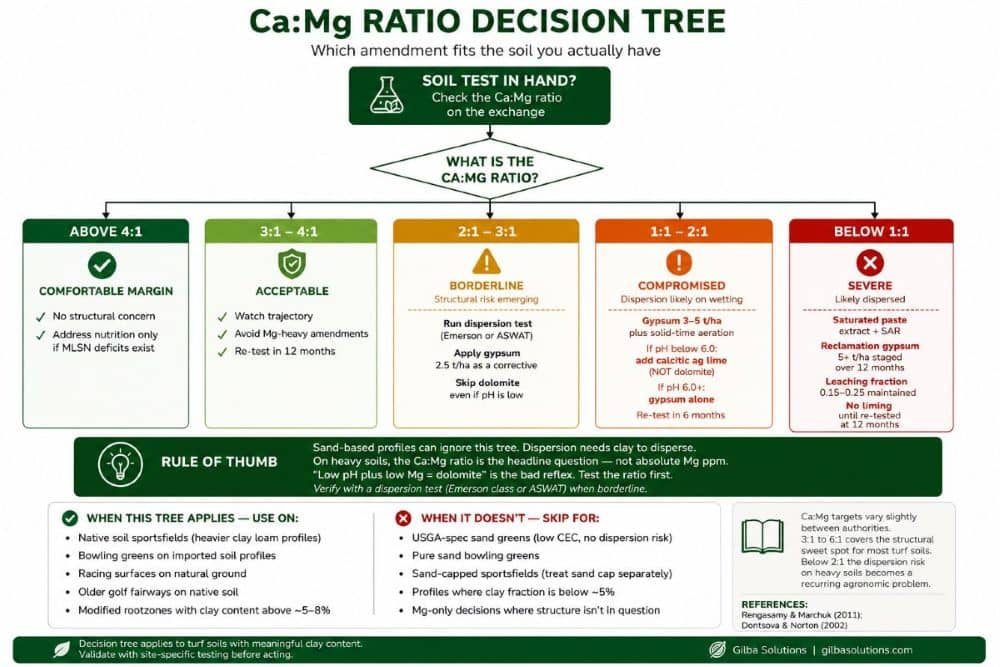
Heavy soils (clay loams, duplex profiles, native sportsfield soils): Dispersion risk is high. Mg-heavy amendments are genuinely damaging. The Ca:Mg ratio on the exchange matters. Target Ca:Mg of at least 3:1 on the exchange, ideally 4:1 to 6:1 for structural stability. Anything below 2:1 is asking for trouble. Test results showing high Mg base saturation (>20% on a moderate-to-high CEC soil) should trigger a structural assessment, not a fertiliser recommendation.
Sand-based profiles (USGA greens, sand-capped fields, pure sand bowling greens): Dispersion is essentially a non-issue. Sand has very low CEC (typically 1–3 cmol(+)/kg), almost no clay, no aggregate structure to disperse in the first place. The water flows through regardless of cation ratio. On these profiles the Mg question becomes purely nutritional — does the plant have enough? Mg supply for plant uptake is the only consideration, and kieserite or Epsom salts (MgSO₄·7H₂O) are perfectly fine if a tissue test shows actual deficiency.
The trap is that the same rep often recommends the same products across both profile types without thinking about which physics applies. A USGA green and a council sportsfield are completely different systems, and the Mg recommendation that’s fine on one is structurally damaging on the other.
Intermediate sand-soil mixes (modified rootzones, push-up greens with significant fines, sand-amended sportsfields): This is the grey zone. If clay content exceeds ~5–8% of the rootzone, dispersion can occur. The lab won’t always flag it on a standard turf soil test because the analysis suite is built for nutrition, not structure. Dispersion tests (Emerson aggregate stability test, ASWAT, or simple field-based crumb tests) tell you what the chemistry suite won’t.
Where the magnesium come from? Bore vs town water
The soil chemistry on a heavy turf profile drifts toward magnesium for two reasons: amendments (dolomite, kieserite) and irrigation water. The amendments are visible. The water is the silent loader, year after year, and most turf supers never test it for Mg.
Town water across Australia
For most Australian capital cities, mains water is too low in Mg to matter. Sydney, Melbourne, Canberra, Hobart all run Mg below 5 mg/L. Even on a fairway taking 800 mm of irrigation annually, that’s under 40 kg Mg/ha/year — trivial against the soil pool.
Three exceptions worth knowing:
- Perth (33 mg/L Mg) and Brisbane (11 mg/L Mg) deliver enough Mg over a full irrigation season to shift the exchange measurably on a heavier profile over 5-10 years. (Source: Australian tap water mineral composition study.)
- Darwin and Cairns run Ca:Mg ratios of 1:1 or worse in the water itself. The absolute volumes are low but the proportion delivered is already structurally unfavourable.
- Recycled or Class A effluent used by many councils for sportsfield irrigation often carries higher Mg than the mains supply, plus elevated bicarbonate that precipitates Ca on the exchange.
Bore water is a different story
Bore water across Australia is variable and the Mg loading risk is substantially higher. The headline mechanism is bicarbonate-driven Ca precipitation: when irrigation water carries bicarbonate above ~120 mg/L, it reacts with soil Ca to form insoluble CaCO₃. MgCO₃ precipitates much less readily, so Mg stays in solution and concentrates on the exchange. The Ca:Mg ratio drifts the wrong direction even when the bulk water analysis looks acceptable.
Where this hits hardest in Australia:
- Great Artesian Basin bores — high bicarbonate (often 500-1000+ mg/L), variable Mg.
- Murray-Darling alluvial bores — Mg often 30-80 mg/L plus elevated Na.
- Hard groundwater from limestone aquifers — WA Gnangara mound, parts of SA, Daly Basin NT — Mg can run 40-100+ mg/L.
- Coastal sand aquifers in southeast Queensland and northern NSW — Mg 15-40 mg/L plus Na.
A useful back-of-envelope calculation
Multiply your water Mg (mg/L) by annual irrigation depth (mm) and divide by 100. That’s the annual Mg load in kg/ha. A bore at 50 mg/L Mg irrigating 800 mm annually deposits 400 kg Mg/ha/year. Compare that to a typical soil exchangeable Mg pool of 200-500 kg/ha in the top 15 cm and the trajectory becomes obvious.
Why SAR misses this
Australian irrigation water labs default to reporting SAR. The SAR equation treats Ca and Mg as identical flocculating cations and lumps them together in the denominator. Two waters with identical SAR can have completely different Ca:Mg ratios, and the one with more Mg drives more long-term dispersion on a heavy soil. The CROSS equation (Rengasamy & Marchuk 2011) corrects this by weighting Mg at 0.6× the dispersive effect of Na — but CROSS isn’t routinely calculated on water reports. You have to ask for it, or do the Ca:Mg ratio math yourself from the raw ion concentrations.
The Albrecht ratio problem
Some of this confusion traces back to the Albrecht/Kinsey base saturation school, which prescribes specific cation ratios as “ideal” — typically 65–75% Ca, 10–15% Mg, 3–5% K, with Mg “ideal” at 12–15%. Those numbers got embedded in soil test report templates and into rep training across the industry.
The problem is that 13% Mg base saturation is not structurally ideal — it’s at the upper edge of safety. On a high-CEC clay soil that 13% represents a lot of Mg in absolute terms and a Ca:Mg ratio that’s borderline dispersive. Kopittke and Menzies (2007) reviewed the Albrecht ratios systematically and found the research basis for the specific Mg targets was weak — most subsequent agronomic work shows yield and quality responses depend on sufficient absolute supply, not on hitting a specific ratio.
The MLSN (Minimum Level for Sustainable Nutrition) approach developed by Woods, Stowell, and Soldat from PACE Turf and others moves away from ratios entirely and works in absolute ppm sufficiency thresholds. For Mg, MLSN sits at 50 ppm Mehlich-III as the floor below which response is likely. Anything above that is sufficient for the plant. Whether the soil also has structural issues is a separate question that needs separate analysis.
What to actually recommend
If a soil test on a heavier profile comes back with low pH and elevated Mg base saturation:
- Check the Ca:Mg ratio on the exchange. If below 3:1, that’s the headline issue.
- Run a dispersion test — Emerson class or ASWAT — to confirm structural status. A standard turf soil test won’t tell you this; you have to ask for it specifically.
- Use gypsum to supply Ca and improve the ratio. Rate depends on the gap — typically 2.5–5 t/ha for sportsfield-scale problems.
- If pH genuinely needs lifting, use agricultural lime (CaCO₃) — calcitic, not dolomitic. Specify “calcitic lime” or “ag lime” on the purchase order; don’t accept dolomite as a substitute.
- If plant Mg supply is genuinely insufficient (tissue test below ~0.2% Mg), apply Mg via foliar (Epsom salts at 5–10 kg/ha) rather than soil. Foliar bypasses the soil structural pathway entirely.
- Skip kieserite as a “low pH fix” — it doesn’t raise pH and it makes the structural problem worse.
- If irrigation water is from a bore or any non-domestic-mains source, test it for full ICP suite (Na, Ca, Mg, K, Cl, SO₄, HCO₃, pH, EC) and calculate the Ca:Mg ratio directly. If below 3:1 in the water, ongoing gypsum maintenance becomes a baseline requirement, not a corrective response.
For sands and pure rootzone mixes, none of this dispersion logic applies. Pick the cheapest Mg source that suits the application method and move on.
The deeper issue
Most turf reps work on commission for distributors carrying specific product ranges. Dolomite and kieserite are cheap, profitable, easy to move in pallet quantities, and “low pH plus low Mg equals dolomite” is a one-line decision rule that doesn’t require thinking about soil physics. Gypsum-plus-calcitic-lime is two products, more expensive per tonne, and requires explaining cation ratios to a club manager who just wants the field to look green.
The result is that sites accumulate Mg year after year, the Ca:Mg ratio drifts downward, structural problems compound, and the response is usually to apply more product rather than question the diagnosis.
If you’re a super, a council turf officer, or anyone responsible for a heavier-profile turf site, the action item is: get a soil test that reports both base saturation percentages and Mehlich-III ppm, check the Ca:Mg ratio, and if it’s below 3:1 on the exchange, push back on any recommendation that adds Mg without adding more Ca. That single check would prevent a lot of avoidable damage.
Common questions on magnesium soil dispersion
Does magnesium soil dispersion affect sand-based turf rootzones?
No. On sand-based profiles — USGA greens, sand-capped sportsfields, pure sand bowling greens — magnesium soil dispersion is essentially a non-issue. Sand has very low cation exchange capacity (typically 1 to 3 cmol(+)/kg), almost no clay content, and no aggregate structure to disperse. The magnesium question on sands becomes purely nutritional: does the plant have enough? Use whatever Mg source suits the application method. Dispersion only matters on profiles with meaningful clay content, typically above 5 to 8 percent of the rootzone.
Why does dolomite cause magnesium soil dispersion on heavy turf soils?
Dolomite is calcium magnesium carbonate, supplying roughly 22 percent Ca and 13 percent Mg. Applied at typical agricultural rates onto a soil already carrying elevated Mg on the exchange, it pushes the Ca:Mg ratio further toward Mg dominance. Magnesium has a larger hydrated radius than calcium (0.47 nm versus 0.42 nm), which widens the diffuse double layer around clay particles and weakens aggregate stability. The result is clay dispersion, surface sealing, reduced infiltration, and weaker root anchorage.
What is the ideal Ca:Mg ratio on the soil exchange for turf?
Target a Ca:Mg ratio of at least 3:1 on the exchange for structural stability on heavier turf profiles. Ratios of 4:1 to 6:1 give a comfortable margin against dispersion. Anything below 2:1 is structurally compromised and likely to disperse on wetting, particularly with low-EC water. Note that the Ca:Mg ratio matters far more than absolute Mg ppm — a high Mg reading on a sand profile is irrelevant; the same reading on a heavy clay loam is the headline issue.
Should kieserite be used to raise soil pH?
No. Kieserite is magnesium sulphate monohydrate, a neutral salt that does not raise pH. It supplies magnesium without any liming effect. Recommendations to use kieserite as a low-pH fix confuse magnesium supply with calcium-based liming. For acid soils with elevated exchangeable Mg, the correct combination is gypsum to supply Ca and improve the Ca:Mg ratio, plus calcitic agricultural lime (CaCO₃) to raise pH without adding more Mg.
How do I test for magnesium-induced soil dispersion?
Standard turf soil tests do not flag dispersion risk directly. Request a dispersion test specifically: Emerson aggregate stability class, ASWAT (Aggregate Stability in Water Test), or a simple field-based crumb test. Combine this with a base saturation report showing the Ca:Mg ratio on the exchange. If exchangeable Mg exceeds 20 percent of base saturation on a moderate-to-high CEC soil, structural assessment is warranted before any liming or amendment decision.
Does my irrigation water contribute to magnesium soil dispersion?
Usually yes, especially on bore water. Most Australian capital city mains water runs Mg below 5 mg/L and isn’t a structural concern. Perth and Brisbane are exceptions. Bore water is highly variable: Murray-Darling alluvial bores, Great Artesian Basin sources, and coastal sand aquifers in southeast Queensland and northern NSW commonly run Mg at 30 to 100 mg/L. Test the water with a full ICP suite, calculate the Ca:Mg ratio directly, and if it’s below 3:1, plan ongoing gypsum maintenance into the program.
References
- Rengasamy P & Marchuk A. (2011) Cation ratio of soil structural stability (CROSS). Soil Research 49, 280–285.
- Smith, C.J. & Oster, J.D. & Sposito, G., 2015. Potassium and magnesium in irrigation water quality assessment, Agricultural Water Management, Elsevier, vol. 157(C), pages 59-64.
- Dontsova, Katerina M. Norton, L. Darrell, Clay Dispersion, infiltration and erosion as influenced by exchangeable Ca and Mg. Soil Science 167(3):p 184-193, March 2002.
- Kopittke, P.M. and Menzies, N.W. (2007), A Review of the Use of the Basic Cation Saturation Ratio and the “Ideal” Soil. Soil Sci. Soc. Am. J., 71: 259-265. https://doi.org/10.2136/sssaj2006.0186
- Kwok M, McGeorge S, Roberts M, Somani B, Rukin N. Mineral content variations between Australian tap and bottled water in the context of urolithiasis. BJUI Compass. 2022 Jun 20;3(5):377-382. doi: 10.1002/bco2.168. PMID: 35950043; PMCID: PMC9349584.
- PACE Turf MLSN guidelines: https://www.paceturf.org/journal/minimum_level_for_sustainable_nutrition
- GCSAA MLSN reference card: https://www.gcsaa.org/docs/default-source/Environment/ipm-planning-guide/mlsn.pdf

Principal agronomist, Gilba Solutions Pty Ltd
BSc Hons Soil Science (Newcastle). Former STRI agronomist. Author of Nutrition of Sports Turf in Australia (CSIRO/Landlinks Press) and The Definitive Guide to Australian Turfgrass Pesticide Management. 35+ years advising on sports turf, golf and stadia across Australia, NZ, UK and Europe.