
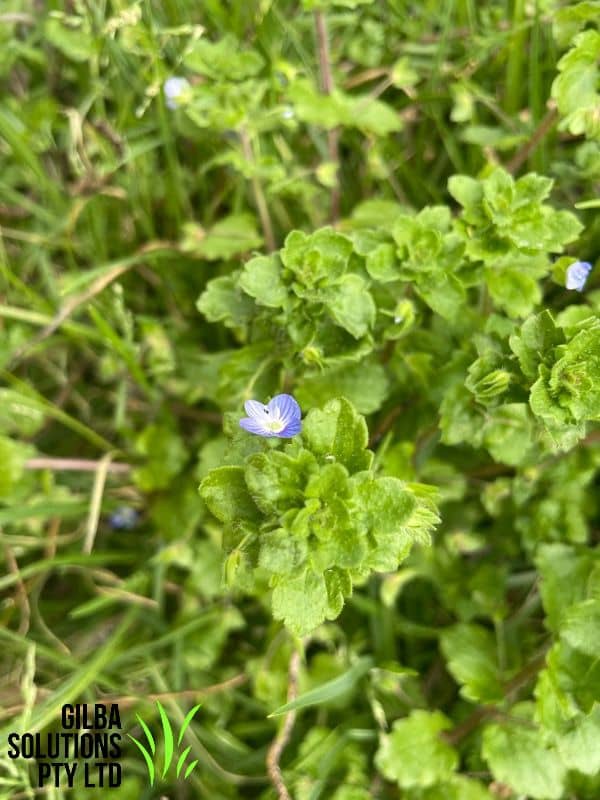


Speedwell Weed (Veronica spp).
Four speedwells (Veronica spp.) turn up in Australian lawns and turf. Two are annuals that spread by seed: birdseye speedwell and field speedwell. Two are perennials that form mats and spread by creeping stems: thyme-leaved speedwell and slender speedwell. The difference matters for control: you beat an annual by stopping it setting seed, but that does nothing to a perennial mat.
All four like moist soil. They die back in dry spells and regrow after rain.
After you read this, you will be able to:
- Identify these weeds.
- Know their habitat.
- Know the best cultural and chemical way to control them.
Speedwell Weed Identification.
Speedwells have small, rounded to oval leaves and small four-petalled flowers, usually blue to lilac, borne in the leaf axils along the stems.
Category: broadleaf (dicot) weeds.
Photosynthetic pathway: C3. They grow most in the cool months, which is why they are a late winter and spring problem.
Birdseye speedwell (Veronica persica).
Also called Persian speedwell or common field speedwell. Creeping speedwell is a different plant; see slender speedwell below.
- Growth habit: a prostrate, sprawling annual with weak stems whose tips turn upward.
- Leaves: broadly ovate, coarsely toothed and hairy, 1 to 2 cm long. The largest leaves of the four.
- Flowers: about 1 cm across, sky blue with darker stripes and a white centre, each on its own long, slender stalk.
- How it spreads: mainly by seed, which it sets in large numbers. Stem fragments can also regrow.
- Habitat: disturbed soil, thin lawns and garden edges.
- Control: it is low enough to escape the mower, so it seeds freely in thin turf.
Field, Corn or Wall Speedwell (Veronica arvensis).
- Growth habit: a small, upright winter annual, usually under 15 cm tall. It germinates in autumn and flowers in spring.
- Leaves: hairy. The lower leaves are round to ovate; the upper ones are narrower and clasp the stem.
- Flowers: tiny (about 2 to 4 mm) and blue to lilac, often hidden among the upper leaves. They only open on bright days.
- How it spreads: by seed only.
- Habitat: dry, sandy soils, often along walls and paths. It is found in Canberra and the Southern Tablelands.
| Birdseye speedwell (V. persica) | Field speedwell (V. arvensis) | |
|---|---|---|
| Seed longevity | More than 5 years | 1 to 5 years |
| Seeds per flower | 7 | 15 |
| Seeds per plant | 50 to 10,000 | 15,000 |
Thyme or Turf Speedwell (Veronica serpyllifolia).
- Growth habit: a low-growing perennial that forms dense mats.
- Leaves: small, nearly hairless, round to oval and opposite, like the leaves of thyme.
- Flowers: pale lilac-blue to white with dark lines, 4 to 6 mm across.
- How it spreads: mainly by creeping stems that root at the nodes, and also by small seeds.
- Habitat: damp lawns and shady areas.
Slender or creeping speedwell (Veronica filiformis).
- Growth habit: a creeping perennial that forms dense mats. Its thin stems root wherever a node touches the soil.
- Leaves: rounded to kidney-shaped with scalloped edges, about 5 to 10 mm across. Smaller than birdseye speedwell, larger than thyme-leaved speedwell.
- Flowers: about 8 to 10 mm across, pale blue to lilac with darker stripes, each on a long, thread-like stalk.
- How it spreads: almost entirely by stem fragments. It is self-sterile and rarely sets seed. Mowing chops the stems up and carries the pieces across the lawn, so cutting an infested patch spreads it.
- Habitat: lawns and other mown grass, usually where it is damp.
A Comparison Table of The Veronica species.
| Species | Life cycle and habit | Leaves | Flowers | Spreads by | Habitat | Key ID feature |
|---|---|---|---|---|---|---|
| Veronica persica (birdseye speedwell) | Prostrate, sprawling annual | Broadly ovate, coarsely toothed, hairy, 1 to 2 cm | Sky blue, white centre, about 10 mm, on long stalks | Seed, in large numbers | Disturbed soil, thin lawns | Largest leaves; bright blue flowers on long stalks |
| Veronica arvensis (field or wall speedwell) | Small upright winter annual, under 15 cm | Lower ovate, upper narrow and stalkless; hairy | Blue to lilac, 2 to 4 mm, often hidden in the leaves | Seed only | Dry, sandy soil, walls, paths | Upright habit; tiny hidden flowers |
| Veronica serpyllifolia (thyme-leaved speedwell) | Low, mat-forming perennial | Small, rounded, opposite, nearly hairless | Pale lilac-blue to white, 4 to 6 mm, dark lines | Creeping stems that root at the nodes, and seed | Damp lawns, shade | Thyme-like leaves; pale flowers |
| Veronica filiformis (slender or creeping speedwell) | Creeping, mat-forming perennial | Rounded to kidney-shaped, scalloped, 5 to 10 mm | Pale blue to lilac, 8 to 10 mm, on thread-like stalks | Stem fragments; rarely sets seed | Mown lawns, damp grass | Mats of thin rooting stems; no seed capsules |
For more information, please check out our weed ID chart. Speedwell is a good indicator weed of wet soils and shade.
Comments: most vegetative growth occurs in cool weather in late winter and early spring.
The image below is courtesy of Massey University.

How to Control Speedwell Weed in your lawn.
Cultural Control of Speedwell Weed.
Dense, healthy lawns will choke out this weed.
- Cut at the right height for your turf grass.
- Irrigate appropriately.
- Fertilise properly. Don’t skip on N as this just favours this weed. You want the turf to outcompete this weed.
Chemical Control of Speedwell Weed.
Management Calendar for Speedwell.
Management Calendar for Speedwell | ||||||||||||
Month | Jan | Feb | Mar | Apr | May | Jun | Jul | Aug | Sep | Oct | Nov | Dec |
Germination | ||||||||||||
Flowering/Seeding | ||||||||||||
Pre Emergent Herbicide | ||||||||||||
Post Emergent | ||||||||||||
Pre-emergent Herbicides.
- BASF Freehand suppresses Veronica sp.
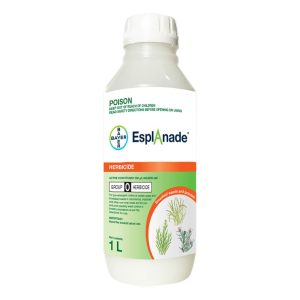
- In NZ Envu Esplanade has a label to control Veronica persica.
Post Emergents for Speedwell Weed.
- Use these in the Spring and the Autumn when the plants are actively growing.
- Don’t mow for two or three days before or after application. Use when there is no rainl forecast for at least 24 hours.
- You can control Corn Speedwell with Carfentrazone, Quinclorac and Tenacity herbicides (not registered in Australia).
- MCPA does not work well vs Speedwells.
- In the USA you can use Xonerate (Amicarbazone) to suppress Speedwell.
- Pylex has a label for post emergent Veronica sp suppression and control in the USA.
- Trifloxysulfuron has a label for this weed in the USA but not in Australia.
- Most 3 way mixes of post emergent herbicides like Stature and Warhead Trio will control this weed.
Table of Post Emergent Herbicides for Speedwell.
Product | Active | Chemical Group | Rate/Ha | Comments |
2,4-D | 2,4-D | 4 | 1.8-3.2 L | Wet foliage. DO NOT mow lawn for 1 week before and at least 1 weed after use. DO NOT use on Buffalo grass (WA only). |
Casper | Prosulfuron + Dicamba | 2 and 4 | 800 g-1 Kg | Use from the Autumn to the Spring. Use high rates in cool months or if there is high weed pressure. Control takes 4 to 6 weeks. Use an NIS at a rate of 0.25 to 0.5% v/v. |
Contra M. | Dicamba + MCPA | 4 | 6.5 L | Apply in 250-400 L of water. DO NOT use on Buffalo grass. After use do not mow for 2 days before or after use or fertilize within two weeks |
Dicamba | Dicamba | 4 | 1.2 L + 3.2 L of 2,4-D Amine 625 g/L | Use a minimum of 1000 L/Ha water. Do not spray on Buffalo or Bent Grass. |
Warhead | MCPA + Clopyralid + Diflufenican | 4 + 12 | 5 L | You may see discolouration on kikuyu, carpet grass and Queensland blue. Avoid overlap. Use an NIS. |
Weed Blast MA. | Bromoxynil + MCPA | 6 + 4 | 3-6 L | Apply in a minimum of 500 L/Ha water. DO NOT mow for 2 days after use. |
Non Selective Control.
- Glufosinate-ammonium provides control for 4 to 6 weeks, but it regrows and recovers due to the limited movement of glufosinate.
- Glyphosate. You can use Glyphosate but if you use Glyphosate, and water quality is an issue then use ProForce Manta Ray.
The following are non-selective but also have a long term residual and stop any re-growth.
- Renegade. Renegade stops germination for up to 12 months, and reduces the need for multiple herbicide applications.
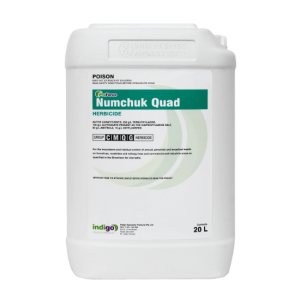
- Numchuk Quad. This gives effective post and pre emergent Speedwell control for up to 12 months.
- Cortex Duo. Cortex Duo gives a rapid knockdown, and residual control for up to 3 months. It is also safe to use around trees.
Table of Non Selective Herbicides for Speedwell.
Product | Active Ingredient | Group | Use Rate/Ha |
Glufosinate 200 | Glufosinate-ammonium | 10 | 1 to 6 L |
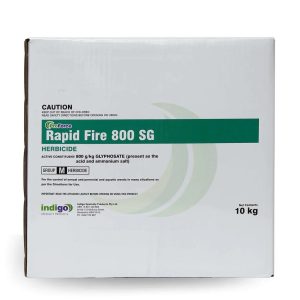
Rapid Fire 800 | Glyphosate | 9 | 0.9 to 1.35 Kg |
Numchuk Quad | Terbuthylazine + Glyphosate + Amitrole Oxyfluorfen | 5 + 9 + 34 + 14 | 20 to 25 L |
Cortex Duo | Nonanoic Acid + Oxyfluorfen | 14 | 7 L/1000L |
Renegade | Bromacil | 5 | 3.5 to 6.5 Kg |


ProForce Cortex Duo Industrial Herbicide is a non glyphosate weed killer. It is both a non-selective knockdown & a residual herbicide. You can use this to kill seedling & young




Principal agronomist, Gilba Solutions Pty Ltd
BSc Hons Soil Science (Newcastle). Former STRI agronomist. Author of Nutrition of Sports Turf in Australia (CSIRO/Landlinks Press) and The Definitive Guide to Australian Turfgrass Pesticide Management. 35+ years advising on sports turf, golf and stadia across Australia, NZ, UK and Europe.