
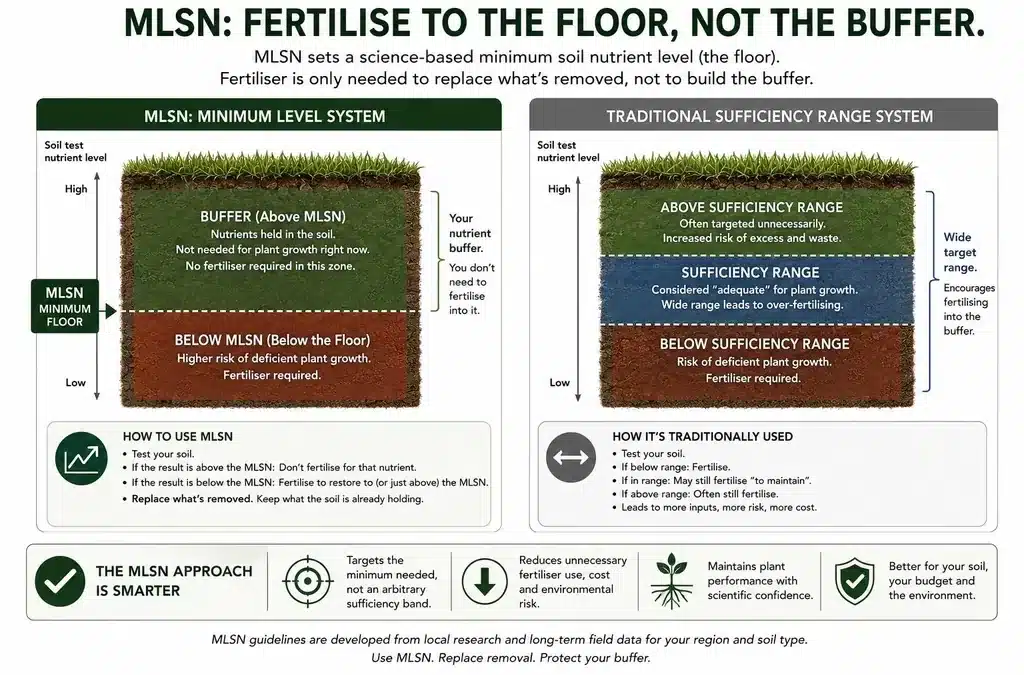
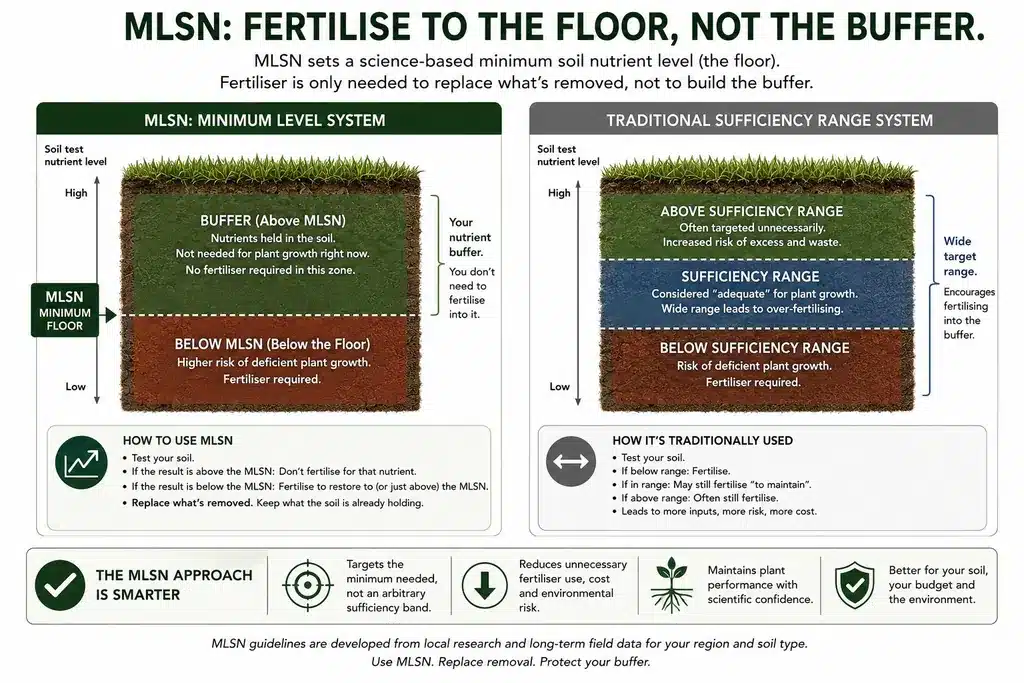
MLSN interpretation is a method for reading turf soil test results against minimum thresholds rather than ideal ratios. Developed in 2012 by Micah Woods at the Asian Turfgrass Center and Larry Stowell at PACE Turf, MLSN sets a single threshold for each nutrient. If your soil test sits above the threshold, the soil supplies enough of that nutrient and no fertiliser is required to maintain it. If it drops below, fertiliser is needed to lift the rootzone back above the line. The method is simpler than the Base Cation Saturation Ratio (BCSR) approach and more practical than Sufficiency Levels of Available Nutrients (SLAN) for high-traffic sand-based turf surfaces. Australian turf managers can apply MLSN directly because the dominant turf labs in this country report Mehlich-3 extraction results, which is the same method MLSN was built on.
What MLSN measures and what it does not
MLSN is a soil-supply interpretation method. It tells you how much nutrient the soil itself can provide to the grass plant over a growing season. It does not directly tell you how much fertiliser to apply. To work out fertiliser rates, you combine the MLSN deficit (how far below threshold your soil sits) with an estimate of how much nutrient the grass will remove through clipping yield over the season. This second step uses Growth Potential (GP) modelling and is covered separately under the turf fertiliser programme guidance.
What MLSN deliberately does not use:
- Cation ratios. BCSR specifies a target Ca:Mg:K saturation of roughly 65:10:5 percent of CEC. Two peer-reviewed reviews (Kopittke and Menzies, 2007; Culman et al., 2021) found no evidence that hitting these ratios improves turf or crop performance. MLSN ignores cation ratios and uses single-nutrient thresholds instead.
- Yield-based crop sufficiency tables. SLAN guidelines were calibrated for grain and forage crops where dry-matter yield was the measure of success. Turfgrass managers want playability and density, not biomass. Carrow et al. (2001) noted that historical turf SLAN guidelines were knowingly set high because fertiliser cost was assumed not to matter for turf.
The result is a leaner fertiliser programme. Most managers who switch to MLSN find they can reduce P and K applications without losing turf quality, which is what the title “Minimum Levels for Sustainable Nutrition” describes.
The MLSN threshold values
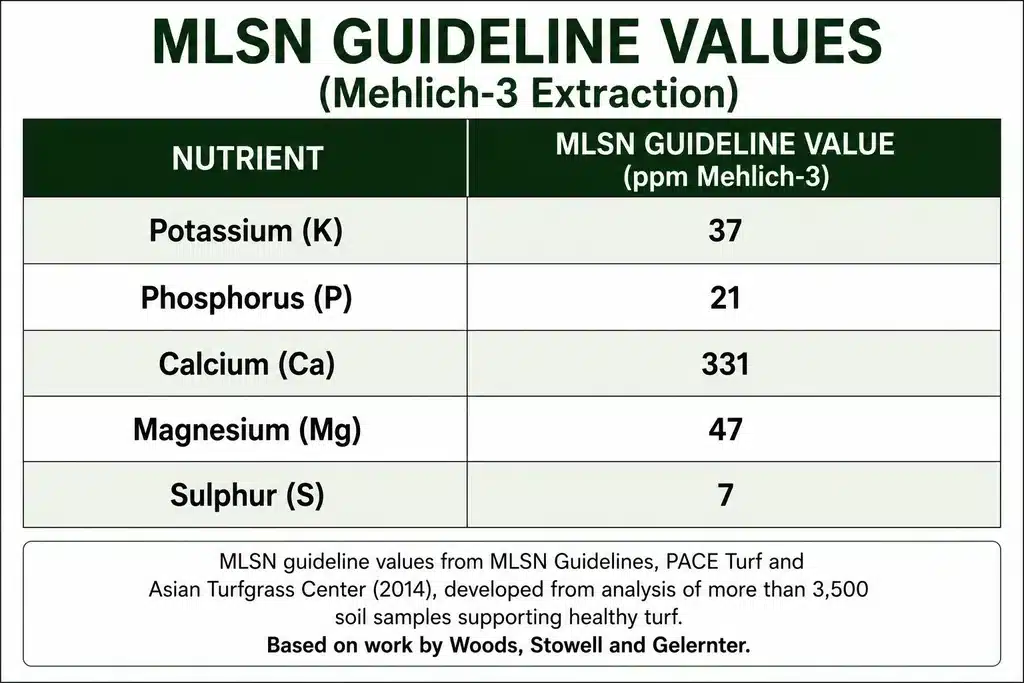
The current MLSN thresholds are based on review of thousands of turf soil samples and were refined in 2014. Values are in mg/kg of soil using Mehlich-3 extraction:
| Nutrient | MLSN threshold (mg/kg) | Common Australian unit |
|---|---|---|
| Potassium (K) | 37 | ppm or mg/kg |
| Phosphorus (P) | 21 | ppm or mg/kg |
| Calcium (Ca) | 331 | ppm or mg/kg |
| Magnesium (Mg) | 47 | ppm or mg/kg |
| Sulphur (S) | 7 | ppm or mg/kg |
These are minimums for sustainable turf nutrition, not yield-maximising targets. If your soil sits at twice the MLSN threshold for K, you have no agronomic reason to add more K. The grass will not respond.
Climate zone matters more than lab method in Australia
The four main turf-specialist labs in Australia (Gilba Solutions, Nuturf, GTS and Living Turf) all report Mehlich-3 extraction results, so the lab method itself does not need translation. The thresholds in the table above are directly usable on a standard Australian turf soil test.
What does need adjustment for Australian conditions is the rate at which the soil moves through its nutrient reserves. MLSN was developed largely on cool-season turf data from North America and Asia. Two Australian factors change how fast a soil draws down its supply of K, P, and the other nutrients:
- Climate zone and Growth Potential. A couch oval in coastal NSW has 9 to 10 months of active growth a year. A cool-season bowling green in the Southern Highlands has the opposite seasonal pattern with strong winter activity and a summer slowdown. Annual clipping yield and therefore annual nutrient removal can vary two- to three-fold across these climates even when starting from the same soil test.
- Warm-season versus cool-season tissue composition. Couch and kikuyu clippings typically run lower in N and K concentrations than perennial ryegrass clippings on a percent dry-matter basis. The same Growth Potential value translates to less nutrient removal in a warm-season sward. This shifts where you sit relative to MLSN thresholds across a season.
The practical implication is that two soils with identical MLSN scores at 1 July can be in very different positions by 1 December depending on whether the surface is couch in Brisbane or bent in Bowral. The MLSN threshold is the floor. How fast you fall toward the floor depends on Growth Potential and tissue composition.
Worked example 1: USGA sand bowling green in the Southern Highlands
Consider a Mehlich-3 soil test from a USGA-spec sand-based bowling green in the NSW Southern Highlands, with cool-season bentgrass and Poa over a USGA profile:
| Nutrient | Test result (mg/kg) | MLSN threshold | Status |
|---|---|---|---|
| K | 28 | 37 | Below threshold. Deficit 9 mg/kg. |
| P | 26 | 21 | Above threshold. No scheduled P needed. |
| Ca | 410 | 331 | Above threshold. No action. |
| Mg | 52 | 47 | Above threshold. No action. |
| S | 9 | 7 | Above threshold. No action. |
The interpretation is straightforward. Calcium, magnesium, sulfur and phosphorus are all above MLSN thresholds and require no scheduled application. Potassium is 9 mg/kg below threshold, so a K programme is needed to lift the soil above the line and then maintain it through clipping yield removal. The low cation exchange capacity of a USGA sand (typically below 4 cmolc/kg, see our companion article on cation exchange capacity in turf soils) means that K leaches readily, so a steady supply rather than a single large application will keep the soil above the threshold more reliably.
This is a common pattern across Australian USGA sand profiles. Calcium and magnesium are usually well-supplied from the parent sand material and from any gypsum or dolomite that was incorporated at construction. K is the nutrient that most frequently drops below the MLSN line and needs ongoing management.
Worked example 2: Couch sports oval on a sandy loam in coastal NSW
Now consider a Mehlich-3 soil test from a Wintergreen couch sports oval on a sandy loam profile in the Sydney basin:
| Nutrient | Test result (mg/kg) | MLSN threshold | Status |
|---|---|---|---|
| K | 54 | 37 | Above threshold. |
| P | 18 | 21 | Below threshold. Deficit 3 mg/kg. |
| Ca | 520 | 331 | Above threshold. |
| Mg | 68 | 47 | Above threshold. |
| S | 11 | 7 | Above threshold. |
Here the position is reversed. K, Ca, Mg and S are all comfortably above threshold thanks to the better cation exchange capacity of the sandy loam. The nutrient sitting below the line is P. Because couch is actively growing for nine to ten months of the year in this climate zone, P will continue to be drawn down faster than on a cool-season surface, so the P deficit needs an active maintenance plan rather than a one-off application.
Across both examples, the MLSN reading takes about two minutes once you know your thresholds. The fertiliser plan that follows takes longer because it has to integrate climate, species, traffic and the surface’s history. MLSN tells you which nutrients matter on this surface. It does not tell you the answer to the whole nutrition programme.
Golf greens versus heavily-used sports grounds: same thresholds, different drivers
MLSN thresholds are the same if you are looking at a soil test on a sand based golf green or a heavily-used council ground. What changes between the two surfaces is how fast the soil moves toward those thresholds, what drives this, and how the manager responds.
On a sand-based golf green the main drivers of nutrient depletion are leaching and clipping yield. The CEC sits below 4 cmolc/kg, the irrigation programme delivers more water than the rootzone can hold, and the surface is mown daily at 3 to 4 mm with the clippings being removed. Potassium leaches first, calcium loss becomes measurable, and the response is to make small frequent applications (5 to 10 kg N/ha every 7 to 10 days in peak growth) plus foliar K to bypass the leaching issue. MLSN interpretation on a green is a continuous maintenance exercise. The soil sits close to threshold for most of the year because that is the most efficient place to keep it.
On a heavily-used sports ground the dominant drivers are traffic and recovery. Most Australian sports grounds are native soil or hybrid profiles with a CEC of 8 to 20 cmolc/kg. This means that leaching is a much smaller factor and the soil reserve is much larger. A typical soccer match concentrates 22 players plus officials, and produces localised wear in goal mouths and the central channels that needs rapid tiller production and root regeneration.
The fertiliser response is driven by the recovery needs after each event rather than by any ongoing leaching loss. A surface can sit comfortably above the MLSN threshold on paper and still benefit from extra N and K applications timed to the post-match recovery window, because the active turf need exceeds what the soil can mobilise in the available time.
The Practical Implications of MLSN
The practical implication is that two surfaces with identical MLSN scores can need very different programmes. A golf green at K 38 (just above threshold) probably needs a maintenance K application within weeks because leaching will pull it below the line. A sports ground at K 38 with three weeks until the next match can sit there until the post-match recovery window before any K is applied. MLSN tells you where you are. Surface type and event schedule tell you when to act.
One further difference matters for stadium-grade surfaces with hybrid reinforcement (StrathAyr, SISGrass, Desso GrassMaster and similar systems). The synthetic fibre component does not contribute to CEC, so a hybrid profile reads on the soil test as if it were the native sand or sandy loam component alone. The agronomic behaviour shifts toward the golf-green pattern (faster leaching, smaller reserve) but the surface is being used as a heavy-traffic sports ground. This combination demands more frequent soil testing (quarterly rather than annually) to catch threshold breaches before recovery is compromised.
When MLSN does not apply cleanly
MLSN was developed for turfgrass on mineral soils and sand-based rootzones in temperate climates. It is less suitable for the following Australian situations:
- Highly weathered tropical soils. Soils across far northern Australia with low effective CEC, high exchangeable aluminium, and strong P fixation need adjusted interpretation rather than direct MLSN application. The aluminium toxicity and the P-fixation behaviour can dominate the agronomic decision before MLSN-style sufficiency becomes the limiting factor.
- Acid sulphate soils. Coastal acid sulphate conditions create extraction artefacts that distort all soil test interpretation methods, not just MLSN. Get the acid sulphate condition under management first.
- Sodic and saline soils. Where exchangeable sodium percentage (ESP) is above 6 percent, sodium and structural problems dominate the agronomic decision before nutrient sufficiency becomes the limiting factor. The structural collapse caused by high ESP affects rooting depth, infiltration and aeration. Address sodicity first, then return to MLSN for the nutrient supply question.
- Native organic soils. Peat-amended rootzones and native organic soils have very different cation exchange dynamics. The threshold values do not account for the buffering provided by very high organic matter content at elevated CEC values.
For these soil types, soil supply estimation needs to combine MLSN with additional information about CEC, organic matter, and the dominant cation balance.
How MLSN fits into a turf nutrition programme
MLSN is the first step in deciding what to apply. The second step is estimating clipping yield to project how much nutrient will be removed from the rootzone during the growing season. Multiply the projected clipping yield by the tissue nutrient concentration to estimate annual removal. Then the season’s fertiliser plan needs to supply at least that amount plus any deficit identified by the soil test.
This combined approach (MLSN soil supply plus clipping yield removal) is the basis of the PACE Turf Climate Appraisal and the Asian Turfgrass Center’s “what the grass needs” workflow. The same logic drives the nutrition outputs in the GAIP Hub for sites where soil test history and climate data are both available, with the additional layer of Australian climate-zone Growth Potential curves.
For more on the underlying soil chemistry that MLSN works with, see the related cation exchange capacity in turf soils guide, interpretation of different soil testing methodologies and the science of soil aeration. For the practical management side covering fertiliser products and timing, the turf fertiliser page covers slow-release, controlled-release and soluble options.
References
- Carrow, R.N., Waddington, D.V. and Rieke, P.E. (2001). Turfgrass Soil Fertility and Chemical Problems. John Wiley and Sons.
- Culman, S., Mann, M., Sharma, S., Saeed, M.T., Fulford, A.M. and Lindsey, L.E. (2021). Calibration of Mehlich-3 with Bray P1 and ammonium acetate in the Tri-State Region of Ohio, Indiana and Michigan. Communications in Soil Science and Plant Analysis, 52(2), 141-155.
- Kopittke, P.M. and Menzies, N.W. (2007). A review of the use of the basic cation saturation ratio and the “ideal” soil. Soil Science Society of America Journal, 71, 259-265.
- Stowell, L. and Woods, M. (2014). Only what the turf needs: updating the Minimum Levels for Sustainable Nutrition guidelines. Crop Science Society of America annual meeting, November 2014.
- Woods, M.S., Stowell, L.J. and Gelernter, W.D. (2016). Minimum soil nutrient guidelines for turfgrass developed from Mehlich-3 soil test results. PeerJ Preprints, 4:e2144v1.
Part of the Soil and Rootzone Science series.

Principal agronomist, Gilba Solutions Pty Ltd
BSc Hons Soil Science (Newcastle). Former STRI agronomist. Author of Nutrition of Sports Turf in Australia (CSIRO/Landlinks Press) and The Definitive Guide to Australian Turfgrass Pesticide Management. 35+ years advising on sports turf, golf and stadia across Australia, NZ, UK and Europe.