
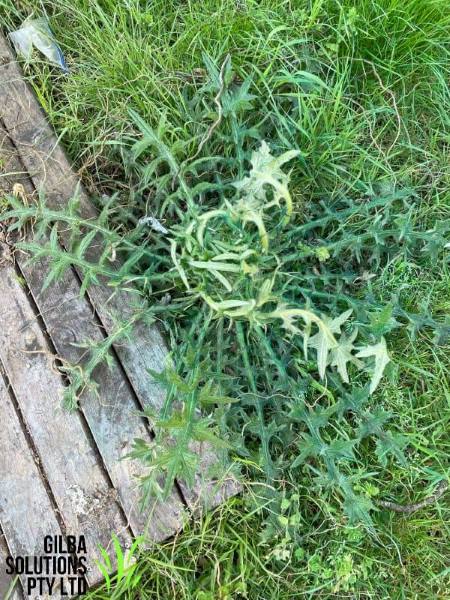
Warhead Trio: Bow & Arrow Alternative for Australian Turf
What Is Warhead Herbicide?
Warhead Trio is a selective broadleaf herbicide for Australian lawns and recreational turf. It contains the same three actives as Bow & Arrow and Spearhead (300 g/L MCPA (potassium salt), 20 g/L clopyralid (potassium salt), and 15 g/L diflufenican) at the same concentrations and the same usage rate of 5 L/ha.
If you want a Bow and Arrow or Spearhead herbicide alternative, Warhead Trio is a direct equivalent. The actives are identical. The labels are identical. The turf safety profile is identical. The main practical differences are branding, pack size options, and price.
It is registered for broadleaf weed control across all recreational turf situations and is safe on couch, kikuyu, buffalo, QLD blue couch, paspalum, fescue, and ryegrass.
Warhead Trio vs Bow & Arrow vs Spearhead: Head-to-Head
All three products share the same active ingredient combination. This matters for both product selection and to manage herbicide resistance. If you rotate between these brands it does not constitute a mode-of-action rotation.
| Feature | Warhead Trio | Bow & Arrow | Spearhead |
|---|---|---|---|
| Actives | MCPA 300 g/L + Clopyralid 20 g/L + Diflufenican 15 g/L | MCPA 300 g/L + Clopyralid 20 g/L + Diflufenican 15 g/L | MCPA 300 g/L + Clopyralid 20 g/L + Diflufenican 15 g/L |
| Groups | 4 + 4 + 12 | 4 + 4 + 12 | 4 + 4 + 12 |
| Rate | 5 L/ha | 5 L/ha | 5 L/ha |
| Buffalo safe | Yes | Yes | Yes |
| Couch safe | Yes | Yes | Yes |
| Kikuyu safe | Yes (transient discolouration possible) | Yes (transient discolouration possible) | Yes (transient discolouration possible) |
| QLD blue couch | Yes (transient discolouration possible) | Yes (transient discolouration possible) | Yes (transient discolouration possible) |
| Bentgrass | No | No | No |
| Odour | Low odour | Low odour | Low odour |
| Schedule | S5 | S5 | S5 |
| Pack size | 10 L | 500 mL, 10 L | Various |
| Supplier | Indigo Specialty Products | Turf Culture | Bayer / Envu |
| Dicamba free | Yes | Yes | Yes |
| Pre-emergent residual | Yes (diflufenican, 3-month overseed restriction) | Yes (diflufenican, 3-month overseed restriction) | Yes (diflufenican, 3-month overseed restriction) |
Bottom line: For field performance, the three products are interchangeable. Warhead Trio tends to be more economical in the 10 L format for professional or large-area use. Bow & Arrow’s 500 mL pack is the more practical option for home lawn use.
How Warhead Works
Three actives, two modes of action, working at different speeds and by different mechanisms.
MCPA (Group 4 is an auxin mimic) Foliar-absorbed, systemic. Mimics natural plant growth hormones (auxins), and disruptis cell elongation, protein synthesis, and cell division in susceptible broadleaf species. Causes rapid unregulated growth and eventual plant death. Translocates through the phloem.
Clopyralid (Group 4 is an auxin mimic) Synthetic growth hormone, also an auxin mimic. More persistent in plant tissue than MCPA, which means it continues to disrupt growth after initial uptake. Plant death tends to occur within 2–4 weeks. Clopyralid provides stronger activity on legumes (clover, medics) and composites (capeweed, catsear) than MCPA alone.
Diflufenican (Group 12 is a carotenoid biosynthesis inhibitor) Taken up mainly by shoots of germinating seedlings, and has limited translocation. Inhibits carotenoid biosynthesis, which leads to bleaching and necrosis. Acts as a short-term residual pre-emergent.. The diflufenican is why you see a bleaching effect and why you cannot overseed for 3 months after application.
The combination gives Warhead Trio activity on both established weeds (via MCPA + clopyralid) and seedlings (via diflufenican), which is why it provides more durable control than single-active products.
Weeds Controlled
Warhead Trio controls the following broadleaf weeds in Australian turf:
- White clover (Trifolium repens)
- Plantain / Lambs tongue (Plantago lanceolata)
- Capeweed (Arctotheca calendula) — use NIS for woolly-leaved plants
- Cat’s ear (Hypochaeris radicata)
- Bindii / Onehunga (Soliva sessilis)
- Cudweed (Gnaphalium spp.)
- Creeping buttercup (Ranunculus repens)
- Creeping oxalis (Oxalis corniculata)
For hard-to-wet weeds (capeweed, creeping oxalis), add a non-ionic surfactant such as Optispread 1000 to the spray mix. For photo identification of any of these weeds, see the Weed ID Chart.
Application Guide
Rate: 5 L/ha in 200–500 L water per ha (50 mL in 2–5 L water per 100 m²)
Best timing: May to October, when broadleaf weeds are actively growing. Autumn applications (May–July) will target actively growing winter weeds before they set seed. Spring applications (September–October) clean up any populations that are left before summer turf growth closes the canopy.
Step-by-step:
- Shake the container thoroughly before you measure it out
- Half-fill the spray tank with clean water
- Add the measured Warhead Trio and top up with water while you agitate
- Apply evenly to the target area with a calibrated sprayer
- Do not mow for 2–3 days before or after use
- Do not use if you expect rain within 4 hours
- Do not use on turf under stress or when frost is imminent
Adjuvant: Use a non-ionic surfactant (NIS) for difficult-to-wet weeds. Do not use crop oils as these can cause turf damage with this product.
Transient discolouration: May occur on kikuyu, carpet grass, and QLD blue couch. Test a small area on buffalo varieties before full application. Discolouration is temporary and turf recovers as the chemical breaks down.
Overseed restriction: Do not overseed treated areas for 3 months after use. Diflufenican has soil residual activity that inhibits seedling establishment.
Do not use on: Bent or wintergrass greens and bowling surfaces.
Resistance Management
Warhead Trio, Bow & Arrow, and Spearhead are all Group 4 + Group 12 herbicides. If you switch between brands it is not a resistance rotation as you are using the same modes of action. For genuine resistance management in broadleaf weed programs, rotate to products with different modes of action in alternate seasons, such as:
- Group 2 herbicides (Duke, Casper, Recondo). These are effective on many of the same targets
- Group 6 herbicides (Weed Blast MA is bromoxynil + MCPA) and so has a different primary active
- Group 27 herbicides (Pylex) for cool-season turf situations
See the herbicide resistance chart for full mode-of-action groups.
Is Warhead Trio the same as Bow and Arrow herbicide?
Yes, for all practical purposes. Both contain the same active ingredients at the same concentrations: 300 g/L MCPA, 20 g/L clopyralid, and 15 g/L diflufenican. The use rate, turf safety profile, registered weed list, and withholding periods are the same. Warhead Trio is made by Indigo Specialty Products; Bow & Arrow is made by Turf Culture. The main difference is pack size. Warhead Trio is available in 10 L only, while Bow & Arrow comes in 500 mL and 10 L.
Is Warhead Trio safe on buffalo grass?
Yes. All three actives are safe on buffalo grass (Stenotaphrum secundatum) at label rates. This is one of Warhead Trio’s key advantages over products that contain dicamba. Dicamba is not safe on buffalo. Test varietal buffalo on a small area before large-scale use as this variety can show more pronounced transient effects
How long does Warhead Trio take to work?
Visible symptoms are leaf curl, distortion, and yellowing. These tend to appear within 7–14 days. Full weed death on established plants occurs within 2–4 weeks. Smaller, actively growing weeds respond faster. If weeds are large or well-established, you may need a follow up 4–6 weeks after the first. Do not re-use within 3–4 weeks, as the diflufenican component continues acting after initial application.
Can I use Warhead Trio for bindii?
Yes. Bindii (Soliva sessilis) is on the label. For best results, apply in June–July before the burr stage. This is because once spines form the plant is harder to control and the burrs will remain in the soil regardless of whether the plant dies. See the bindii control guide for full timing and rate guidance.
Does Warhead Trio need a surfactant?
For most weeds, you do not need a surfactant. For hard-to-wet weeds with waxy or hairy leaves such as capeweed and creeping oxalis add a non-ionic surfactant such as Optispread 1000. Do not use crop oil concentrates or methylated seed oils with this product.
Can I overseed after using Warhead Trio?
No you can’t overseed for 3 months after use. The diflufenican has soil residual activity that inhibits the germination of newly sown seed. Plan herbicide use with this restriction in mind if autumn overseeding is part of your program.
Is rotating between Warhead Trio and Bow & Arrow a resistance management strategy?
No. Both products contain the same active groups (Groups 4 and 12). Alternating between brands with the same actives provides no resistance management at all. For proper mode-of-action rotation, switch to Group 2 (Duke, Casper) or Group 6 (Weed Blast MA) in alternate seasons.
Label: Warhead Trio Label PDF SDS: Warhead Trio SDS PDF
Written by Jerry Spencer, Principal Agronomist, Gilba Solutions Pty Ltd. BSc Hons Soil Science, former STRI agronomist, author of Nutrition of Sports Turf in Australia (CSIRO/Landlinks Press). 35+ years advising golf courses, stadiums and councils across Australia, NZ, UK and Europe.
Related pages: Herbicide Resistance Chart | Weed Control in Autumn | Bindii Control | Capeweed Control | Spray Adjuvants | Weed ID Chart
Principal agronomist, Gilba Solutions Pty Ltd
BSc Hons Soil Science (Newcastle). Former STRI agronomist. Author of Nutrition of Sports Turf in Australia (CSIRO/Landlinks Press) and The Definitive Guide to Australian Turfgrass Pesticide Management. 35+ years advising on sports turf, golf and stadia across Australia, NZ, UK and Europe.