
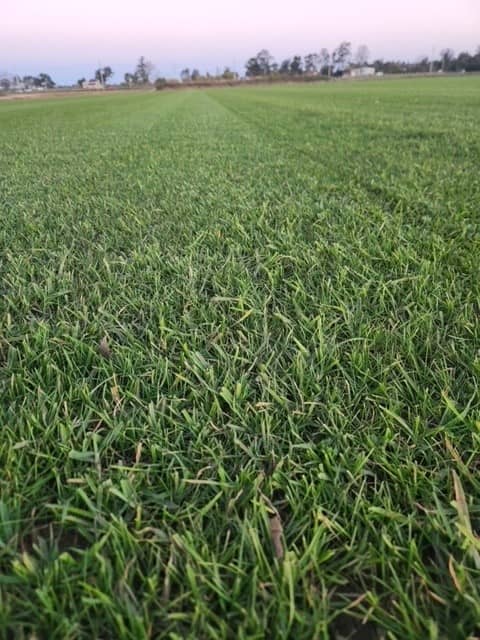
Tall Fescue Seed for Australian Sports Turf and Lawns
Tall fescue (Festuca arundinacea) is an ideal cool-season species for a narrow but important use. It’s ideal as a permanent turf with better summer persistence than perennial ryegrass.
It is deeper rooting, needs less water and fertiliser, and gives acceptable performance under moderate traffic and partial shade. It is not a substitute for ryegrass, but an option that meets a different use.
In Australia, you tend to find tall fescue in premium lawns, parks, golf course rough, school grounds and utility sports turf across the cool-temperate and inland temperate zones. Where summer stress will punish ryegrass and winter cold rules out warm-season species, tall fescue is able to do what no other cool-season species can.
When you need to make a choice on whether to use tall fescue or not the question is not “which tall fescue is cheapest” but is “is tall fescue right for this use, and which cultivar matches the site.”
Establishment speed, disease resistance, rhizomatous growth, and trial data all drive the answer. At Gilba Solutions we stock Spyder 2LS. This is a laterally spreading turf-type tall fescue selected for genuine performance rather than marketing claims.
We cover species positioning, the differences between bunch-type and rhizomatous fescues, how to read tall fescue trial data, mowing and management thresholds, and where you shouldn’t use tall fescue.
This guide was written by Jerry Spencer, Principal Agronomist at Gilba Solutions, with 35 years advising on Australian sports turf.
Recommended variety from Gilba Solutions
Spyder 2LS is a laterally spreading turf-type tall fescue. It recovers and knits better than standard bunch-type tall fescue, without being marketed as a true rhizomatous cultivar.
The reality is that it recovers better than conventional tall fescue, but it is not the equivalent to couch or kikuyu for lateral repair.
Typical applications: premium lawns, parks, golf rough, school grounds, utility sports turf across temperate and cool-temperate Australia.

Spyder 2LS
Lateral-spreading tall fescue. For premium lawns, parks, golf rough and utility sports turf.
Where tall fescue fits, and where it doesn’t
Tall fescue’s main use in Australia is simple. This is a cool-season grass when you want year-round green colour, deep rooting, better summer survival than perennial ryegrass, and a lower need for inputs than elite rye-based turf.
It is the best choice in climates where the summers are too hot for ryegrass but the winters are still cool enough that warm-season grass is either undesirable or becomes dormant.
Regionally in Australia, this means Canberra, the Southern Highlands, elevated tablelands, cooler inland NSW, much of Victoria, Tasmania, and the cooler parts of South Australia and Western Australia.
Root depth, drought and heat
The main agronomic argument for tall fescue is its root depth. Tall fescue develops a deeper root system than perennial ryegrass and other cool-season turfgrasses. This is why it has better drought tolerance and better summer survival once it establishes.
Tall fescue does not thrive in the extreme temperatures of Australia, but it tolerates heat and drought better than rye once the root system establishes. That is why this grass often looks like the more stable species through the late spring to the early autumn in inland temperate zones, while rye tends to decline.
It is not a tropical grass, and in genuinely hot humid summer areas it still a needs to be cut at the right height, irrigation discipline, and a rootzone that does not stay saturated.
Poor drainage shifts the conversation from drought tolerance to root stress and disease pressure very quickly. A fescue stand on a saturated rootzone in a humid summer will tend to fail regardless of what cultivar you choose.
When NOT to specify tall fescue
- Elite winter sports surfaces. Rye establishes faster, recovers quicker under play, and looks better at low cutting heights. Tall fescue is not the right species when you want fast establishment and quick in-season repair.
- Warm-season winter oversowing. For dormant couch and kikuyu that need winter colour and playability, perennial ryegrass remains the best choice.
- Deep shade. Tall fescue tolerates some shade, but not excessive shade. Once direct sunlight falls below four hours per day, it declines. Very low-light sites need fine fescue, and not tall fescue.
- Chronically waterlogged or badly drained sites with summer humidity. Brown patch and root stress will quickly cause problems.
- Clients expecting couch-like lateral recovery. Even Spyder 2LS should not be sold that way. Lateral spread is a recovery aid, not self-repair at the level of true stolon- or rhizome-driven warm-season grasses.
Rhizomatous vs bunch-type, and where Spyder 2LS sits
The majority of tall fescue cultivars in Australia are bunch-types. This means that they tiller, but don’t tend to spread to fill wear scars the way couch, kikuyu or Kentucky bluegrass do.
There are some cultivars sold as rhizomatous tall fescue (RTF). This is where their rhizomes are promoted as being able to self repair. Barenbrug’s patented RTF is the best-known example of this, but independent verification of RTF cultivars is limited.
Barenbrug’s original RTF cultivar was Labarinth. It was never entered in NTEP trials, which makes a clean comparison difficult.
A 2012 two-year Buffalo NY trial by Drew Kinder, included Labarinth alongside four standard tall fescue cultivars. This found that no rhizomatous spread occurred that was sufficient enough to repair bare ground in any of the cultivars. This included RTF.
That was one cool-temperate trial in a backyard. Not a multi-site research program. However, it remains the only published side-by-side comparison that included a named RTF cultivar.
What NTEP data shows
Spyder 2LS sits between the classic bunch-type and the RTF claim. It is marketed with “Lateral Spread” technology (“creeps and crawls”). This means better knitting, thickening and recovery than conventional bunch-type turf tall fescue.
What the NTEP data actually shows for Spyder 2LS. In the 2018 National Tall Fescue Test (2019–2023 final report, 2023 progress data), Spyder 2LS (entry ZRC1) gave an LPI Group 1 mean turf quality rating of 6.5 and an LPI Group 2 mean of 6.8. This is on the standard 1-to-9 NTEP scale where 6.0 is the threshold for acceptable turf quality, and places it in the top tier in cool-humid and transition-zone US sites.
The commercial reality. Spyder 2LS is a high quality turf type tall fescue with NTEP data behind it and genuine lateral spread behaviour. It is not a couch substitute nor a self-repairing turf. It is a premium tall fescue supported by independent trial data.
Establishment trade-offs
Tall fescue establishes more slowly than perennial ryegrass.
Germination is limited below about 12°C. At optimal soil temperatures, you will still get a expect slower cover than rye. This means you should plan any renovation program accordingly.
If you seed at low rates this slower establishment gives weeds and competition a longer window to establish.
Seed rate reality
Its seed is larger than ryegrass seed. Kilogram-per-hectare rates mislead buyers who compare directly without accounting for seeds per square metre. The practical ranges for Australian use are:
- New pure stand: 25 to 40 g/m²
- High-quality renovation or faster cover: 35 to 50 g/m²
- Overseeding into existing tall fescue: 20 to 35 g/m² depending on canopy opening, wear and season
The Spyder 2LS label rate of roughly 29 to 44 g/m² for sowing and 25 to 34 g/m² for overseeding sits neatly inside those practical bands.
The error buyers make is that they assume rye rates translate directly. Rye can get away with lower rates because it grows quickly. Tall fescue rewards adequate rate, shallow seed placement, warm soil and low competition.
Buyers who try to stretch the bag usually end up with an open canopy, weed invasion and a false conclusion that the cultivar is coarse or patchy. The problem is usually rate or establishment conditions, not genetics.
Disease and insect profile
Tall fescue’s disease profile is not the same as ryegrass. The differences matter for fungicide treatment.
- Brown patch is the main disease in turf-type tall fescue. It is the major summer concern, especially in humid subtropical pockets and under excessive nitrogen. Resistant cultivar selection significantly reduces brown patch risk. Cultivar matters more than texture.
- Pythium can occur on tall fescue under wet, hot, poorly drained conditions. However, in comparison to perennial ryegrass, disease development is generally limited and tall fescue is rarely severely damaged.
- Insects. Tall fescue is generally more tolerant of root feeding insects than perennial ryegrass, because of its deeper root system.
Overseeding suitability
For Australian winter oversowing into dormant warm-season sports turf, tall fescue is usually not the first choice. Perennial ryegrass owns that role because it germinates faster, establishes quicker, presents cleaner under traffic sooner, and is the standard overseeding species for dormant couch.
Tall fescue is a better choice for overseeding where the existing base is already tall fescue or a tall fescue-dominant mix. Reinforcement of existing fescue stands makes sense. Using tall fescue as a winter colour tool on couch does not.
Commercial framing: if you want autumn cover on couch for winter play, rye is the right choice. If you want a permanent cool-season sward with better summer persistence than rye, then choose tall fescue.
Traffic tolerance
Tall fescue traffic tolerance is decent to good. However its often overstated, and is not the right answer for the highest-wear winter sports situations where fast establishment and rapid in-season recovery matter most.
When traffic begins shortly after seeding, research consistently shows perennial ryegrass outperforms tall fescue on wear tolerance. Under high-traffic overseeding, rye maintains higher density. In heavily trafficked areas, tall fescue cultivars can become clumpy and may need frequent overseeding to maintain uniformity.
The honest commercial line is that it handles general wear, family lawn use, parks, golf rough traffic and moderate sports use well enough, especially once mature.
Drainage tolerance
Tall fescue is better than rye on heavier soils. It is also tolerates short periods of flooding better than most cool-season turfgrasses.
However, if soils are waterlogged for any period of time it will struggle.
Shade tolerance compared with ryegrass
Tall fescue is more shade-tolerant than perennial ryegrass. It is a safe cool-season choice for mixed shadey lawns, tree-lined parks, golf rough edges and building-side strips. Ideally it needs at least least four hours of direct sunlight per day for acceptable performance.
Mowing height
You should aim to cut tall fescue higher than elite rye sports turf. The practical Australian range:
- Lawns and utility turf: 40 to 70 mm
- Sports surfaces with managed cultivar choice: 25 to 50 mm depending on cultivar and inputs
- Very close cutting (below 25 mm): is possible with modern cultivars under controlled conditions, but surrenders part of the species advantage
It performs best when you allow enough leaf area to support its root system and summer stress tolerance. If you go chasing rye-like presentation at low cutting heights it pushes the species away from what it does well.
How to read NTEP data for tall fescue
The methodology is covered in detail on the perennial ryegrass page. The tall fescue specific quirks are worth flagging separately.
- Cultivar rankings shift hard with trial type. NTEP’s tall fescue reports include separate tables for traffic stress, shade, drought stress and 1.5-inch mowing height. Sorting by overall mean quality and declaring a winner misses the point. A cultivar excellent in broad quality may not be the best pick for shade, traffic, low mowing or summer disease pressure on your site.
- Genetic colour sells bags but distorts buying decisions. NTEP separates genetic colour from turf quality for a reason. A very dark cultivar is not automatically the best performer.
- Modern turf-type tall fescues are finer and denser than their old reputation suggests. Assess current cultivar data, not species memory.
- NTEP does not make variety recommendations. The program provides data for regional and management-level interpretation. A turf quality rating of 6 in one context is not the same as a 6 somewhere else. You need to bear this in mind when you make a choice.
Comparison: Spyder 2LS vs generic tall fescue vs perennial ryegrass
| Attribute | Spyder 2LS | Generic Tall Fescue | Perennial Ryegrass |
|---|---|---|---|
| Growth habit | Laterally spreading turf-type | Bunch-type | Bunch-type |
| Establishment speed | Moderate, above 12°C soil | Moderate, above 12°C soil | Fast, 3 to 7 days at 10 to 20°C |
| Root depth | Deep | Deep | Shallow to moderate |
| Summer heat tolerance | Good | Good | Moderate, declines under stress |
| Drought tolerance | Good, benefits from deep rooting | Good, benefits from deep rooting | Moderate |
| Traffic tolerance | Moderate to good, improved by lateral spread | Moderate, can become clumpy | High, especially established |
| Wear recovery | Better than standard, not couch-equivalent | Limited, no lateral repair | High, with adequate inputs |
| Shade tolerance | Moderate | Moderate | Low to moderate |
| Wet soil tolerance | Moderate, not waterlogged | Moderate, not waterlogged | Low, Pythium risk |
| Brown patch risk | Cultivar-dependent, modern resistance good | High without resistant cultivar | Moderate |
| Pythium risk | Low to moderate | Low to moderate | High under wet heat |
| Mowing height | 25 to 70 mm | 40 to 70 mm | 18 to 35 mm |
| Best use | Premium lawns, parks, golf rough, utility sports | Lawns, parks, low-maintenance turf | Stadiums, elite sports, overseeding |
| Climate fit (AU) | Temperate, cool-temperate, elevated | Temperate, cool-temperate, elevated | Cool to warm-temperate, not humid tropics |
Seeding rates and timing
- A new stand: 25 to 40 g/m² with shallow placement and consistent moisture
- Renovation for faster cover: 35 to 50 g/m², upper end if the window is compressed
- Overseeding into an existing tall fescue: 20 to 35 g/m², depending on canopy opening and wear
Timing. Tall fescue establishes best with soil temperatures above 12°C and consistent moisture. In southern Australia, early autumn is the main seeding window, aiming to target falling temperatures rather than rising summer heat. Spring establishment is possible but compresses the root development window before the first summer stress event.
Late seeding produces a weak stand as you go into the summer. The seed rate and timing work together. If you compromise either it punishes tall fescue more than it punishes rye.
When to specify tall fescue over ryegrass
Tall fescue is the right grass when you need a permanent cool-season turf with better summer persistence than rye, reasonable wear and shade tolerance, higher mowing acceptance, and a lower-drama management than an elite rye surface. It is good for premium lawns, parks, golf rough, schools, councils and utility sports areas in temperate and cool-temperate Australia.
Rye is the right specification when you need speed, winter sports performance, fast overseeding response, cleaner low-cut presentation, or quick repair under play pressure.
Tall fescue is not the universal answer. It is the best choice when you want permanent cool-season turf with summer persistence. That distinction is what most of the market still misses.
For specification advice on a particular site talk to an agronomist.
What mowing height suits tall fescue?
40 to 70 mm for lawns and sports turf. 25 to 50 mm for sports surfaces with appropriate cultivar selection and inputs. Below 25 mm is possible with modern cultivars under controlled conditions but surrenders part of the species’ root and stress advantage. Higher cutting heights generally produce better summer persistence and the need for lower inputs.
Does tall fescue work in humid Queensland summers?
Marginal. Tall fescue tolerates heat and drought better than ryegrass once it establishes. However, in genuinely hot humid areas with poor drainage, brown patch and root stress erase the species advantage. Tall fescue is strongest in temperate and cool-temperate Australia: Canberra, Southern Highlands, elevated tablelands, Victoria, Tasmania, cooler inland NSW.
What seeding rate should I use for a new tall fescue lawn?
25 to 40 g/m² for a new stand. Make sure you get proper seed-to-soil contact, don’t seed to deep and allow adequate watering through establishment. Under-seeding is punished harder in tall fescue than in ryegrass because slower establishment gives weeds a better window to encroach.
Can Spyder 2LS repair wear scars like couch or kikuyu?
No. Spyder 2LS has meaningful lateral spread and recovers better than standard bunch-type tall fescue. However, it is not a true rhizomatous cultivar and not a substitute for stolon-driven warm-season grasses. Sold honestly, it is a tall fescue with improved knitting and recovery, not a couch replacement.
Is tall fescue better than ryegrass for Australian conditions?
Better in some cases, worse in others. Tall fescue has deeper roots and better summer persistence than perennial ryegrass. This makes it the best choice for permanent cool-season turf in temperate and cool-temperate Australia where summer stress punishes rye. Ryegrass is the right choice for winter overseeding of warm-season bases, elite sports surfaces that need a fast cover, and any case where speed and recovery under traffic dominate.
References
[1] Bonos, S.A., Rush, D., Hignight, K. and Meyer, W.A. (2004). Selection for deep root production in tall fescue and perennial ryegrass. Crop Science, 44(5): 1770-1775.
[2] Beard, J.B. and Green, R.L. (1994). The role of turfgrasses in environmental protection and their benefits to humans. Journal of Environmental Quality, 23(3): 452-460.
[3] National Turfgrass Evaluation Program (NTEP). 2018 National Tall Fescue Test: 2023 Progress Data.
[4] National Turfgrass Evaluation Program (NTEP). Tall fescue trial data index.
[5] Powlen, J.S., Fidanza, M.A., Kerns, J.P., Hoagland, L.A. and Bigelow, C.A.(2024). Turf-type tall fescue brown patch resistance as influenced by morphological characteristics. Plant Health Progress, 25(2): 193-200
[6] Sykes, V.R., Horvath, B.J., McCall, D.S., Baudoin, A.B., Askey, S.D., Goatley, J.M. and Warnke, S.E. (2020). Screening tall fescue for resistance to Rhizoctonia solani and Rhizoctonia zeae using digital image analysis. Plant Disease, 104: 358-362
[7] Penn State Extension (2024). Turfgrass diseases: Brown patch (Rhizoctonia solani).
[8] Kinder, D. (2012). Does tall fescue spread? Seeds 4 Thought blog.
[9] Fry, J. and Huang, B. (2004). Applied Turfgrass Science and Physiology. John Wiley and Sons, Hoboken NJ.
[10] Rimi, F., Macolino, S., Richardson, M.D., Karcher, D.E. and Leinauer, B. (2021). Base temperatures affect accuracy of growing degree day model to predict emergence of bermudagrasses. Agronomy Journal, 113.
[11] Mountain View Seeds. Spyder 2LS technical data sheet.

Principal agronomist, Gilba Solutions Pty Ltd
BSc Hons Soil Science (Newcastle). Former STRI agronomist. Author of Nutrition of Sports Turf in Australia (CSIRO/Landlinks Press) and The Definitive Guide to Australian Turfgrass Pesticide Management. 35+ years advising on sports turf, golf and stadia across Australia, NZ, UK and Europe.