
Padre 270 (Maleic Hydrazide) for Australian Turf: A Practical Guide
Padre 270 is a maleic hydrazide (MH) plant growth regulator containing 270 g/L MH as the potassium salt. It is registered in Australia under APVMA approval 92873/149852 and supplied by Indigo Specialty Products. As a Class A (Type I) regulator, it inhibits cell division in actively dividing meristematic tissue, particularly shoot apices and seedheads. That is a fundamentally different mode of action to the gibberellin-pathway regulators such as trinexapac-ethyl and paclobutrazol that dominate fine-turf management.
This means that Padre nicely fills a niche for turf registered PGR’s that are economical to use over large areas of low maintenance turf.
The label registers Padre for bahia grass (Paspalum notatum) suppression and seedhead control. It also covers kikuyu (Pennisetum clandestinum) in low-maintenance grassed and turfed areas, fencelines, industrial sites, non-crop situations, roadsides, rail corridors and rights-of-way. It is not a fine-turf product. That distinction governs every recommendation on this page: Padre earns its place in mowing-cost reduction across low-priority vegetation, not on playing surfaces.
This guide sets out what the published evidence actually supports. It covers where Padre belongs in an Australian programme, how to time and apply it, and the failure modes that turn a sound application into a worse-looking result than doing nothing. It is written for professional turf managers, council operators, and applicators.
Prepared by Jerry Spencer, Principal Agronomist, Gilba Solutions Pty Ltd. BSc (Hons) Soil Science, 35+ years in turf agronomy, CSIRO/Landlinks published. Always read and follow the registered label.
Published: 27 May 2026
What this guide covers
Maleic hydrazide is one of the oldest growth-regulating chemistries in turf. Its track record depends heavily on timing, turf density, and an integrated herbicide programme. This page works through:
- Mode of action and where MH differs from GA-pathway PGRs — why cell-division inhibition behaves differently to trinexapac-ethyl and paclobutrazol
- What the evidence supports — the Rhode Island and Minnesota field record behind the “12 to 16 week” claim
- Where Padre genuinely belongs — kikuyu and bahia suppression on roadsides, rail, fencelines, and council mowing programmes
- Application timing by Australian region — the narrow active-growth window that determines success or failure
- Rates, tank mixing, and the broadleaf herbicide partner — why MH without a companion herbicide thins turf
- Failure modes and cost-benefit reality — the sites where MH pays and the sites where it does not
How maleic hydrazide works, and why it is not trinexapac-ethyl
Maleic hydrazide is taken up through actively transpiring leaf tissue. It translocates to dividing meristems, where it stops new cells forming. Trinexapac-ethyl (a Class B/Type II regulator) and paclobutrazol work differently: they inhibit gibberellin biosynthesis, reducing internode elongation while cell division continues. The practical consequence is large. MH suppression is slower to appear, longer in duration, and carries a higher discolouration and thinning risk than the GA-inhibitors used on greens, tees and fairways. The two chemistries do different jobs. Putting MH where a GA-inhibitor belongs is a predictable way to damage a surface.
MH also does not shrink existing tissue. For the first two weeks after application there is little visible change. That routinely leads owners and council inspectors to assume the application has failed when it has not. The suppression becomes visible only as untreated areas pull ahead in height and seedhead production over weeks two to six.
What the published evidence actually supports
The marketing claim is 12 to 16 weeks suppression with 70 to 90 per cent seedhead reduction. That is consistent with the better field results in the literature. Treat it as achievable under good conditions, though, not as a default.
What the replicated US trials found
Wakefield and Clapham (1968, University of Rhode Island) ran a two-year replicated trial on a mixed Kentucky bluegrass, orchardgrass and quackgrass sward. At 4.5 and 9 kg/ha MH applied in early May, height fell by 32 per cent and 45 per cent respectively through eight weeks. Seedhead suppression was strong in orchardgrass and quackgrass, partial in bluegrass. Critically, MH thinned the turf, which favoured weed encroachment by red sorrel and crabgrass. The authors concluded MH without a companion broadleaf herbicide produced an unsatisfactory result. They also found high cutting outperformed low cutting for maintaining density in treated turf.
Foote and Himmelman (1965, Minnesota DOT Investigation 616) is the more sobering read. Across four years of roadside trials, a spring application near 6.7 kg/ha retarded height by about 60 per cent. Lower rates and autumn applications were generally ineffective. The effective spring window was about two weeks, narrow enough that correct timing under field conditions was difficult. Where turf was less than excellent quality, MH opened the canopy and annual weeds became prominent. Treated areas often looked worse than untreated controls. Mowings saved ranged from zero to five depending on site, with application cost equalling or exceeding the cost of mowings saved on standard rural roadside. The one application that clearly paid was fencelines at 11.2 kg/ha, where MH eliminated maintenance for the season.
The Australian promotional trial
A Peracto Tasmania field evaluation (2016, cited in the Padre technical guide) tank-mixed Padre with trinexapac-ethyl and with paclobutrazol. Both mixes produced visibly shorter swards than untreated controls at 12 weeks. The photographs are convincing. Trial design here is promotional rather than peer-reviewed, though, so it carries less weight than the replicated work above.
Where Padre genuinely earns its place in Australia
The strongest case is kikuyu suppression on roadsides, rail corridors and industrial perimeters. Kikuyu dominates low-maintenance ground through coastal NSW, southern Queensland, and much of Victoria and South Australia. It seeds constantly through the growing season and runs aggressively over kerbs, into drains and through fencelines. One well-timed Padre application replacing two to three slashing passes is real money saved.
Bahia grass seedhead suppression in Queensland and northern NSW is the second clear case. Bahia produces V-shaped racemes that look poor and shed pollen and seed prolifically. Padre is one of the few tools that knocks down seedhead production for an extended period.
Fencelines, guard rails, signage bases and stormwater infrastructure are where MH delivers the cleanest economic return. Apply it in narrow bands at the upper rate. You get full suppression for the season and no whipper-snipping, and the vegetation is retained for erosion control rather than killed off as a knockdown or sterilant would do. Rural and urban council mowing programmes are the classic LGP-panel use case, where the alternative is repeated slashing of long runs of low-priority grass.
Where Padre does not belong
Padre is the wrong product for golf course fairways, tees and greens, sportsfield playing surfaces, bowling greens, and premium domestic lawns. On these surfaces, use trinexapac-ethyl or paclobutrazol instead. Do not use it on turf less than 12 months old; the original Connecticut DOT advice was two to three years. Couch (Cynodon dactylon) and buffalo (Stenotaphrum secundatum) are not on the label. As a rule, anywhere visual quality matters more than mowing cost, MH is the wrong choice. A client wanting their kikuyu shorter without mowing will get a discoloured, thinner sward that looks worse than if it had simply been cut.
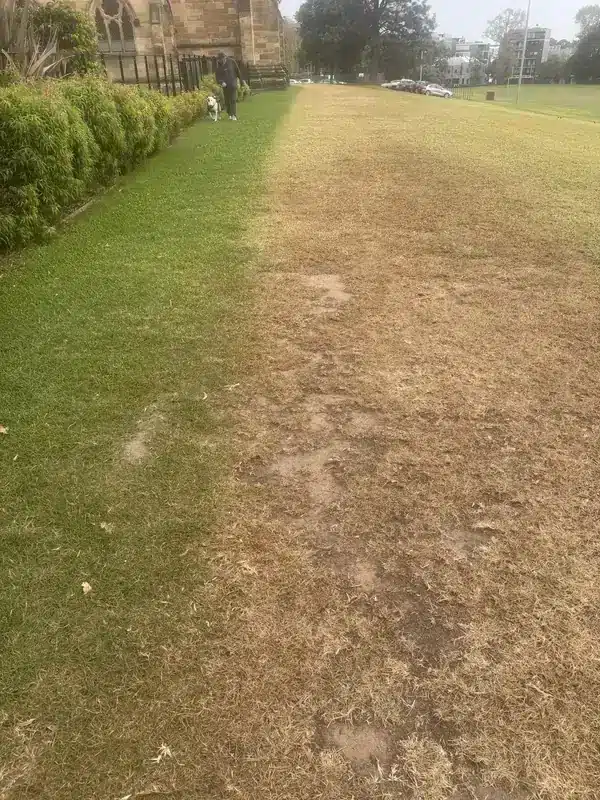
MH applied out of season to stressed kikuyu. This is the failure mode the page describes
Application timing by Australian region
If the plant is not actively growing, the chemistry does not work. The Foote and Himmelman data are unambiguous: autumn and summer-dormant applications failed, while spring applications during active growth succeeded. The grass should be 5 to 10 cm tall, green, and actively growing. It should not be stressed, dormant, or just emerging from frost. If seedheads are already visible, the window for that flush has passed.
| Region | Target species | Best application window |
|---|---|---|
| Southern Highlands NSW, Tablelands, Victoria | Kikuyu | Late October to mid-November (post green-up, pre-seedhead initiation) |
| Coastal NSW, SE Queensland | Kikuyu, bahia | Early to mid-spring (Sep–Oct), repeat early autumn if needed |
| Tropical / subtropical QLD | Bahia, kikuyu | Early wet season (Oct–Nov), occasional late-summer top-up |
| Tasmania | Kikuyu (where present), cool-season grasses | Mid to late spring |
Application conditions that matter
No mowing or slashing within 12 hours either side of application. MH needs leaf area to absorb through. Cutting before strips the absorption surface, and cutting after removes the chemical before it translocates. Allow no rainfall or irrigation within 24 hours post-application, because the potassium salt is water-soluble and washes off leaves easily. Check the BoM forecast carefully for summer afternoon storms in QLD and northern NSW. Leaf surfaces must be dry and free of dew, dust or thatch overlay. Dust-coated roadside grass after a dry spell is a common failure mode.
Soil moisture should be adequate. Moisture-stressed plants have closed stomata and reduced transpiration, which limits uptake. After a dry fortnight, irrigate or wait for rain, then time the application 36 to 48 hours after the soil rewets. High humidity helps by slowing cuticle drying and extending the absorption window. Early-morning (after dew has evaporated) or late-afternoon applications generally beat midday for this reason. Avoid applying above 30°C, where uptake drops and discolouration risk rises. Avoid applying below 10°C, where the grass is not growing fast enough to absorb effectively. Apply in wind of 3 to 20 km/h with a MEDIUM droplet minimum. Keep boom height at 0.5 m or lower for the zero buffer zones; above 1.0 m the vegetation buffer extends to 20 m at full label rate.
Rates and tank mixing
| Application method | Rate range | Notes |
|---|---|---|
| Boom (low-volume) | 6 – 12.5 L/ha | Spray volume 100–500 L/ha; MEDIUM droplet minimum; boom 0.5 m or lower for zero buffer |
| Handgun (high-volume) | 600 mL – 1.25 L per 100 L water | Apply at 1000 L/ha spray volume |
| Knapsack | 60 – 125 mL per 100 m² | Apply 2–10 L water per 100 m²; flat-fan nozzles preferred |
Use the lower end of the rate range when growth is moderate and a moderate level of suppression is acceptable. The lower end also suits Padre rotated within a wider PGR programme. Use the upper end when growth is vigorous, when maximum duration is wanted, or for fencelines and other set-and-forget applications.
Add a non-ionic surfactant at label rate (typically 0.1 to 0.25 per cent v/v). The label notes this improves coverage and translocation. Without a wetter, the potassium salt formulation can bead off waxy leaf surfaces, particularly on mature kikuyu. This is not optional for serious work.
Tank mix with a broadleaf herbicide. This is the Wakefield and Foote lesson: MH thins the canopy and lets broadleaf weeds and annual grasses fill the gap. The label explicitly recommends tank mixing with a suitable broadleaf herbicide on grass areas where weeds are an issue. Australian options include 2,4-D amine (low volatility for sensitive-area buffers), a 2,4-D/dicamba combination, or MCPA where clovers and capeweed dominate. Always run a small jar test for physical compatibility before mixing volumes. Do not tank mix with ester formulations in hot weather without a small-area trial first. Volatility risk above 30°C, combined with the spray-drift restraints on the Padre label, makes this a poor choice.
Programmed applications and managing expectations
Single high-rate applications are a blunt instrument. A programmed approach gives more consistent suppression with less discolouration. Run a spring base application at 8 to 10 L/ha with surfactant and broadleaf herbicide. Add a mid-summer top-up at 6 to 8 L/ha if growth resumes, typically 10 to 14 weeks later. Apply in autumn only where the species is still actively growing, which is often viable for kikuyu in coastal NSW or QLD but generally not in southern Australia. Do not exceed two applications per season as a default. Repeated MH applications can cause cumulative thinning and rust susceptibility, both documented in the Rhode Island and Minnesota work.
In the field, expect little visible change in the first two weeks. Maximum visual differentiation from untreated areas runs through weeks two to six. Possible cosmetic yellowing or purpling follows through weeks six to 12. Suppression begins to break with a carbohydrate-driven flush around weeks 12 to 16. Weed pressure during weeks four to 10 is the failure mode to watch. Crabgrass, summer grass, Paspalum dilatatum, fleabane and ragweed will exploit any thinning. That is exactly why the broadleaf tank mix matters and why MH is unsuitable for poor-quality turf. You cannot create good turf by suppressing the existing cover.
Cost-benefit reality check
At Australian list prices, a Padre application at 8 L/ha with surfactant and a broadleaf tank mix sits in the order of $150 to $250 per hectare in product, plus application cost. The economics work cleanly in three situations. One is where mowing costs are high, through fuel, difficult access, traffic management, or multiple operator passes. Another is where mowing frequency would otherwise be three or more times in the suppression window. A third is where mowing failure carries consequence costs such as fire risk, sight-line obstruction, or noxious-weed seedhead suppression.
Elsewhere the numbers do not work. They fail where the area is mowed only once or twice a season anyway, where quality expectations exceed what MH can deliver, or where a missed window forces a second recovery application. The Foote and Himmelman finding still holds: application cost equals or exceeds the cost of mowings saved on standard rural roadside. Pick the sites carefully.
Safety and regulatory
Padre carries standard PPE requirements: cotton overalls, elbow-length chemical-resistant gloves, and a face shield or goggles when mixing. Re-entry is permitted once spray has dried, or earlier with PPE. The product is non-scheduled, low in mammalian toxicity, and degrades in soil without persistent residues. The spray-drift restraints on the label are explicit and worth re-reading before each job, particularly wind speed (3 to 20 km/h), droplet size (MEDIUM minimum), and boom height (0.5 m for zero buffer zones, with vegetation buffers up to 20 m at higher booms). Do not contaminate watercourses, triple-rinse containers, and return them to drumMUSTER or equivalent collection.
Is Padre 270 safe to use on golf greens or sportsfields?
No. Padre 270 (maleic hydrazide) is not a fine-turf product. It is not registered for golf greens, tees, fairways, sportsfields or bowling greens. Padre inhibits cell division rather than gibberellin-driven elongation. This means its suppression is slower to appear and carries a higher risk of discolouration and canopy thinning than the PGR’s normally used on playing surfaces.
For fine turf, trinexapac-ethyl or paclobutrazol are the correct tools because they regulate growth through the gibberellin pathway with far better surface tolerance. Padre is registered for Kikuyu grass and bahia grass in low-maintenance grassed and turfed areas, fencelines, roadsides, rail corridors, industrial sites and rights-of-way. Its value is in reducing mowing cost across low-priority vegetation, not in maintaining playing quality. Using it on a surface where appearance matters produces a thinner, discoloured sward that looks worse than simply mowing.
How does maleic hydrazide differ from trinexapac-ethyl and paclobutrazol?
Maleic hydrazide is a Class A (Type I) regulator that stops new cells forming by inhibiting cell division in actively dividing meristematic tissue. Trinexapac-ethyl and paclobutrazol inhibit gibberellin biosynthesis. This reduces the cell elongation that drives internode and leaf extension while cell division continues. The difference is practical, not academic.
MH suppression appears more slowly, lasts longer, and has a greater risk of discolouration and thinning. This is why it suits low-maintenance vegetation rather than playing surfaces. Maleic hydrazide is taken up through transpiring leaf tissue and translocates to meristems, so it needs adequate leaf area and active transpiration to work at all. The gibberellin-inhibitors give finer, more reversible regulation suited to high-value turf.
In short, MH is a seedhead and bulk-growth suppressant for rough vegetation, while the GA-pathway regulators are precision tools for fine turf. They are not interchangeable.
When should I apply Padre 270 in Australia?
Use Padre when the target grass is actively growing, green, and 5 to 10 cm tall. Do not apply to stressed turf, turf that is dormant, or turf just emerging from frost. If seedheads are already visible you have missed the window.
The kikuyu window for the Southern Highlands of NSW, the Tablelands and Victoria is late October to mid-November, after green-up and before seedhead initiation. Coastal NSW and south-east Queensland call for early to mid-spring (September to October) for kikuyu and bahia, with a possible early-autumn repeat. In tropical and subtropical Queensland, use the early wet season (October to November) with an occasional late-summer top-up. Tasmania suits a mid to late spring application for kikuyu where present and cool-season grasses.
The underlying rule is that maleic hydrazide only works on actively transpiring tissue, so autumn and summer-dormant applications fail. Confirm that there is active growth before booking the job rather than working to a calendar date.
What rate of Padre 270 should I use?
Boom application is 6 to 12.5 L/ha in a spray volume of 100 to 500 L/ha with a MEDIUM droplet minimum. Handgun application is 600 mL to 1.25 L per 100 L of water at around 1000 L/ha spray volume. Knapsack application is 60 to 125 mL per 100 m² in 2 to 10 L of water per 100 m².
Use the lower end of the range when growth is moderate, when a moderate level of suppression is acceptable, or when Padre is rotated within a wider PGR programme. Use the upper end when growth is vigorous, when maximum duration is the goal, or for fencelines and other set-and-forget applications. Calibrate carefully. At these rates a 5% calibration error is 0.3 to 0.6 L/ha, enough to drop below the effective threshold or into the discolouration zone. Always add a non-ionic surfactant at label rate.
Why do I need to tank mix Padre with a broadleaf herbicide?
Maleic hydrazide thins the turf canopy, and a thin canopy lets broadleaf weeds and annual grasses fill the gap. This is the central lesson from both the Wakefield and Clapham (1968) and Foote and Himmelman (1965) field trials, where MH applied without a companion herbicide produced unsatisfactory results and weed encroachment. The Padre label explicitly recommends tank mixing with a suitable broadleaf herbicide on grass areas where weeds are an issue.
In Australian conditions, options include 2,4-D amine (low volatility for sensitive-area buffers), a 2,4-D/dicamba combination, or MCPA where clovers and capeweed dominate. Always run a small jar test to confirm physical compatibility before mixing full volumes, and avoid ester formulations in hot weather without a small-area trial first. This is because of the volatility risk above 30°C combined with the label’s spray-drift restraints makes esters a poor choice. The weed-pressure window to watch is weeks four to 10 after application.
How long does Padre 270 suppress growth?
The marketing claim is 12 to 16 weeks of suppression with 70 to 90% seedhead reduction, achievable under good conditions rather than guaranteed. In practice you see little visible change for the first two to three weeks, because MH stops new cell division but does not shrink existing tissue. Maximum visual differentiation from untreated areas occurs through weeks two to six. Untreated grass pulls ahead in height and produces seedheads while treated grass does not.
Through weeks six to 12 the treated turf may show some cosmetic yellowing or purpling, particularly at higher rates or under stress. Around weeks 12 to 16 the suppression begins to break, and a carbohydrate-driven flush of growth follows as the chemical effect dissipates. Duration depends heavily on application timing, growth stage, rate, and whether a surfactant was used. Poor timing or rainfall within 24 hours of application shortens or eliminates the effect entirely.
Why does my Padre application look like it did nothing?
The most common reason is that it is too early to judge. Maleic hydrazide stops new cell division but does not shrink existing tissue. For the first two weeks there is little visible change, and the application often appears to have failed when it has not. Photograph treated and untreated areas at application so you have a baseline for comparison.
If there is genuinely no suppression after several weeks, a few causes are likely. You may have applied too late, after seedhead initiation, when the window has passed. The grass may not have been actively growing at application. Rainfall or irrigation within 24 hours can wash the water-soluble potassium salt off the leaves before it translocates. Dust-coated leaves after a dry spell, moisture stress closing the stomata, and temperatures above 30°C or below 10°C all reduce uptake. To avoid this, confirm active growth and a clear 48-hour forecast before applying, wash dust off the canopy first, and apply early morning or late afternoon for best uptake.
Does Padre 270 work on couch or buffalo?
Couch (Cynodon dactylon) and buffalo (Stenotaphrum secundatum) are not on the Padre 270 label, so it should not be used on either. For couch growth regulation you have better and label-supported options in trinexapac-ethyl and paclobutrazol, which regulate growth through the gibberellin pathway with much better surface tolerance and far lower discolouration risk. The Padre label registers maleic hydrazide for bahia grass and kikuyu in low-maintenance grassed and turfed areas, fencelines, roadsides, rail corridors, industrial sites and rights-of-way.
If the goal is reduced mowing on a couch or buffalo surface where appearance matters, maleic hydrazide is the wrong chemistry regardless of rate, because it thins and discolours the sward. Match the regulator to the species and the surface: MH for rough kikuyu and bahia where mowing cost is the issue, and the gibberellin-inhibitors for fine and managed warm-season turf.
References
- Indigo Specialty Products. Padre 270 Technical Guide and APVMA-approved label (leaflet dated 24/10/2025, APVMA Approval No. 92873/149852).
- Wakefield, R.C. and Clapham, A.J. (1968). “Management of Turfgrass Treated with Maleic Hydrazide.” Highway Research Record 246-003, University of Rhode Island, pp. 36–43.
- Foote, L.E. and Himmelman, B.F. (1965). “Maleic Hydrazide as a Growth Retardant.” Minnesota Department of Highways, Investigation No. 616 Final Report, in cooperation with the U.S. Bureau of Public Roads and the Minnesota Local Road Research Board.
- Peracto field evaluation cited in the Padre Technical Guide (Granton, Tasmania, 2016).
This guide is prepared for professional turf managers and applicators. Always read and follow the registered label. For site-specific advice, contact Jerry Spencer at Gilba Solutions, gilbasolutions.com, Bowral NSW.
Part of the Turfgrass Physiology and Plant Growth Regulators resource series.
Principal agronomist, Gilba Solutions Pty Ltd
BSc Hons Soil Science (Newcastle). Former STRI agronomist. Author of Nutrition of Sports Turf in Australia (CSIRO/Landlinks Press) and The Definitive Guide to Australian Turfgrass Pesticide Management. 35+ years advising on sports turf, golf and stadia across Australia, NZ, UK and Europe.