The Hidden Costs of Organic Fertilisers in Turfgrass
The turf industry is under more and more pressure to use organic fertilisers and products. With the current war in Iran this is becoming even more difficult to achieve.
Sustainability, regulatory trends, and consumer demand have driven this shift. However, for golf course supers and sports turf managers who manage sand-based rootzones, this move toward organic N sources has consequences that rarely feature in any marketing material.
The research tells a more complicated story than “organic is better.”
This article examines four related problems that can arise when you use organic fertilisers on intensively managed turfgrass:
- Increased disease development.
- Softer playing surfaces.
- Increased Poa annua levels, and
- Changes in dynamics between soil and water.
Organic Matter Build up: The Root of the Problem.
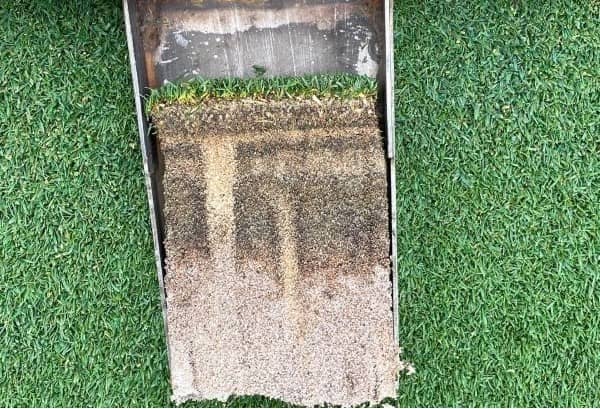
Sand-based greens and sports surfaces are designed to drain well. Their ability to drain depends on maintaining the macropore space in the upper rootzone.
Extensive research demonstrates that when you have high organic matter (OM) levels in the top 75 mm of sand based greens it reduces macroporosity, oxygen diffusion, and water infiltration whilst increasing water retention (Murphy et al., 19931Murphy, J.A., Rieke, P.E. & Erickson, A.E. (1993). Core cultivation of a putting green with hollow and solid tines. Agronomy Journal, 85(1), 1–9.; Neylan, 19942Neylan, J. (1999). Sand profiles for turf. Australian Turfgrass Management, 1(5), 24–26..
In fact, the USGA Green Section has consistently stated that excessive OM is a primary cause of soft, disease-prone greens3Moeller, A. & Lowe, T. (2016). Managing organic matter in putting greens. USGA Green Section Record, 54(21), 1–7..
Organic Fertilisers.
Organic turf fertilisers add C to the soil. In contrast, synthetic N fertilisers deliver plant available N with no organic content.
Organic fertilisers like composted manures, deposit large quantities of organic matter into the rootzone that slowly decomposes. This is in addition to the OM already being generated by the turf itself through the turnover of roots, leaf aging, and stoloniferous growth.
You can regard thatch levels that exceed 13 mm as excessive4Christians, N.E. (1998). Fundamentals of Turfgrass Management. Ann Arbor Press.5Miller, R.W. (1965). Nature and process of thatch formation. USGA Green Section Record, 3(1), 18–21Cornman, J.F. (1952). Effects of thatch on turf. Proceedings of the Northeastern Weed Control Conference, 6, 96–98.6McCarty, L.B. & Miller, G. (2002). Managing Bermudagrass Turf. Ann Arbor Press..
When there is a build up of thatch it is results in lower cold tolerance, more disease and insect activity, and a reduction in pesticide efficacy7Cornman, J.F. (1952). Effects of thatch on turf. Proceedings of the Northeastern Weed Control Conference, 6, 96–98.8Miller, R.W. (1965). Nature and process of thatch formation. USGA Green Section Record, 3(1), 18–21.9Thompson, W.R. (1967). Turfgrass thatch. USGA Green Section Record, 5(4), 2–4..
Several factors accelerate this build-up of OM in well managed turf:
- Low heights of cut.
- High N.
- Frequent irrigation and
- The type of fertiliser used (Weaver et al., 2022).
Organic fertilisers contribute to two of these simultaneously by adding more N and more carbon substrate.
Soft Playing Surfaces.
Excessive OM at a green surface:
- Produces soft conditions.
- Increases ball marks.
- Gives inconsistent green speeds and
- Increases the susceptibility of turf to scalping10Barton, L., Wan, G.G.Y., Buck, R.P. & Colmer, T.D. (2009). Effectiveness of cultural thatch-mat controls for young and mature kikuyu. Agronomy Journal, 101(1), 67–74.11Carrow, R.N. (2001). Thatch and organic matter management on turfgrass. USGA Green Section Record, 39(2), 18–21.12Hurto, K.A., Turgeon, A.J. & Spomer, L.A. (1980). Physical characteristics of thatch as a turfgrass growing medium. Agronomy Journal, 72(1), 165–167..
On sports pitches:
- It leads softer surfaces.
- Inconsistent ball bounce and
- More divots.
Research at several US universities confirms that coring increases surface hardness by around 19% on creeping bent greens. This is in contrast to untreated greens with high OM levels that became progressively softer13McCarty, L.B., Gregg, M.F. & Toler, J.E. (2007). Thatch and mat management in an established creeping bentgrass golf green. Agronomy Journal, 99(6), 1530–1537..
When you topdress with sand it dilutes the OM layer and firms the surface. However, this is a race. If organic inputs outpace dilution and OM breakdown, the surface becomes softer.
If you manage greens with heavy organic inputs these need more aggressive and frequent sand topdressing, aeration, and verticutting to compensate. That means more disruption, more cost, and more days where surfaces are unavailable for play.
The turf manager’s dilemma is clear. Companies pushing organics promote microbial activity and “soil health.” But if you add more OM to a system that already produces OM faster than it decomposes it works against the engineering intent of the rootzone.
Disease Development with Organic Fertilisers.
The relationship between N, OM, and disease is not straightforward, so you should challenge claims that organics are “better for turf health”.
Low N makes turf more susceptible to dollar spot, anthracnose, red thread, and rust.
Although adequate N levels are a common cultural tool to suppress low N diseases, the flip side is also well known. Too much N makes turf prone to brown patch, Pythium blight, Fusarium patch, and leaf spot/melting-out diseases14Landschoot, P.J. & McNitt, A.S. (1997). Effect of nitrogen fertilizers on suppression of dollar spot disease of Agrostis stolonifera L. International Turfgrass Society Research Journal, 8, 905–911.15Clarke, B.B., Vincelli, P., Koch, P. & Chou, M-Y. (2024). Chemical Control of Turfgrass Diseases 2024. University of Kentucky, Rutgers University, University of Wisconsin-Madison..
Organic N sources release N by microbial activity. This process is temperature dependent and difficult to accurately predict. In warm, moist conditions, release rates can spike, and N is released at precisely the wrong time for diseases like brown patch and Pythium.
In fact. the results do not support the common belief that organic N suppresses disease better than synthetics.
- Davis and Dernoeden (2002)16Davis, J.G. & Dernoeden, P.H. (2002). Dollar spot severity, tissue nitrogen, and soil microbial activity in bentgrass as influenced by nitrogen source. Crop Science, 42, 480–488. found that organics only controlled disease in the spring when there is low to moderate disease pressure. Any benefit was attributed to an increase in plant N rather than better microbial suppression.
- Kaminski et al. (2004)17Kaminski, J.E., Dernoeden, P.H. & Bigelow, C.A. (2004). Soil amendments and fertilizer source effects on creeping bentgrass establishment, soil microbial activity, thatch, and disease. HortScience, 39(3), 620–626. found no effect from organics on dollar spot in comparison to standard fertilisers.
Organics as a Habitat for Disease Pathogens.
The addition of OM can be a great habitat for pathogens. Thatch harbours fungae, retains moisture, and hinders fungicide penetration18McCarty, L.B., Huber, A., Tucker, B. & Toler, J.E. (2016). Thatch-mat management on ultradwarf bermudagrass greens. Agronomy Journal, 108(3), 1075–1084..
A 2022 study19Beckley, P.M. et al. (2022). Utilizing organic amendments for general suppression of dollar spot on creeping bentgrass turf. International Turfgrass Society Research Journal, 14, 532–541. found that N reduced dollar spot in comparison to unfertilised turf. However, the organics did not perform better than conventional fertilisers.
The evidence is consistent. N plays an vital role in disease management.
- The source of N is not as important as the rate and timing.
- Organics have an unpredictable release and
- They are substrates for pathogens.
Poa annua invasion and Organic Fertilisers.
Winter grass (Poa annua) thrives in organic-heavy nutrition programs. Research from Oregon State University20Brauen, S.E. & Goss, R.L. (2008). Annual bluegrass, Poa annua L. Oregon State University Extension. shows that Winter grass increases with rising soil P and high N rates.
Organic fertilisers in contrast to synthetic N sources tend to have high P levels relative to their N content . As a result they raise soil P over time regardless of whether any extra P is needed.
The USGA Green Section identifies that when you apply excessive N and irrigation for aesthetics they act as drivers of Winter grass encroachment on bent greens21Managing putting greens that are a mix of Poa annua and creeping bentgrass. USGA Green Section Record, 60(10). (2022)
High N rates favour this weed over creeping bentgrass. Bent may need only 100-150 kg N/ha/yr, while Poa demands 150-200 kg N/ha/yr to maintain quality22The ins and outs of managing Poa annua putting greens. USGA Green Section Record, 59(10). (2021)
Organic programs that use high N for “soil health” benefits can easily push annual rates above what bent needs. This tilts the balance toward Winter grass.
Scandinavian research on fescues found that rootzones amended with compost had higher levels of Winter Grass than those amended with peat. This is despite compost having several turf benefits such as better tiller density23Aamlid, T.S., Andersen, T.E., Kvalbein, A., Pettersen, T. & Jensen, A.D. (2014). Composted garden waste as organic amendment to the USGA-rootzone and topdressing sand on red fescue (Festuca rubra) greens. European Journal of Horticultural Science, 79(3), 87–96..
The high P content of the compost was identified as a likely contributing factor.
On USGA-spec greens where you are aiming to maintain a desirable sward composition, organic programs that deliver surplus P and unpredictable N work against this.
Water Retention and Hydrophobicity.
In agricultural soils, increases in OM improve the water-holding capacity. This is regarded as being beneficial24Li, Z. et al. (2018). Long-term effects of organic fertilization on soil organic carbon and its fractions. Soil & Tillage Research, 178, 50–58. 25Beck-Broichsitter, S. et al. (2020). Soil organic carbon determines soil water retention. Soil & Tillage Research, 196, 104426.
In sand-based rootzones, the opposite is true. The entire purpose of a sand-based construction is rapid drainage.
Water Retention impacts on Turfgrass.
If you increase water retention in the upper profile it means saturated conditions persist long after rainfall or irrigation. This then reduces oxygen availability to roots, extends the length of time that leaf tissue remains wet and promotes fungal disease.
Simultaneously, as OM accumulates and decomposes in sandy rootzones, hydrophobic coatings can form on sand particles from root exudates and decomposing organic tissue26Cisar, J.L., Williams, K.E., Vivas, H.E. & Haydu, J.J. (2000). The occurrence and alleviation by surfactants of soil-water repellency on sand-based turfgrass systems. Journal of Hydrology, 231–232, 352–358.27Doerr, S.H., Shakesby, R.A. & Walsh, R.P.D. (2000). Soil water repellency: its causes, characteristics and hydro-geomorphological significance. Earth-Science Reviews, 51(1–4), 33–65.
Research in Western Australia demonstrated that water repellency is much more severe in turfgrass soils with high OM content (32%) than low OM (8.6%)28Barton, L. & Colmer, T.D. (2011). Granular wetting agents ameliorate water repellency in turfgrass of contrasting soil organic matter content. Plant and Soil, 348(1–2), 411–424.29Barton, L. & Colmer, T.D. (2011). Ameliorating water repellency under turfgrass of contrasting soil organic matter content: Effect of wetting agent formulation and application frequency. Agricultural Water Management, 99(1), 1–7.
This means that the rootzone can retain too much water, and also repel water where hydrophobic conditions develop. This creates wet, disease-prone areas adjacent to dry, stressed areas.
Our own soil wetting agent research at Bonnie Doon GC in Sydney confirms that soil moisture contents and water penetration times are significantly affected by OM content, and that excessive water produces soft, disease-prone surfaces with increased maintenance costs (Gilba Solutions, 2024).
Managing this requires wetting agents, more precise irrigation scheduling, and aggressive OM dilution through sand topdressing.
Ectotrophic Root-Infecting (ERI) Fungi and Couch Decline: A Case Study in Compounding Risk.
Couch decline on ultradwarf putting greens deserves separate attention because it shows how every risk factor discussed above converges in a single disease system.
Couch decline (BD) was first described by Elliott (1991)30Elliott, M.L. (1991). Determination of an etiological agent of bermudagrass decline. Phytopathology, 81(11), 1380–1384. and is caused by a complex of ectotrophic root-infecting fungi31Vines, P.L. (2015). Evaluation of ultradwarf bermudagrass cultural management practices and identification, characterization, and pathogenicity of ectotrophic root-infecting fungi associated with summer decline of ultradwarf bermudagrass putting greens. PhD dissertation, Mississippi State University.32Stephens, C.M. & Kerns, J.P. (2020). First report of Gaeumannomyces graminicola causing bermudagrass decline of ultradwarf bermudagrass putting greens in North Carolina. Plant Disease, 104(6), 1552.33Stephens, C.M., Gannon, T.W., Thiessen, L.D., Cubeta, M.A. & Kerns, J.P. (2023). In vitro fungicide sensitivity and effect of organic matter concentration on fungicide bioavailability in take-all root rot pathogens isolated from North Carolina. Plant Health Progress, 24(2).
These organisms colonise the outer surfaces of roots, stolons, and rhizomes and gradually destroy root function. You can see damage as irregular chlorotic patches that can lead to total turf loss on affected greens34Tucker, M.A. & Tomaso-Peterson, M. (2019). Bermudagrass decline. Mississippi Turfgrass, Spring 2019.
No published peer-reviewed trial has directly compared organic vs synthetic fertiliser programmes and measured ERI fungal load on ultradwarf couch greens.
However, the known predisposing factors for ERI disease align precisely with the consequences of organic fertiliser use, creating a strong inferential case that warrants serious caution.
Soil pH and Organic Fertilisers.
ERI fungi, like their cereal crop relative Gaeumannomyces tritici (the cause of take-all in wheat), are favoured by neutral to alkaline soil conditions.
- The Alabama Cooperative Extension identifies neutral soil pH as a key risk factor for both spring dead spot and couch decline35Hagan, A.K. (2000; updated 2025). Control of spring dead spot and bermudagrass decline. Publication ANR-0371. Alabama Cooperative Extension System..
- The Georgia Extension confirms that take-all root rot is most severe at a soil pH of 6.5 or above36Waltz, C. & Martinez-Espinoza, A.D. (2023). Turfgrass diseases in Georgia: identification and control. UGA CAES Publication B-1233.
- NC State recommends maintaining pH at 5.8–6.2 and using acid forming fertilisers37Tredway, L.P. (2024). Spring dead spot in turf. NC State Extension Publications.
- Penn State explicitly recommends acidifying nitrogen sources and avoiding nitrate-based fertilisers for ERI disease management38Landschoot, P.J. & McNitt, A.S. (1997). Effect of nitrogen fertilizers on suppression of dollar spot disease of Agrostis stolonifera L. International Turfgrass Society Research Journal, 8, 905–911.
This is where the use of organic N sources becomes a problem. Ammonium sulphate, delivers a sustained pH-lowering effect through the nitrification of ammonium combined with the residual sulphate anion.
Organic nitrogen sources mineralise through microbial pathways that produce ammonium initially. However, in warm soils where you tend to find couch this converts rapidly to nitrate.
This means that any acidifying effect is transient and unpredictable. Some organic fertilisers will actually raise the soil pH through the release of calcium and magnesium from the decomposing organic matrix.
On ultradwarf greens irrigated with alkaline bore water, organic N program will not provide the rootzone acidification that is required.
Thatch management and Organic Matter in Putting Greens.
The Alabama Extension directly links “exceptionally low mowing heights, poor drainage, thatch accumulation, and high soil organic matter” with increased couch decline on greens and tees39Hagan, A.K. (2000; updated 2025). Control of spring dead spot and bermudagrass decline. Publication ANR-0371. Alabama Cooperative Extension System..
Vines40Vines, P.L. (2015). Evaluation of ultradwarf bermudagrass cultural management practices and identification, characterization, and pathogenicity of ectotrophic root-infecting fungi associated with summer decline of ultradwarf bermudagrass putting greens. PhD dissertation, Mississippi State University. documented that ultradwarf couch cultivars, with their extremely high shoot densities, already accumulate excessive OM that can impact plant health.
NC State recommends aerification and frequent topdressing to reduce OM as a key practice to manage Take-all Root Rot (TARR).
When you add organic fertiliser carbon to a system that already overproduces OM it adds fuel to the fire.
Fungicide bioavailability.
Perhaps the biggest impact on turf management comes from Stephens et al. (2023)41Stephens, C.M., Gannon, T.W., Thiessen, L.D., Cubeta, M.A. & Kerns, J.P. (2023). In vitro fungicide sensitivity and effect of organic matter concentration on fungicide bioavailability in take-all root rot pathogens isolated from North Carolina. Plant Health Progress, 24(2). at NC State. They investigated the effect of organic matter on fungicide bioavailability against TARR pathogens.
Their work showed that high OM can limit the bioavailability of fungicides. This potentially reduces the efficacy of DMI and QoI chemistries that turf managers rely on for TARR control.
This means that high OM rootzones may need higher rates or more frequent applications to achieve the same degree of disease control.
Organic fertiliser programs that elevate rootzone OM tend to favour the pathogen and negatively impact the main tool that turf managers use to fight it.
The ERI complex complicates matters further.
Tucker and Tomaso-Peterson (2019)42Tucker, M.A. & Tomaso-Peterson, M. (2019). Bermudagrass decline. Mississippi Turfgrass, Spring 2019. and Vines et al. (2020) showed that couch decline is not a single pathogen disease but involves a complex of four or more ERI species that can co-infect roots.
Their work showed that 59% of samples that showed symptoms contained multiple ERI species. Of greater importance was that the ERI complex was present in both greens with and without symptoms.
This strongly suggests that this disease depends on environmental and cultural conditions tipping the balance, with thatch, OM, pH, and moisture all being tipping points.
An organic fertiliser programme pushes all four in the wrong direction.
Australian relevance.
While most ERI research has been in the southeastern US, couch decline and TRR are seen on couch greens in eastern Australia, where ultradwarf cultivars are found.
Australian couch greens face many of the same risk factors: sand-based USGA rootzones, alkaline irrigation water, humidity, and aggressive OM accumulation from high shoot density.
The use of organic fertilisers in these pre-existing conditions creates an elevated risk profile for ERI that cannot be dismissed simply because the fertiliser-type trial hasn’t been published.
What Does This Mean in Practice for Organic Fertilisers?
None of this is an argument that organics have no place in turf management. Composts and natural organic products can improve microbial diversity and provide slow-release nutrition on low-maintenance turf.
The problem arises when you apply organics to intensively managed, sand-based surfaces where the physical properties of the rootzone are engineered for a specific purpose.
For superintendents and sports turf managers, the evidence points toward a balanced approach:
- Use synthetic N sources as the backbone to a precision fertility program on greens and high-performance surfaces. This allows N rate, timing, and form to be precisely controlled.
- Reserve organic fertilisers for low maintenance areas (fairways, roughs, surrounds) where OM accumulation is less important. Monitor rootzone OM, aiming for below 4% by weight in the upper 50 mm of sand-based greens43Moeller, A. & Lowe, T. (2016). Managing organic matter in putting greens. USGA Green Section Record, 54(21), 1–7.. Make any fertility decisions based on soil and tissue testing, not ideology.
The marketing of organics often conflates “natural” with “superior.” The peer-reviewed research does not support this on managed turfgrass surfaces. Organic matter management is the single most important long-term determinant of putting green quality, and organic fertiliser programs can make that job harder.
Organic Fertilisers in Turfgrass
Does this advice apply differently to warm-season versus cool-season greens?
The principles are the same, but the risk profile shifts. Warm-season ultradwarf couch greens face compounding factors that make organic programs even more problematic than on cool-season bentgrass.
Ultradwarf cultivars like TifEagle, and Champion have extremely high shoot densities that produces OM at aggressive rates. The article’s section on couch decline details how organic inputs push soil pH, OM, thatch, and moisture in exactly the wrong direction for ERI fungi. In warm soils, organic N also mineralises faster. This means the unpredictable release problem is amplified, not reduced.
Cool-season bent/Poa greens have their own issues. OM accumulation is highest in the cool seasons when microbial decomposition slows but plant growth continues. Dollar spot, anthracnose, and Poa annua all interact with N in ways that demand precise control over rates and timing.
In both cases, the conclusion is the same. The closer you mow and the more you demand from the surface, the less room there is for inputs you can’t precisely control. The specific diseases and competitive dynamics differ, but the underlying principle of controlling OM and N delivery applies regardless of the grass species.
How do I respond to pressure from committees or members to “go organic” on greens?
Frame it around what golf greens are designed to do. A USGA-spec green costs a significant amount of money to build. The aim of a sand-based system is to drain fast, stay firm, and resist compaction. Every agronomic decision on that surface should protect that investment.
- Present the OM data. If you test OM regularly, show the committee where levels sit relative to the USGA’s sub 4% target. Explain that organic fertilisers work against that target. This means that you need more cultivation and topdressing, which means more disruption and more cost.
- Offer a zoned approach. Synthetics on greens where performance standards are the highest. Organics on fairways and roughs where the agronomic context is more forgiving. This demonstrates you take sustainability seriously and protects the surfaces that matter most to the players.
Always Fall back on The research.
If the committee’s concern is environmental rather than agronomic, point to the research that shows that natural organic fertilisers lost 3-6% of applied N as N leachate in comparison to 8.6-11.1% for synthetics on established turf (Cornell/NYS Golf BMP). Precision-applied synthetic N at spoon-fed rates on greens, watered in correctly, is not the environmental problem that broadacre agricultural fertiliser application can be.
Is “feeding the soil biology” a valid reason to use organic fertilisers on greens?
Feeding the soil biology is the most common argument made in favour of organic programs on intensively managed turf, and it deserves a direct answer.
Sand-based rootzones already support active microbial communities. The turf plant itself generates a continuous supply of organic carbon through root exudates, root turnover, leaf senescence, and stoloniferous growth. In a system mown at 3 mm and receiving adequate N, there is no shortage of microbial substrate. The problem on sand-based greens is in fact too much biological residue, not too little.
The soil health framework that drives the “feed the biology” narrative was developed for agricultural soils. In this situation increases in OM that improve the soil structure, water-holding capacity, nutrient retention, and microbial diversity of soils is desirable.
USGA Greens.
They are liabilities in a USGA-spec rootzone designed for rapid drainage. In this environment increased water retention and OM accumulation degrade the very properties the construction aims to provide.
Microbial diversity and function on greens are better supported if you:
- Maintain adequate (not excessive) nutrition.
- Manage the soil pH to favour beneficial organisms.
- Ensure oxygen availability through good drainage and aeration and
- Avoid the anaerobic conditions that develop when OM clogs macropore space. None of those goals require organic fertiliser inputs.
What is the real cost difference between organic and synthetic fertility program on greens?
The direct product cost per unit of Nis typically higher for organic fertilisers because of their lower N concentrations (3-8% N versus 21-46% N for synthetics). This means more product by weight to deliver the same amount of N.
But this larger cost has an indirect impact. If organic inputs accelerate OM accumulation, the cultivation and topdressing costs can be substantial. Topdressing alone represents a significant material and labour cost.
More frequent hollow-tine aeration means more labour, machinery wear, and lost revenue days. More aggressive verticutting etc. add further costs.
Then there’s the cost of managing disease. If elevated OM increases fungicide binding (as Stephens et al. (2023) demonstrated for TARR pathogens), you may need higher rates or more frequent applications to achieve equivalent control. On a per-hectare basis across 18 greens, the cost of an extra fungicide application is substantial.
The honest comparison isn’t “organic fertiliser costs X per tonne versus synthetic costs Y per tonne.” It’s the total system cost: fertiliser plus the additional cultivation, topdressing, irrigation management, wetting agents, and disease control required to compensate for the agronomic consequences of higher OM loading.
How often should I topdress to offset organic matter accumulation?
Topdress light and often: every 7 to 14 days through the growing season. Frequency matters more than any single heavy application, because the aim is to dilute organic matter at the same rate the plant deposits it. For the annual quantity, the research gives a workable range.
Schmid et al. (2014) found that greens receiving about 20 ft³ of sand per 1,000 ft² per year ( roughly 6 mm/year, or about 9 kg/m² at a dry-sand bulk density of ~1.5 t/m³) consistently held soil organic matter at or below 3.3% in the top 75 mm.
USGA agronomists set the target a little higher, at 25 to 35 ft³ per 1,000 ft² per year (about 8 to 11 mm/year, or 11 to 16 kg/m²), to keep pace with organic matter on most sand-based greens. Treat those figures as a floor, not a ceiling. If you are running an organic-heavy fertility programme you are adding carbon substrate on top of what the plant already produces, so you will need to sit at the upper end of that range, or beyond it, to hold the same rootzone physical properties.
That extra sand and the labour, machinery wear and lost playing days it costs is the “race” described earlier in this article, and it belongs in any honest comparison of organic versus synthetic fertility programmes. (Schmid et al., 2014; USGA Green Section Record, 57(9), 2019)
Can I use organic fertilisers on fairways but not greens?
Yes and for most courses that split is the sensible approach. The case against organics in this article is specific to intensively managed, sand-based surfaces, not to turf in general.
Greens are engineered systems. A USGA-spec rootzone is built to drain fast and stay firm, and it is mown low enough that organic matter accumulation directly degrades playability and invites disease. On those surfaces you want synthetic nitrogen as the backbone so you can control rate, timing and form precisely, and you want to hold organic matter below about 4% in the upper 50 mm (Moeller & Lowe, 2016).
Fairways and roughs sit in a different context. They are usually native or push-up soil rather than engineered sand, they are mown higher, and they are not held to green-level firmness or disease tolerances. Here the organic matter that organic fertilisers deposit is far less consequential, and the slow-release nutrition and microbial benefits can be a genuine positive. Composts and natural organic products earn their place in these areas.
Zoning your inputs this way with the use of synthetics where performance standards are highest, and organics where the agronomic context is forgiving also gives you a straightforward answer for any committee pushing sustainability: you are taking it seriously, on the surfaces where it does no harm, while protecting the greens that cost the most to build and matter most to play.
What nitrogen sources give the most precise control on sand-based greens?
Organic fertilisers are unpredictable in contrast to synthetic options that have distinct characteristics that suit different situations.
Ammonium sulphate delivers N as ammonium. This N source is immediately plant available and binds to soil cation exchange (CEC) sites rather than leaching. It has a sustained acidifying effect that makes it the the go to product of choice where rootzone pH matters. So use this for ERI/take-all root rot suppression on couch greens and to discourage Poa annua.
Long-term UK trials at the STRI demonstrated that the use of ammonium sulphate produced finer, weed free Festuca/Agrostis swards with less disease than plots with other N forms.
Urea is the cheapest per unit of N fertiliser. It requires conversion by urease to become plant-available ammonium, so it is slow to respond in cool soils. Volatilisation losses can be high in hot, humid conditions if its not watered in quickly. Stabilised urea products with urease inhibitors (NBPT) or nitrification inhibitors (NI) reduce these losses and extend their release.
Calcium nitrate provides immediately available nitrate-N and extra calcium. It has little acidifying effect and the nitrate form tends to leach in sand profiles. This is why you tend to find this in use in foliar or fertigation programs where precise dosing controls the amount delivered. It is not recommended to use this as a primary N source where pH reduction is the aim.
Methylene urea and polymer-coated urea products are controlled-release options with more predictable release curves than organic N sources. This makes them useful for reducing application frequency while maintaining even growth.
The key advantage all these sources share over organic N? You know exactly how much N you’re applying, in what form, and roughly when it will be available. That precision is what makes spoon-feeding program on greens possible.
How do I test organic matter levels on my putting greens?
The standard method is loss-on-ignition (LOI). This is when a soil sample is oven-dried at 105°C then ignited in a muffle furnace. The weight lost during ignition represents the OM content, reported as a percentage by weight.
Until recently, there was no industry-wide standard for this test. Labs used different furnace temperatures (typically 360°C or 440°C), different preparation methods, and different sampling depths, making it difficult to compare results between facilities. In 2024, a committee of turfgrass scientists from Rutgers, Nebraska, and Delaware Valley University, working with the USGA Green Section, published standardised recommendations. The key points are:
- Leave the verdure (turf canopy) intact on samples rather than remove it. Do not grind or sieve before analysis. If you remove organic material during sample preparation you exclude up to half the total surface OM and increase measurement error.
- You should ignite at 440°C for two hours, not the 360°C that many labs still use. At 360°C, residue can remain, and this leads to an underestimation of the OM content.
- Collect 5 to 10 samples per green, spaced at least 15 m apart, avoid entry/exit points, mounds, bunker-sand splash zones, and shaded areas.
- Sample at the same time each year relative to topdressing and cultivation events. This is because surface OM fluctuates seasonally. It tends to be lowest in the summer and higher in the spring and autumn on cool-season greens.
Before you send samples to a lab, confirm they follow the 440°C intact-sample protocol. If your lab still grinds, sieves, and burns at 360°C, your results will be lower than the new standard and you won’t be able to benchmark against other facilities.
References

Principal agronomist, Gilba Solutions Pty Ltd
BSc Hons Soil Science (Newcastle). Former STRI agronomist. Author of Nutrition of Sports Turf in Australia (CSIRO/Landlinks Press) and The Definitive Guide to Australian Turfgrass Pesticide Management. 35+ years advising on sports turf, golf and stadia across Australia, NZ, UK and Europe.