

Soil Amendments for Australian Golf Greens and Sand-Based Sports Fields.
Sand-based profiles fail when you use an amendment that is not backed by physical and chemical testing. The only way to avoid issues is to use data from PSD, porosity, PAW, Ksat and blend performance.
This guide explains the tests, shows how amendments affect drainage and water holding, and provides the current Australian benchmarks for use in golf greens and sports fields.
Download the Sand amendment Checklist pdf.
Internal tools:
- Argentine Stem Weevil Predictor.
- Overseeding Timing Guide.
- Soil Wetting Agent Selector.
- Traffic Tolerance Calculator.
- Turf Irrigation Calculator.
Professional Qualification & Agronomic Authority.
Jerry Spencer, BSc (Hons) Soil Science, has more than 30 years of experience in sand-based turf systems across the UK and Australia. His work includes:
- Laboratory interpretation of PSD, Ksat, porosity, CEC and PAW.
- Rootzone design and evaluation.
- Diagnosis of hydraulic failures in elite stadiums, golf greens and sportsfields.
- Reconstruction advice after infiltration collapse.
- Amendment compatibility testing.
- Failure analysis of fines overload, hydrophobic organic materials, calcined-clay misuse and silica over-application.
This experience covers construction, renovation and high-stress stadium environments. It forms the basis for the calculator and the guidelines in this article.
Essential Tests for Sand-Based Turf Profiles
Sand constructions rely on predictable hydraulic behaviour. Four tests define this:
- The Particle Size Distribution (PSD). This confirms the particle size grading and the amount of fines present.
- The Bulk Density and Total Porosity. These tests define the pore space.
- A Water Retention or Moisture Release Curve. This shows Plant Available Water (PAW).
- The Saturated Hydraulic Conductivity (Ksat). This shows the infiltration and drainage rate.
Without these tests, the use rate of any amendment becomes guesswork.
Particle Size Distribution (PSD).
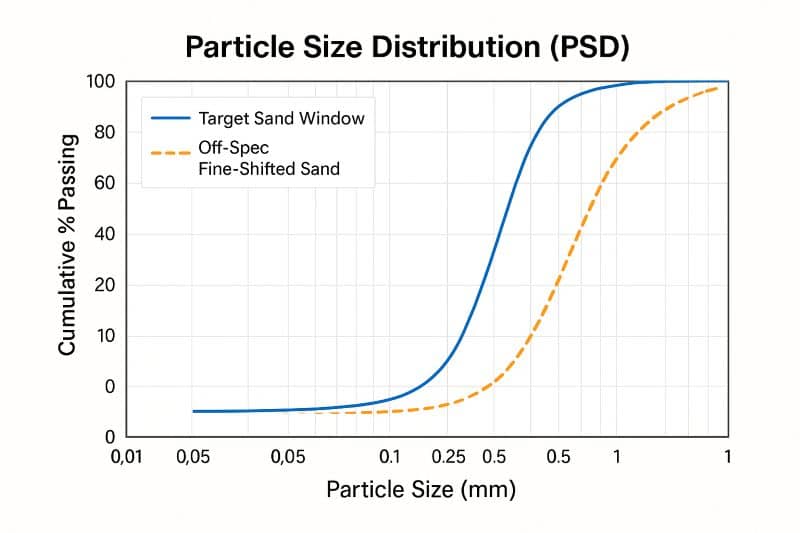
PSD is measured using AS 1289.3.6.1. Sand and granular amendments are dry-sieved. They are then separated into gravel, coarse, medium, fine and very fine fractions, plus silt and clay.
The role of PSD:
-
It confirms that the sand sits within the acceptable range for golf greens and sports fields.
-
Shows whether an amendment shifts the mix toward the fine fraction.
-
Predicts any infiltration loss when fines exceed safe limits.
Bulk Density (ρb) and Total Porosity.
The bulk density for Australian sand profiles usually falls between 1.4 to 1.7 g/cm³, giving a total porosity of 35 to 45% .
Uses:
-
Determines how much of an amendment you need to increase pore space.
-
Provides the basis for volumetric and mass-based amendment calculations.
-
Predicts how a rootzone will behave under traffic (compaction).
Water Retention Curve / Moisture Release.
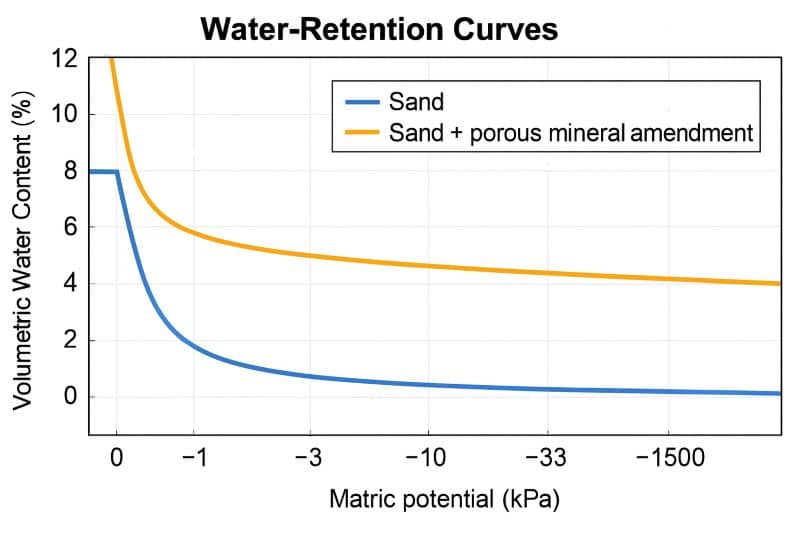
The image shows the separation between clean sand and sand plus an amendment across tensions (0 to –1500 kPa).
The moisture release curve provides the volumetric water content at 0, –1, –3, –10, –33 and –1500 kPa. These values define what is termed Plant available water (PAW).
Key tension points:
-
0 kPa: Saturation and start of drainage.
-
–1 to –3 kPa: Upper-profile dryness between irrigation events.
-
–10 to –33 kPa: Plant available water window.
-
–1500 kPa: The wilting point.
PAW increases when meso-pores increase, but this usually reduces the infiltration rate (Ksat).
Saturated Hydraulic Conductivity (Ksat) / Infiltration.
Ksat is measured using ASTM D2434 constant-head method.
Typical Australian values:
-
Golf greens: 150 to 300 mm/hr.
-
Sports fields: ≥100 mm/hr.
-
Sand-capped ovals: 80 to 150 mm/hr.
Misuse of amendments can drop Ksat below safe thresholds. For example, at rates above 10% v/v of the wrong amendment, it can often result in the need for a full-profile rebuild.
Ksat determines:
-
The maximum safe amendment rate.
-
Resistance to sealing.
-
Drainage capacity under irrigation and rainfall.
Chemical Tests For Sand Constructions.
Test both the base sand and the amendment for:
- Organic matter (OM%).
- CEC and base saturation.
- pH and EC.
- Soluble salts and bicarbonate levels.
- Full nutrient status (P, K, Ca, Mg, S, Fe, Mn, Zn, Cu, B, Mo).
Reject amendments with high EC, sodium, bicarbonate, extreme pH or unstable OM.
Organic Matter (OM%).
Sand contains little organic matter. Many greens target OM levels of between 2 to 4% in the top 100 to 150 mm. Use the OM test results to calculate how much organic amendment you may need without exceeding hydraulic limits.
CEC (Cation Exchange Capacity) and Base Saturation.
Sand has very low CEC. Amendments like peat, compost, zeolite and porous ceramics lift CEC. CEC stabilises pH, supports nutrient retention and reduces leaching.
The CEC should influence decisions only when hydraulic thresholds have already been met.
pH, EC, and Soluble Salts.
Reject amendments with:
- High EC.
- Excess sodium.
- Elevated bicarbonate.
- Excessive organic instability.
These cause long-term issues in sand profiles.
Full Nutrient Profile.
Confirm that nutrient loading will not trigger any toxicity when mixed with a low-CEC sand. Fine-textured amendments can import excessive amounts of trace elements.
Tests for Specific Amendments.
Organic Amendments.
Peat, compost, biosolids and CPM increase the rootzone water-holding and CEC. However they also introduce risks:
- Hydrophobicity.
- Layering.
- Shrinkage.
- Rapid OM turnover.
Inorganic Amendments.
Zeolite, calcined clay, porous ceramics and biogenic silica modify PAW and Ksat.
Blend Testing
- Blend sand with 3%, 5%, 7% and 10% v/v of an amendment.
- Then re-test the PSD, porosity, Ksat and PAW.
- This is the only reliable method to select a safe use rate.
| Amendment | PAW Gain (% per 1% v/v) |
Ksat Reduction (% per 1% v/v) |
CEC Change | Density | Max Safe Rate (v/v) |
|---|---|---|---|---|---|
| Calcined clay | High | Medium | Low | High | 5–10% |
| Zeolite | Medium | Low | Medium | Medium | 5–10% |
| Biogenic silica | Medium | Medium | Low | Low | 3–7% |
| Porous ceramics | High | Medium–High | Low | High | 5–10% |
| Peat moss | High | Medium–High | Medium–High | Low | 5–12% |
| Coir fibre | Medium–High | Medium | Low–Medium | Low | 3–8% |
| Composted poultry manure (CPM) | Medium | High | Medium | Low | 2–5% |
Test PSD, ρb, porosity, water retention, CEC, pH, EC.
Use these to calculate:
- The PAW gain per 1% v/v in sand profiles.
- Ksat reduction per 1% v/v.
- Optimum v/v rate that improves PAW without choking macropores.
Performance/Compatibility Test of the Final Blend.
- Blend the sand with several proposed amendment rates (for example 3%, 5%, 7% and 10% v/v).
- Re-test the PSD, porosity, Ksat and degree of water retention.
- Don’t rely on a brochure with no data to support use rates.
Common Failure Modes in Sand Amendments.
- If an amendment pushes the fines >10%, this will cause a dramatic fall in Ksat.
- Too much organic matter will cause hydrophobicity & layering.
- Above 7% of biogenic silica, surface water tends to be retained & Ksat falls.
- If you do no blend testing it will result in unpredictable PAW shifts.
Biogenic Amorphous Silica as an Amendment.
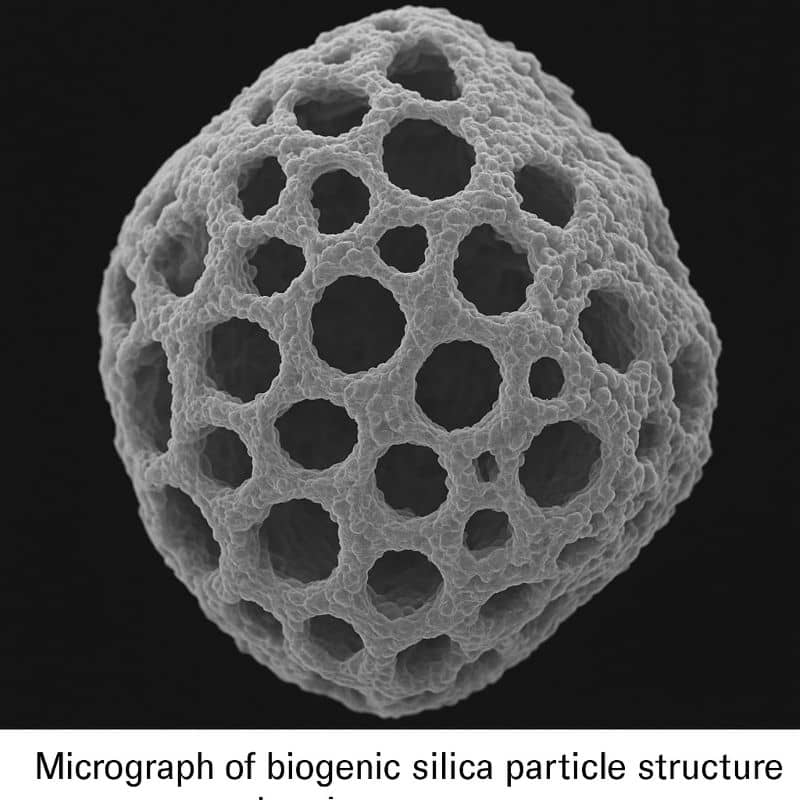
Biogenic silica behaves like other porous minerals:
- Raises PAW.
- Raises meso-porosity.
- Adds modest CEC.
- Does not raise pH.
Risk:
- Alters water flow pathways.
- Retains water near the surface.
- Reduces Ksat at high rates.
- Delays drainage.
Treat it the same way as calcined clay or diatomite.
Tests Specific to Biogenic Silica.
- PSD alignment with sand.
- Bulk density and porosity.
- Moisture release / PAW.
- CEC and surface charge.
- pH / EC.
- Abrasion stability. This test confirms that the particles will not breakdown.
Compatibility Checks.
Blend sand with 3–10% v/v, then re-test bulk density, porosity, Ksat and PAW. Pick the rate that increases the plant available water without causing the Ksat to fall below the standard for your site.
Calculating Amendment Rates.
OM or Volumetric Fraction.
Convert OM targets to a volumetric rate by using the bulk density of the amendment.
Target PAW and CEC.
Use water-retention and CEC data to calculate the amendment fraction that you need to meet PAW targets without collapsing Ksat.
Field Verification.
Use infiltration tests, penetrometer readings and soil-moisture sensors. These can confirm that the field results match laboratory expectations.
How Amendments Products Change Ksat, PAW and CEC.
Porous mineral amendments increase PAW and meso-porosity. However, they also reduce Ksat. At 10% v/v, Ksat often drops by 20 to 40%. Use blend tests to confirm your safe upper limit.
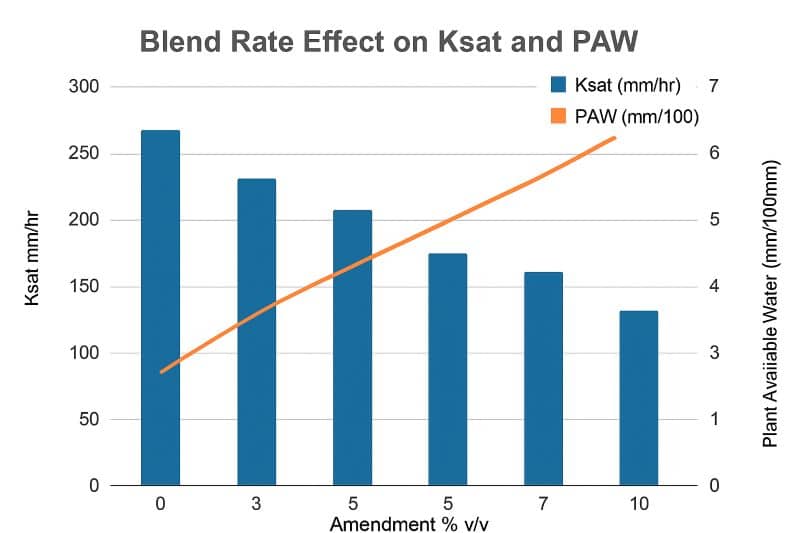
This chart quantifies the hydraulic trade-off for Australian sand-based sportsfields. Each 1% v/v of porous mineral amendment increases PAW by ~0.5 to 0.6 mm/100 mm but reduces Ksat by 8 to 12%.
CEC gains are minor and should not drive your use rate. It should be the hydraulic limits that dictate the final amendment rate.
Minimum Test Package For Amendments For Sand Constructions.
You need:
- PSD.
- Bulk density and porosity.
- A water-retention curve.
- OM, pH, EC, and the CEC.
- An amendment PSD/ρb/WR curve.
- Blend tests at ≥2 rates.
This removes any guesswork in sand-based greens and sports fields.
Standards Referenced.
AS 1289.3.6.1. Particle Size Distribution (Dry Sieve Method).
ASTM D2434. Saturated Hydraulic Conductivity (Constant-Head Method).
USGA Recommendations for a Method of Putting Green Construction.
AGCSA / STRI Australia. Rootzone and sportsfield construction guidance.
AS 4419. Soils for landscaping and garden use (supplementary texture/CEC reference).
AS 4454. Composts, soil conditioners and mulches (for organic amendment compliance).
Sand Amendment Rate Calculator.
This tool predicts how amendments change PAW, porosity, Ksat, AFP, OM, re-watering interval and the hydraulic rating. It identifies the first limiting factor and gives a safe amendment use rate.
Who Should Use It.
- Golf course superintendents.
- Turf agronomists.
- Stadium managers.
- Contractors.
- Anyone adjusting PAW or drainage in sand profiles.
What It Does.
The calculator evaluates:
- Ksat vs required thresholds.
- PAW gains.
- AFP and the porosity.
- OM targets.
- The maximum safe amendment rate.
- kg/m³, t/ha and the re-watering interval.
Charts show Ksat, PAW, HRI, amendment response and the irrigation interval.
How to Use It.
- Select the hydraulic standard.
- Enter sand data (porosity, OM, PAW, Ksat, and fines content)
- Select or enter amendment values.
- Enter PAW and OM targets.
- Set rootzone depth and ET.
- Calculate.
Output shows the safe use rate, the hydraulic behaviour and any risks.
FAQ
What is a safe Ksat for sportsfields?
High-performance sand constructions require a minimum infiltration rate of 100 to 150 mm/hr. At this rate it maintains drainage and moves water rapidly away from the surface.
Stadiums and elite surfaces often target 150 to 300 mm/hr. Community ovals may perform acceptably at 70 to 100 mm/hr. However, anything below 60 mm/hr has an increased risk of waterlogging, and structural failure.
The safe amendment rate is the highest % v/v that keeps Infiltration rate above the required threshold.
What amendment is best for golf greens in Australia?
Australian greens need high infiltration and consistent drainage. This means that the preferred amendment products are calcined clay, porous ceramics, and zeolite at 3 to 8% v/v depending on the particle size distribution of the sand and the plant available water target.
You can use peat moss and coir fibre at low rates because they reduce the infiltration rate more sharply and carry an increased risk of hydrophobicity. You should try and avoid the use of composted poultry manure in greens.
This is because it destabilises hydraulic behaviour and reduces the infiltration rate even when you use it at low rates.
How do amendments change Ksat and PAW?
Inorganic and organic amendments increase plant-available water (PAW). They do this by increasing micro- and meso-porosity.
Each 1% v/v addition typically adds 0.4 to 1.0 mm/100 mm of plant available water depending on the material.
The trade-off for this is a reduction in infiltration. Most amendments reduce the infiltration rate by between 6 to 12% for every 1% v/v in sand.
Once above the safe rate, the infiltration drops below acceptable performance thresholds, water stays near the surface, and profiles become unstable under traffic.
This relationship is linear enough to model. However, it must be verified by blend testing on a case by case basis.
What amendment rate should I use in a sand-based sportsfield?
You cannot safely choose an amendment rate without any test data. Every amendment changes the soil porosity, water holding capacity, and infiltration rate differently.
A safe use rate will depend on the desired levels of plant available water, the fines %, the bulk density, and the desired hydraulic target of the site.
Most Australian sand-based sports fields fall between 2 to 7% v/v for inorganic amendments and 2 to 5% v/v for organics.
The safe rate is always the lowest value set by the PAW target, OM target, Ksat limit, AFP, and the declared maximum safe rate.
Blend testing at two or more % v/v is the only reliable way to fix the final rate.

Principal agronomist, Gilba Solutions Pty Ltd
BSc Hons Soil Science (Newcastle). Former STRI agronomist. Author of Nutrition of Sports Turf in Australia (CSIRO/Landlinks Press) and The Definitive Guide to Australian Turfgrass Pesticide Management. 35+ years advising on sports turf, golf and stadia across Australia, NZ, UK and Europe.